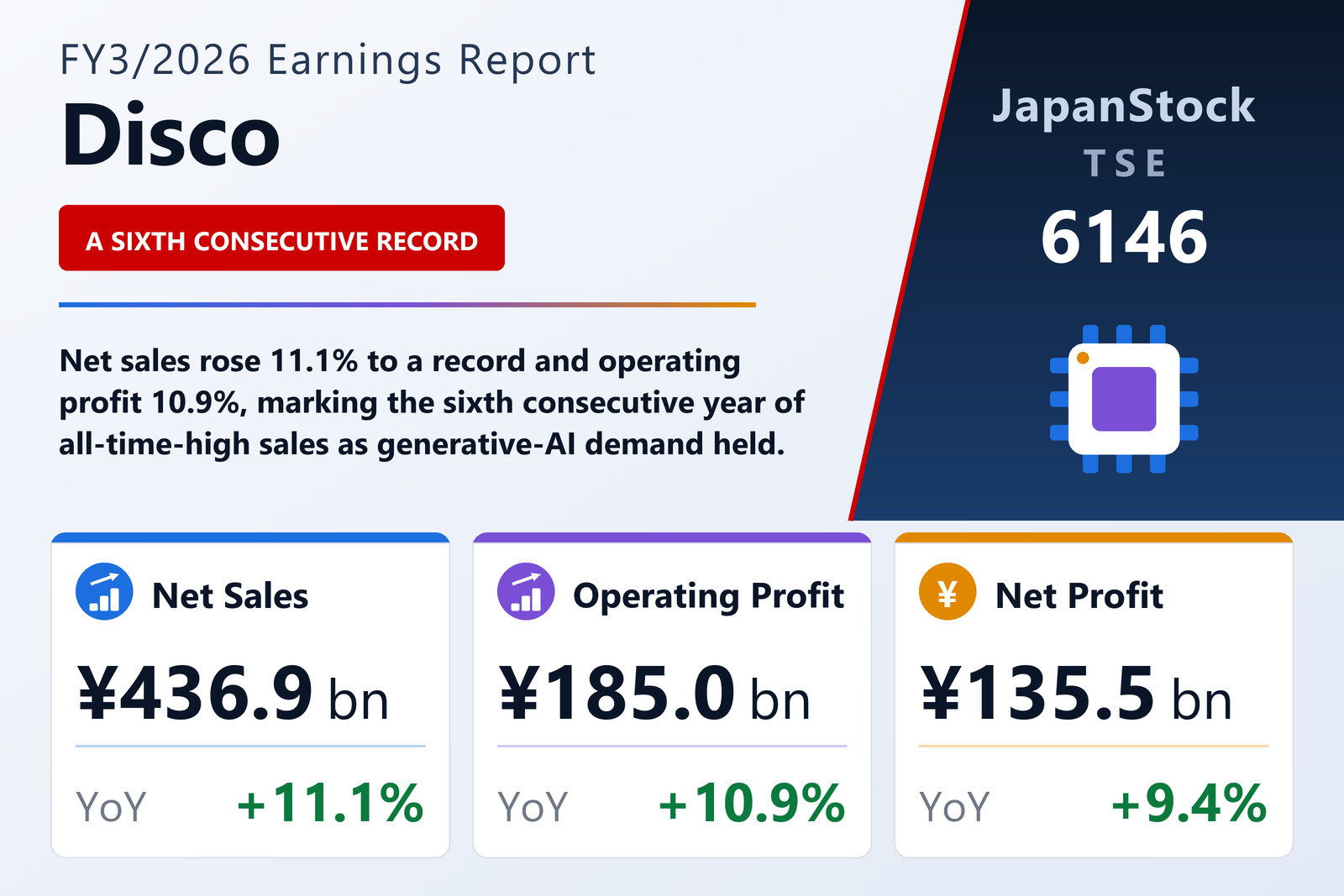
Disco Corporation (TSE: 6146), the world's dominant supplier of precision dicing, grinding and polishing equipment used to cut, thin and finish semiconductor wafers — together with the consumable diamond blades and grinding wheels that feed those tools — released its FY3/2026 consolidated earnings short report (Kessan Tanshin) under J-GAAP on April 22, 2026. Net sales rose 11.1% year-on-year to a record ¥436,889 million (vs. ¥393,313 million), operating profit rose 10.9% to ¥184,989 million, ordinary profit rose 9.5% to ¥184,936 million, and net profit attributable to owners of the parent rose 9.4% to a record ¥135,521 million. Basic EPS came in at ¥1,249.84, up from ¥1,143.26. It is the sixth consecutive year in which both shipments and net sales set fresh all-time highs.
Generative AI sustains HBM and advanced logic demand
Disco's commentary on the FY3/2026 market environment paints a sharply two-speed picture. Generative-AI driven data-center investment continued to expand, keeping demand for high-performance semiconductors — particularly advanced logic (leading-edge GPUs and accelerators) and HBM (High Bandwidth Memory) — at elevated levels throughout the year. PC and smartphone end-demand showed a gradual recovery. Against those tailwinds, power semiconductors remained sluggish on the back of slowing electric-vehicle demand. Within this mix, Disco's precision processing equipment shipments rose on the strength of high-value-added products aimed at high-performance semiconductors, while shipments of consumable precision-processing tools — blades and grinding wheels — tracked customer fab utilisation rates and remained at high levels. Total shipment value reached ¥442.8 billion (+10.3% YoY). A slight decline in gross-profit ratio from product- and application-mix change, plus higher personnel and R&D expenses, was more than offset by the volume lift and high-margin product contribution, yielding both top-line and bottom-line growth.
42.3% OP margin, 78.9% equity ratio, ROE 25.1%
Profitability remained world-class. The operating-profit margin held at 42.3% (essentially flat versus 42.4% the year before, despite a modest shift in product mix), the ordinary-profit margin was 42.3%, and the net-profit margin was 31.0%. Return on equity was 25.1% — a step down from 27.6% as the equity base expanded faster than earnings — and return on assets was 19.4%. The balance sheet remained extremely conservative: total assets grew ¥89.3 billion to ¥743.4 billion, net assets grew ¥95.4 billion to ¥588.1 billion, and the equity ratio improved to 78.9% from 75.1%. Management also highlighted that the company's 4-year cumulative ordinary-profit margin reached 41.4% (vs. 40.0% prior year), marking the 10th consecutive year above the company's internal long-term target of 20%.
¥100bn time-deposit shift drives a heavier investing cash outflow
Operating cash flow rose 10.9% to ¥133.5 billion, supported by record pre-tax earnings and depreciation. Investing cash flow, however, swung to a heavy −¥135.8 billion outflow (vs. −¥68.0 billion last year, a 99.7% increase in outflow) — composed of ¥55.1 billion of property-plant-and-equipment acquisitions (factory land & buildings for capacity expansion) and a ¥100.0 billion outflow placed into term deposits. Because that ¥100 billion is a treasury reallocation rather than a real cash burn, free cash flow excluding the time-deposit shift would remain comfortably positive; on a reported basis (operating + investing) FCF came in at −¥2.2 billion. Financing cash flow used ¥45.0 billion, primarily for dividend payments. Period-end cash and equivalents fell ¥44.6 billion to ¥184.6 billion — but adding back the time deposits leaves the company's liquidity position essentially unchanged at near-record levels.
Dividend raised to ¥505; one-quarter-ahead guidance points to +18% sales
The FY3/2026 annual dividend was raised to ¥505.00 per share (¥129 interim + ¥376 year-end), up from ¥413 a year earlier — a 22.3% increase — for a consolidated payout ratio of 40.4% and a net-asset dividend ratio of 10.2%. Disco has a long-standing — and unusual for a Japanese large-cap — policy of disclosing earnings guidance only one quarter ahead, reflecting management's view that customer capex intentions in the semiconductor and electronic-component industries can swing too violently inside a short window to make a reliable full-year forecast. On that basis, the guidance for Q1 FY3/2027 (April–June 2026) calls for shipments of ¥132.0 billion (assuming USD/JPY ¥157), net sales of ¥106.1 billion (+18.0% YoY), operating profit of ¥42.0 billion (+21.8%), ordinary profit of ¥42.3 billion (+24.4%) and net profit of ¥29.5 billion (+24.1%), with EPS of ¥271.98. No full-year FY27 dividend forecast has been provided pending Q2 results, in line with policy.
| Metric | FY3/2026 | FY3/2025 | YoY |
|---|---|---|---|
| Net sales (¥ billion) | 436.9 | 393.3 | +11.1% |
| Operating profit (¥ billion) | 185.0 | 166.8 | +10.9% |
| Ordinary profit (¥ billion) | 184.9 | 168.9 | +9.5% |
| Net profit attrib. to owners (¥ billion) | 135.5 | 123.9 | +9.4% |
| Basic EPS (¥) | 1,249.84 | 1,143.26 | +9.3% |
| Operating-profit margin | 42.3% | 42.4% | −0.1pp |
| ROE | 25.1% | 27.6% | −2.5pp |
| Equity ratio | 78.9% | 75.1% | +3.8pp |
| Annual dividend (¥) | 505.00 | 413.00 | +22.3% |
JapanStockPulse provides informational content only and does not constitute investment advice. Figures are taken from the company's published earnings short report and may be subject to subsequent revision.