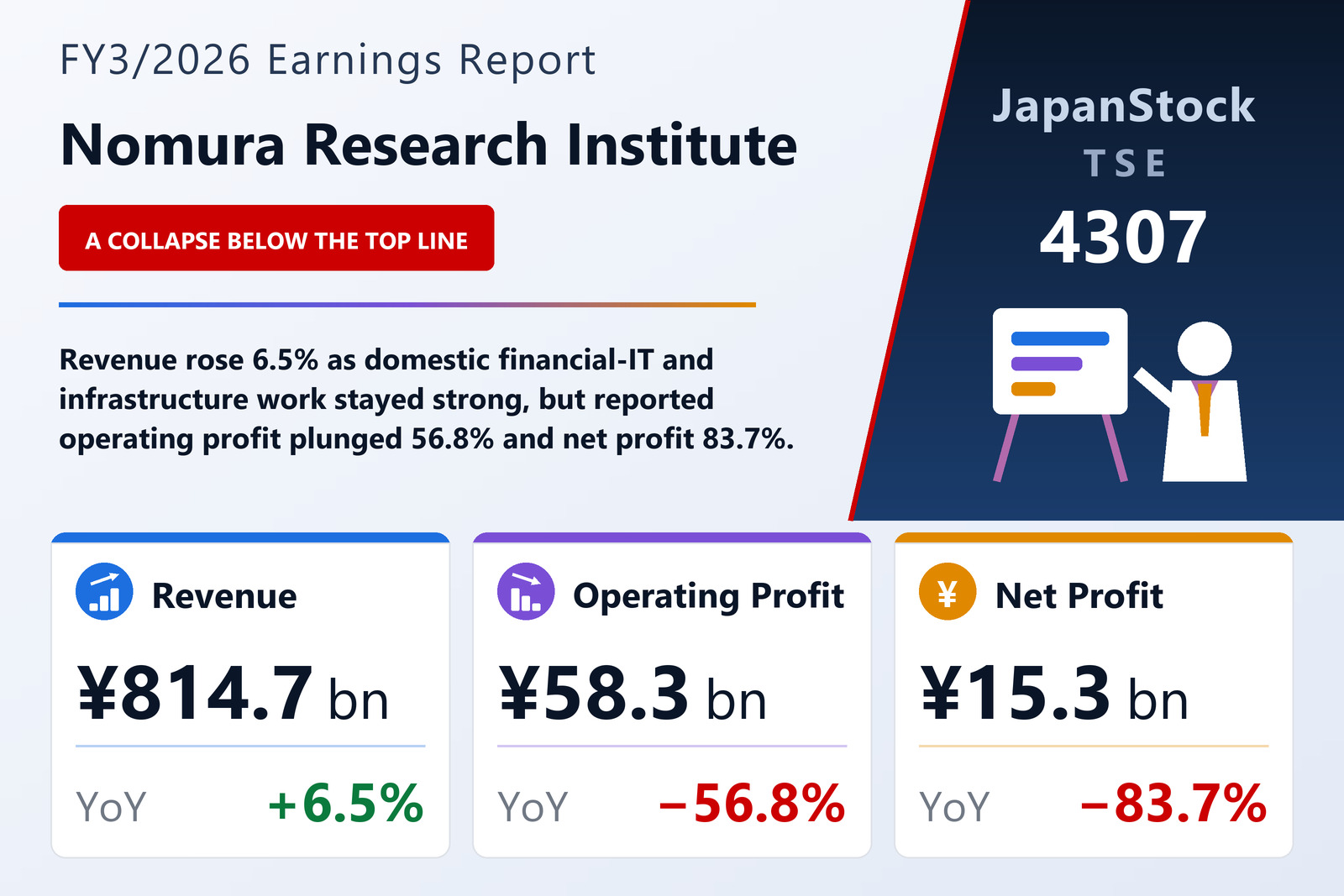
Nomura Research Institute, Ltd. (TSE: 4307), Japan's largest pure-play IT services and systems-integration firm and the technology backbone of the Japanese securities industry, released its FY3/2026 consolidated earnings short report (Kessan Tanshin) under IFRS on April 24, 2026. Revenue rose 6.5% year-on-year to ¥814.7 billion on strong domestic demand for digital-transformation projects, but reported operating profit fell 56.8% to ¥58.3 billion, pre-tax profit fell 56.1% to ¥58.9 billion, and profit attributable to owners of the parent collapsed 83.7% to ¥15.3 billion (from ¥93.8 billion). Basic EPS came in at ¥26.62, down from ¥163.57. ROE fell to 3.5% from 22.5% and the equity ratio slipped to 45.2% from 46.7%. The dramatic earnings reset was driven entirely by goodwill and related impairments at two overseas acquisitions — NRI Australia Limited and U.S. cloud-consulting subsidiary Core BTS, Inc.
Revenue +6.5% but operating profit −57% on ¥97bn overseas impairments
The two figures tell a single story. On the core domestic side, demand for IT investment — particularly DX (digital transformation) and AI-enabled business-model change — remained buoyant, lifting top-line growth across every reportable segment. Cost of sales rose only 5.1% to ¥514.6 billion against the 6.5% revenue gain, so gross profit grew 9.0% to ¥300.2 billion and SG&A was held to a 1.1% increase at ¥145.6 billion. On a pre-impairment basis, that operating leverage worked exactly as planned. But NRI then recognised ¥97.0 billion of impairment losses on non-financial assets — ¥77.0 billion at NRI Australia Limited (the consulting and managed-services arm acquired and most recently integrated with SQA Holdco / Planit Test Management Solutions) and ¥19.9 billion at U.S. cloud-consulting subsidiary Core BTS, Inc. — after revising the business plans for both units in connection with the new "NRI Group Mid-Term Plan (2026-2028)." Combined with smaller charges, the impairments swamped the underlying gains and pushed reported operating profit down to ¥58.3 billion, a margin of just 7.2% versus 17.6% a year earlier. Underlying "business profit" — NRI's own non-IFRS measure that excludes one-off impairments — rose 16.3% to ¥156.7 billion, with a 19.2% margin, indicating the recurring franchise actually grew faster than revenue.
Net profit −84% to ¥15bn; EPS falls to ¥26.62
Below the operating line the picture worsened slightly through tax: pre-tax profit was ¥58.9 billion (−56.1%), but profit for the year fell 83.3% to ¥15.8 billion. The asymmetry reflects the fact that goodwill impairments at overseas subsidiaries are generally not tax-deductible, so the effective tax rate spiked. Profit attributable to owners of the parent landed at ¥15.3 billion, basic EPS at ¥26.62 (vs. ¥163.57), and ROE collapsed to 3.5% from 22.5%. Segment data underline the source: the Industrial IT Solutions segment, which carries the NRI Australia and Core BTS goodwill, swung to a ¥74.6 billion operating loss from a ¥24.3 billion profit, while the other three reportable segments all expanded. Consulting profit rose 4.5% to ¥19.2 billion, Financial IT Solutions profit rose 20.6% to ¥74.3 billion on a 8.7% revenue gain, and IT Platform Services profit rose 27.1% to ¥38.6 billion on the rollback of last year's data-centre disposal charge.
Operating cash flow strengthens 13.4% to ¥147.6 billion — charges are non-cash
The cash-flow statement confirms what the segment data implies: the impairments are non-cash and the underlying business is performing well. Operating cash flow rose 13.4% to ¥147.6 billion (from ¥130.2 billion), a record level for NRI, with the swing driven by stronger pre-impairment operating profit and a smaller working-capital outflow. Investing cash flow used ¥97.0 billion (versus ¥47.6 billion a year earlier), reflecting heavier capex on shared-utility platform development and term-deposit placements. Financing cash flow used ¥90.8 billion, slightly larger than ¥87.3 billion last year, dominated by the repayment of ¥42.9 billion of long-term borrowings. Cash and equivalents closed at ¥132.6 billion, down ¥36.0 billion from the prior year. The net D/E ratio improved sharply to 0.05x from 0.17x as interest-bearing debt fell 16.8% to ¥205.0 billion — leaving NRI with a notably cleaner balance sheet entering the new mid-term plan.
Dividend raised to ¥77 — board signals confidence in normalised earnings
Despite the headline profit collapse — which mechanically pushed the consolidated payout ratio to 289.9% — the board still raised the annual dividend to ¥77.00 per share (¥35 interim + ¥42 year-end, versus ¥63 last year). Management explicitly justified the increase by noting the impairments "do not have a direct impact on cash flow" and that the domestic business is performing well. For FY3/2027, the company guides a further increase to ¥84.00 per share (¥42 + ¥42) for a normalised payout ratio of 40.5% — the long-standing target benchmark of NRI's capital-return policy. On the same day, the board separately approved a major buyback: up to 21.0 million shares (3.66% of issued capital ex-treasury) for up to ¥70.0 billion, to be executed via on-market purchases between May 15, 2026 and August 31, 2026 as part of the new ROE-25%-target capital framework.
FY27 guidance: ¥119 billion net profit (+680%), EPS ¥207 — full return to trend
For FY3/2027, NRI forecasts revenue of ¥850.0 billion (+4.3%), operating profit of ¥175.0 billion (+200.3%), pre-tax profit of ¥177.0 billion (+200.8%), and net profit attributable to owners of ¥119.0 billion (+679.9%), for basic EPS of ¥207.17. The guidance confirms that the FY26 reported result was a one-time accounting reset rather than a deterioration of the underlying business: with the goodwill writedowns absorbed, profit normalises well above the FY3/2025 record of ¥93.8 billion. The company also unveiled longer-term targets under its new "NRI Group Mid-Term Plan (2026-2028)" — revenue of ¥950 billion, operating profit of ¥200 billion (margin 21.1%), and an ROE of around 25% by FY3/2029. By segment, FY27 revenue plans call for Financial IT Solutions to reach ¥465.0 billion (+2.1%), Industrial IT Solutions ¥230.0 billion (+6.7%), IT Platform Services ¥82.0 billion (+6.4%), and Consulting ¥70.0 billion (+10.1%).
| Metric | FY3/2026 | FY3/2025 | YoY |
|---|---|---|---|
| Revenue (¥ billion) | 814.7 | 764.8 | +6.5% |
| Operating profit (¥ billion) | 58.3 | 134.9 | −56.8% |
| Business profit ex-impairments (¥ billion) | 156.7 | 134.7 | +16.3% |
| Pre-tax profit (¥ billion) | 58.9 | 134.2 | −56.1% |
| Net profit attrib. to owners (¥ billion) | 15.3 | 93.8 | −83.7% |
| Basic EPS (¥) | 26.62 | 163.57 | −83.7% |
| ROE | 3.5% | 22.5% | −19.0pp |
| Operating CF (¥ billion) | 147.6 | 130.2 | +13.4% |
| Annual dividend (¥) | 77.00 | 63.00 | +22.2% |
JapanStockPulse provides informational content only and does not constitute investment advice. Figures are taken from the company's published earnings short report and may be subject to subsequent revision.