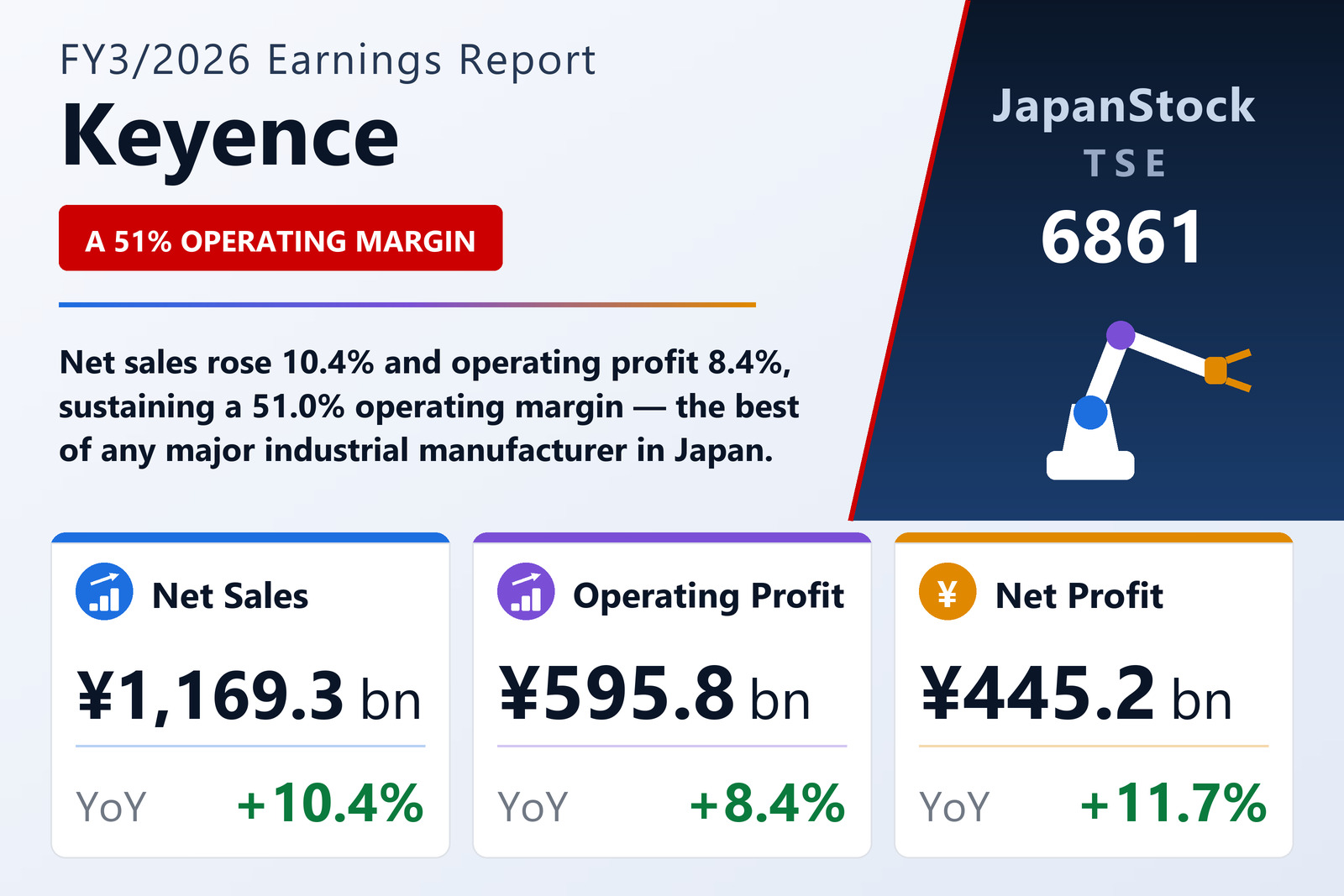
Keyence Corporation (TSE: 6861), the Osaka-based supplier of factory-automation sensors, machine vision systems, measurement instruments and digital microscopes that has built one of Japan's most-watched margin franchises, released its FY3/2026 consolidated earnings short report (Kessan Tanshin) under J-GAAP on April 24, 2026. The fiscal year covers March 21, 2025 through March 20, 2026. Net sales rose 10.4% year-on-year to ¥1,169.3 billion (from ¥1,059.1 billion), operating profit rose 8.4% to ¥595.8 billion (from ¥549.8 billion), ordinary profit rose 13.3% to ¥635.8 billion, and profit attributable to owners of the parent rose 11.7% to a record ¥445.2 billion (from ¥398.7 billion). Basic EPS climbed to ¥1,835.63 from ¥1,643.77. Comprehensive income surged +23.8% to ¥472.1 billion.
Revenue +10.4% and OP +8.4% — direct-sales model continues to win
Keyence's top-line growth of 10.4% in a year of mixed factory-automation demand worldwide reflects the durability of its direct-sales model, in which engineers — not distributors — call on customer factories to identify and solve specific automation problems. This consultative approach allows Keyence to capture pricing power on highly specified sensors, vision and measurement systems that competitors selling through channels typically cannot match. Operating profit of ¥595.8 billion rose 8.4%, with OP growth lagging the revenue line slightly as the company continues to expand its overseas sales-engineer headcount. Ordinary profit grew faster than OP at +13.3%, helped by foreign-exchange gains and higher financial income on the group's growing cash and securities pile. Net profit attributable to owners rose 11.7% to a record ¥445.2 billion.
51% operating margin sustained — best-in-class for global industrial peers
The headline number that continues to set Keyence apart is the operating margin of 51.0% (¥595.8bn OP on ¥1,169.3bn revenue) — a level no other major Japanese industrial manufacturer comes close to matching. For context, large-cap Japanese industrials typically operate in the high-single-digit to mid-teens range; even the most profitable global semiconductor-equipment makers and specialist instrument firms rarely sustain margins above 35%. Keyence's margin reflects three structural factors: (1) fabless manufacturing — the company designs in-house but outsources nearly all production to contract manufacturers, keeping fixed assets light; (2) the direct-sales channel that captures distributor margin internally; and (3) a deliberate product mix skewed to high-value-add sensors and vision systems where engineering content commands premium pricing. ROE for the year was 13.5% and ROA 18.3% — figures that look modest only because the equity base is so large relative to assets deployed.
Fortress balance sheet — 94.6% equity ratio, ¥3.67trn assets, virtually no debt
Keyence's balance sheet remains one of the most over-capitalised in corporate Japan. Total assets ended the year at ¥3,670.7 billion (up from ¥3,289.2 billion), with shareholders' equity of ¥3,471.5 billion producing an equity ratio of 94.6% — the company carries essentially no interest-bearing debt. Operating cash flow generated was ¥430.7 billion, investing activities used ¥312.4 billion (primarily marketable-securities purchases as the company parks excess cash in financial instruments rather than capex), and financing activities used ¥113.7 billion, dominated by dividend payments. The structural cash surplus has been a perennial topic for shareholders and governance commentators, who have long argued that the company could return materially more capital without impairing its operating flexibility.
Dividend hiked 57% to ¥550 — a meaningful shift in capital-return stance
For FY3/2026, the annual dividend was set at ¥550.00 per share (¥275 interim + ¥275 year-end), up 57.1% from ¥350.00 (¥175 + ¥175) in FY3/2025. The consolidated payout ratio rose to 30.0% from 21.3% — still modest by the standards of mature Japanese large-caps but a clear departure from Keyence's historical pattern of incremental, low-payout-ratio dividend policy. Coming alongside record earnings and an equity ratio that continues to climb past 94%, the magnitude of the hike suggests the board is responding to longstanding investor pressure to deploy more of the cash pile through dividends rather than letting equity accumulate further. Whether this marks the beginning of a multi-year capital-return reset or a one-off recalibration will be watched closely.
No FY3/2027 guidance — Keyence's traditional non-disclosure policy remains
Consistent with longstanding company policy, Keyence did not issue earnings guidance for FY3/2027. The company's stated rationale is that the factory-automation capital-investment cycle is too volatile and customer-specific to forecast with the precision implied by formal guidance, and that providing point estimates can distort management decision-making. This stance — unusual among large-cap Japanese listed companies — places extra weight on each quarterly tanshin release for investors trying to read the cycle. The FY26 result, with double-digit revenue growth and a record OP figure, suggests underlying demand for vision, sensing and measurement gear from semiconductor, electronics, automotive and battery customers remained firm through the company's March-end fiscal year, though the path of fixed-investment plans into the upcoming year remains an open question.
| Metric | FY3/2026 | FY3/2025 | YoY |
|---|---|---|---|
| Net sales (¥ billion) | 1,169.3 | 1,059.1 | +10.4% |
| Operating profit (¥ billion) | 595.8 | 549.8 | +8.4% |
| Operating margin | 51.0% | 51.9% | −0.9pp |
| Ordinary profit (¥ billion) | 635.8 | 561.0 | +13.3% |
| Net profit attrib. to owners (¥ billion) | 445.2 | 398.7 | +11.7% |
| Basic EPS (¥) | 1,835.63 | 1,643.77 | +11.7% |
| ROE | 13.5% | 13.2% | +0.3pp |
| Equity ratio | 94.6% | 93.7% | +0.9pp |
| Annual dividend (¥) | 550.00 | 350.00 | +57.1% |
| Payout ratio | 30.0% | 21.3% | +8.7pp |
JapanStockPulse provides informational content only and does not constitute investment advice. Figures are taken from the company's published earnings short report and may be subject to subsequent revision.