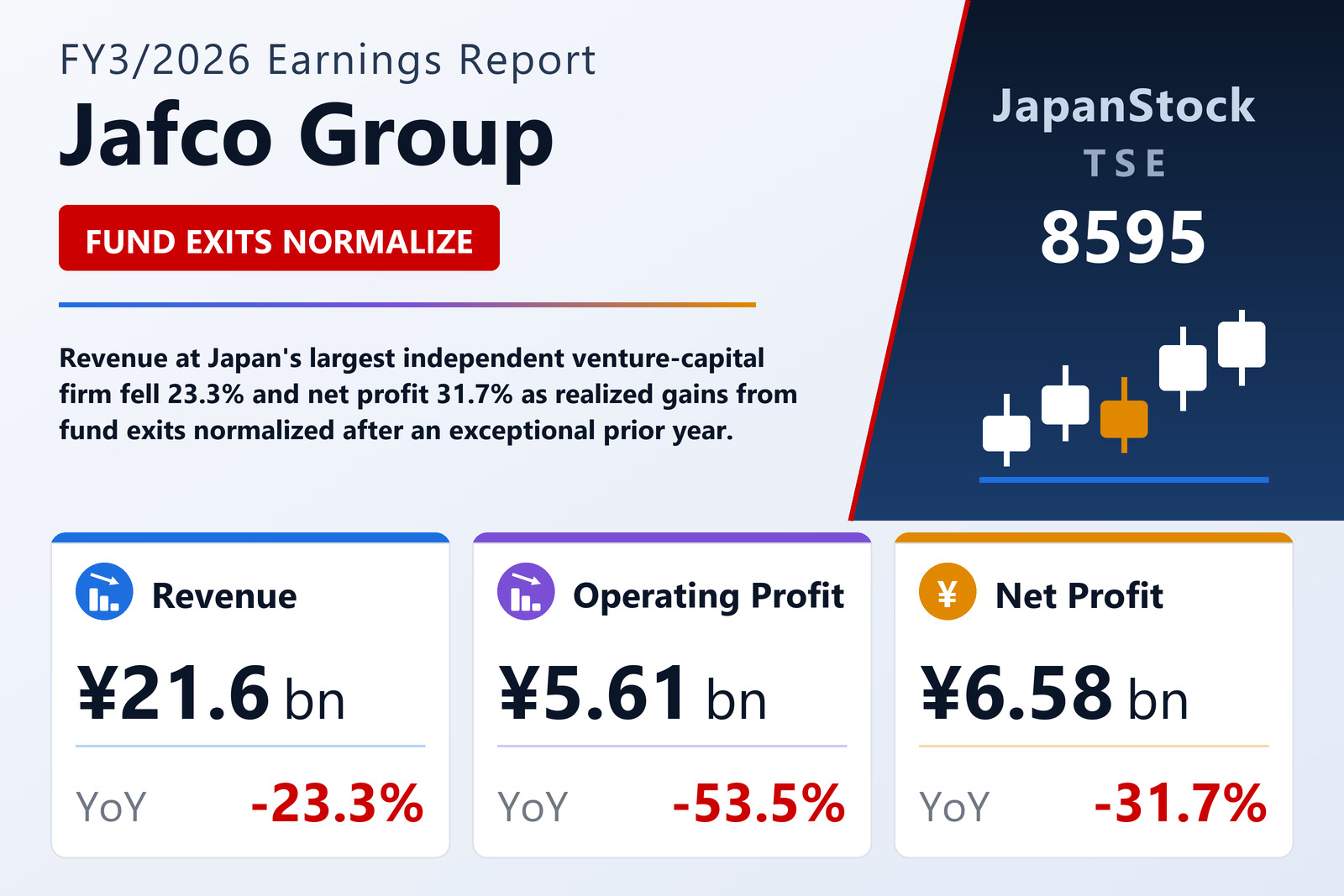
Jafco Group Co., Ltd. (TSE: 8595) reported full-year results for the fiscal year ended March 31, 2026 (FY3/2026) under Japanese GAAP. Revenue fell 23.3% to ¥21,619 million from ¥28,192 million, operating profit dropped 53.5% to ¥5,607 million, ordinary profit fell 55.1% to ¥5,905 million, and net profit declined 31.7% to ¥6,576 million from ¥9,632 million. Basic EPS came in at ¥123.65 against ¥176.61, ROE eased to 4.8% from 7.1%, and the operating margin compressed to 25.9% from 42.8%. Net profit exceeded ordinary profit for the year owing to extraordinary items.
A natural reset, not a deterioration
As Japan's largest independent venture-capital and private-equity firm, Jafco raises and manages buyout and venture funds and earns the bulk of its income from capital gains realized when portfolio companies are sold or go public. That makes results inherently lumpy from year to year: a single strong cluster of exits can lift a year, and its absence can pull the next one down. The FY3/2026 decline reflects exactly this dynamic — realized exit gains normalized after an exceptionally strong prior year, rather than any deterioration in the underlying franchise or investment pipeline.
Accounting basis switched to non-consolidated
An important presentational change accompanied the results: from the third quarter of FY3/2026, the company switched from consolidated to non-consolidated (parent-only) accounting. The FY3/2026 figures reported here are therefore non-consolidated, and the prior-year comparatives have been restated to a non-consolidated basis where applicable. The change reflects the firm's structure as a fund manager whose economics are concentrated at the parent level.
Strong balance sheet, ample liquidity
Jafco closed the year with a robust balance sheet. Total assets stood at ¥157,856 million and net assets (equity) at ¥134,113 million, leaving an equity ratio of 85.0% — an unusually conservative capital structure that gives the firm flexibility to commit to new funds and absorb the swings inherent to its business. Book value per share was ¥2,548.70. Operating cash flow was ¥5,587 million, and period-end cash and cash equivalents stood at ¥61,183 million, underpinning the firm's enhanced distribution policy.
New DOE-floor policy nearly doubles the dividend
The headline for shareholders is capital return. The FY3/2026 annual dividend was raised to ¥133.00 per share (¥66.50 interim + ¥66.50 year-end), up from ¥88.00 — a payout ratio of 107.6% and a net-asset dividend ratio (DOE) of 6.0%. The increase reflects a new shareholder-return policy effective from FY3/2026, under which the annual dividend is set as the greater of (a) a 6% DOE on prior-year-end equity or (b) a 50% payout ratio. This year the 6% DOE figure (¥133) exceeded the 50%-payout figure (about ¥62), so ¥133 was paid. The policy signals a commitment to steady, predictable distributions despite volatile profits.
No guidance; FY27 dividend floored at ¥133
Consistent with its long-standing practice, Jafco does not issue earnings guidance, because results depend heavily on equity-market and IPO conditions that are difficult to forecast. The company did, however, set a FY3/2027 dividend forecast of ¥133.00 as a minimum — the DOE-floor mechanism establishing a baseline below which the distribution should not fall. For an investor, the takeaway is a business whose reported profit will continue to swing with the exit cycle, paired with a return policy now designed to smooth the cash that reaches shareholders.
| Metric | FY3/2026 | FY3/2025 | YoY |
|---|---|---|---|
| Revenue (¥M) | 21,619 | 28,192 | -23.3% |
| Operating profit (¥M) | 5,607 | 12,066 | -53.5% |
| Ordinary profit (¥M) | 5,905 | 13,151 | -55.1% |
| Net profit (¥M) | 6,576 | 9,632 | -31.7% |
| Basic EPS (¥) | 123.65 | 176.61 | -30.0% |
| ROE | 4.8% | 7.1% | -2.3pp |
| Annual dividend (¥) | 133.00 | 88.00 | +51.1% |
| Payout ratio | 107.6% | 49.8% | +57.8pp |
JapanStockPulse provides informational content only and does not constitute investment advice. Figures are taken from the company's published earnings short report and may be subject to subsequent revision.