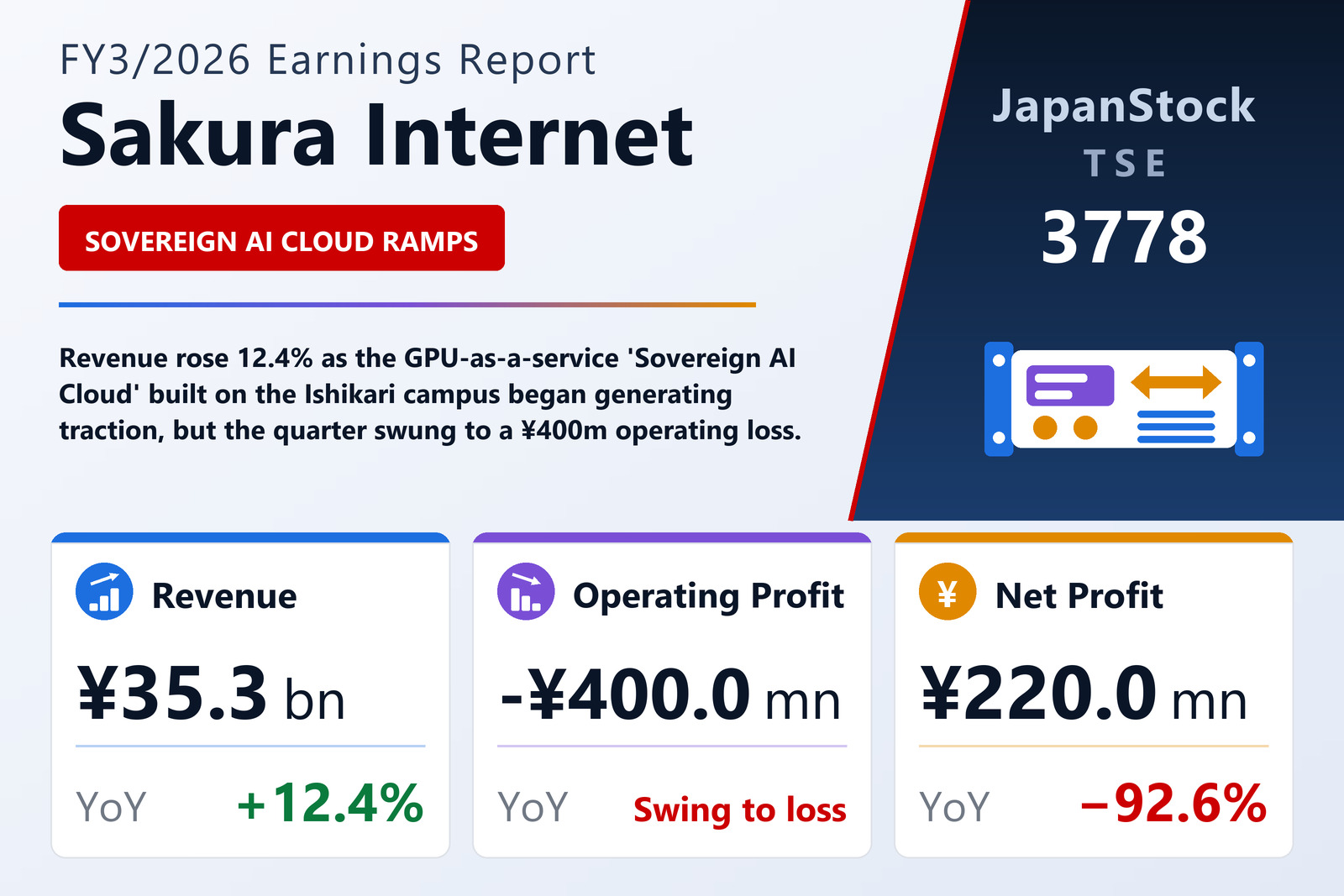
SAKURA Internet Inc. (TSE: 3778), the Osaka-based domestic cloud infrastructure provider that operates Japan's largest data-center campus in Ishikari, Hokkaido, reported FY3/2026 consolidated J-GAAP results that prioritized strategic positioning for the AI infrastructure cycle over near-term reported earnings. Revenue rose 12.4% to ¥35.3 billion, but operating profit swung from a ¥4.1 billion profit to a ¥403 million loss, ordinary profit collapsed to ¥105 million (-97.4%), and profit attributable to shareholders dropped 92.6% to ¥216 million. Basic EPS came in at ¥5.40 (vs ¥75.23 prior).
The Sovereign AI Cloud bet
The earnings collapse is entirely the result of a deliberate capital-investment cycle. Sakura Internet is one of the few Japan-listed pure-play cloud providers positioned to capture the "Sovereign AI Cloud" thesis — the idea that Japanese government, defense, healthcare, and large-enterprise workloads will increasingly demand domestic-soil GPU compute for compliance and data-residency reasons, rather than running on AWS / Azure / Google Cloud. To capture this opportunity Sakura signed a multi-year procurement agreement for NVIDIA H100/H200 GPUs (with the Japanese government providing partial subsidy via the METI "Generative AI Cloud Infrastructure" program) and accelerated build-out of new GPU racks at the Ishikari campus.
Investing cash outflow tripled to ¥24.6 billion (vs ¥8.3 billion prior) — almost the entire incremental investment funding the GPU buildout. The resulting depreciation, electricity, cooling and operational-ramp costs have temporarily overwhelmed the (still-modest, but growing) GPU-cloud revenue stream. This is precisely how every cloud infrastructure scaling story has looked at the inflection point — AWS lost money for years before scaling.
Cash flow and balance sheet positioning
Operating cash flow remained positive at ¥6.2 billion (vs ¥5.8 billion) — a key signal that the core hosting/colo business continues to generate cash even as the AI segment ramps. Financing inflow was ¥4.3 billion (vs ¥26.8 billion prior — the bulk of the prior-year financing inflow was the equity issuance and debt raise that funded the H100 procurement, now substantially complete). Total assets edged up to ¥82.5 billion from ¥81.4 billion. Net assets stayed at ¥30.3 billion, equity ratio 36.5% (vs 36.9%). Cash and equivalents finished at ¥15.4 billion, down from ¥29.5 billion — reflecting heavy capital deployment.
Dividend held; payout reflects the investment phase
The annual dividend was modestly raised to ¥5 per share (¥0 interim + ¥5 year-end), up from ¥4. The payout ratio jumped to 92.6% (vs 5.3% prior) optically — but this is an artifact of the depressed earnings base. On a normalized "ex-capex-cycle" basis the dividend remains a token symbolic distribution, consistent with the company's policy of prioritizing growth reinvestment over capital return.
Outlook: when does the investment cycle pay back?
Sakura Internet's investment thesis hinges on the timing question — at what point do the GPU-cloud revenues compound past the depreciation drag and re-inflect to profitability? Investor focus is now on two metrics: (i) GPU utilization rate at the Ishikari campus (Sakura has not disclosed this granularly but commentary suggests booking through 2H 2026 has accelerated); and (ii) average revenue per H100/H200 hour, which is benchmarked against AWS p5 instances and signals the company's pricing power in the domestic sovereign-cloud niche.
FY3/2027 guidance was not provided in this disclosure. The standalone parent-only numbers (Sakura Internet Inc., before consolidation of subsidiaries) showed similar dynamics: revenue +12.4%, operating loss of ¥403 million. This is a "wait-and-see" year for the equity story — but the strategic positioning in Japan's sovereign-AI infrastructure thesis is among the cleanest in the listed universe.
| Metric | FY3/2026 | FY3/2025 | YoY |
|---|---|---|---|
| Revenue (¥ billion) | 35.3 | 31.4 | +12.4% |
| Operating profit (¥ billion) | −0.40 | 4.15 | swing to loss |
| Ordinary profit (¥ billion) | 0.11 | 4.06 | −97.4% |
| Profit attrib. to owners (¥ billion) | 0.22 | 2.94 | −92.6% |
| Basic EPS (¥) | 5.40 | 75.23 | −92.8% |
| Operating margin | −1.1% | 13.2% | −14.3pp |
| ROE | 0.7% | 15.0% | −14.3pp |
| Equity ratio | 36.5% | 36.9% | −0.4pp |
| Investing CF outflow (¥ billion) | −24.6 | −8.3 | ~3× higher |
| Annual dividend (¥) | 5.00 | 4.00 | +25.0% |
JapanStockPulse provides informational content only and does not constitute investment advice. Figures are taken from the company's published earnings short report and may be subject to subsequent revision.