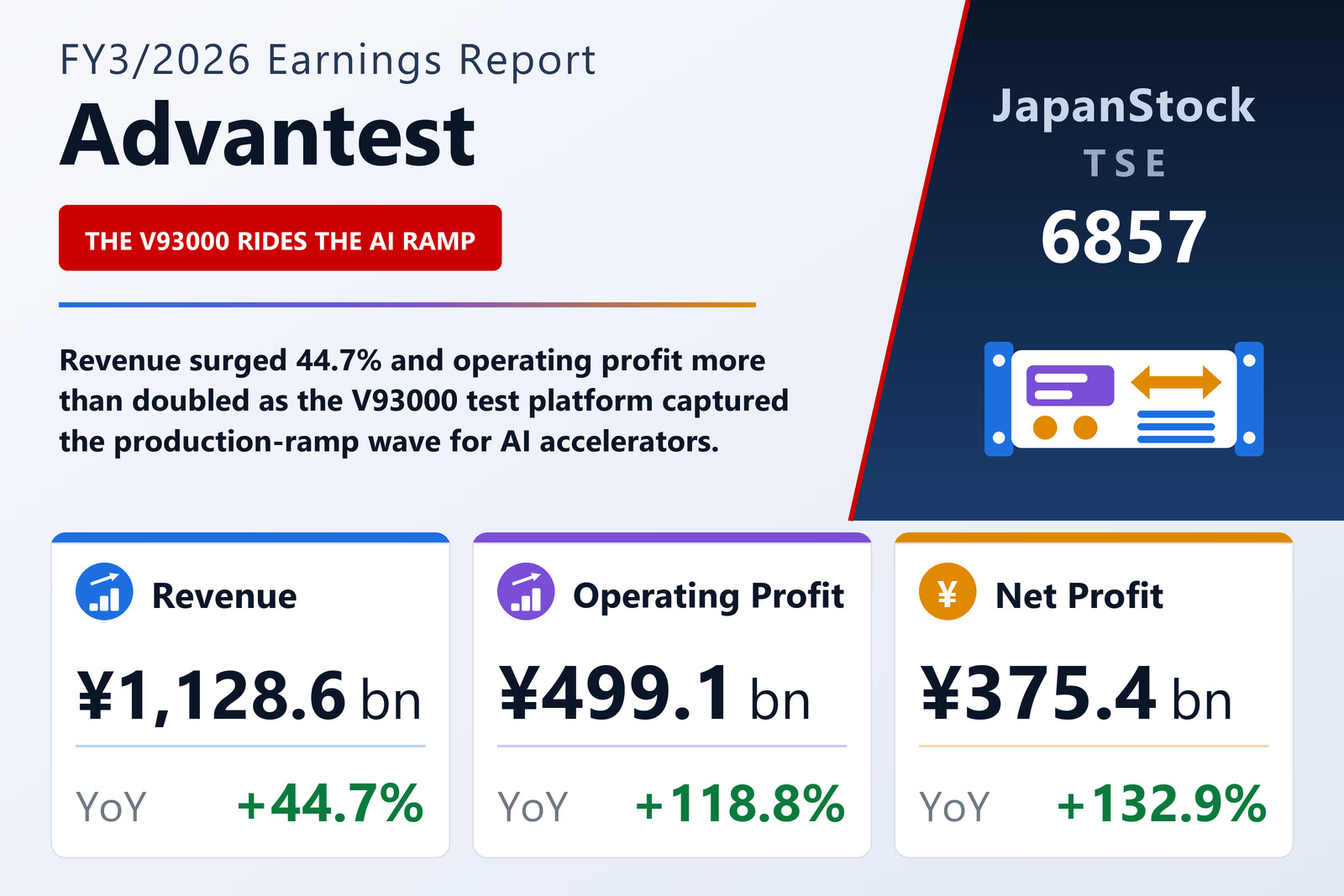
Advantest Corporation (TSE: 6857), the Tokyo-based global leader in semiconductor automated test equipment (ATE) — with effective duopoly versus Teradyne in the high-end logic and memory test markets — reported FY3/2026 consolidated IFRS results showing one of the most explosive earnings expansions in the Japanese listed universe this cycle. Revenue surged 44.7% to ¥1,128.6 billion, operating profit more than doubled to ¥499.1 billion (+118.8%), profit before tax climbed 129.9% to ¥516.7 billion, and profit attributable to owners of the parent (which equals net profit, as there are no minority interests) jumped 132.9% to ¥375.4 billion. Comprehensive income soared 189.3% to ¥432.2 billion. Basic EPS came in at ¥515.15 (vs ¥218.67 prior).
44.2% operating margin — the AI tax on memory and logic
The headline that should command the most attention is the operating margin: 44.2% (vs 29.3% prior). Few non-software businesses globally sustain mid-40s operating margins at scale. Advantest can because of the structural dynamics of its market: every NVIDIA Hopper / Blackwell GPU, every HBM3E and HBM4 stack from Samsung / SK hynix / Micron, every advanced AMD MI300 / MI400 accelerator, and every custom AI chip from Google TPU, AWS Trainium, Microsoft Maia and Meta MTIA must be tested using Advantest's V93000 platform before shipment. The customer's choice is constrained — the alternative (Teradyne UltraFLEX/J750) cannot match V93000 on HBM and high-mix logic. Pricing power flows directly from technical lock-in.
The ROE of 57.6% (vs 34.4%) underscores how efficiently Advantest is converting this technical position into shareholder value. The PBT/total-assets ratio reached 51.0% — exceptional. The asset-light fabless business model (Advantest doesn't make chips, just the test platforms) amplifies every margin point into bottom-line earnings.
Cash conversion strong; capital return accelerates
Operating cash flow expanded to ¥335.2 billion from ¥286.0 billion — strong, though it lagged the operating-profit growth on working-capital absorption (system shipments require longer revenue-recognition cycles). Investing outflow was modest at ¥42.2 billion (no major M&A; reinvestment focused on R&D facilities). Financing outflow widened dramatically to ¥230.6 billion from ¥82.8 billion — a near-tripling — reflecting both higher dividend payouts and an active share-buyback program. Cash and equivalents finished at ¥339.9 billion (vs ¥262.5 billion).
The annual dividend was raised to ¥59 per share (¥29 interim + ¥30 year-end), up from ¥39 the prior year (¥19 + ¥20) — a 51% per-share increase. The payout ratio, however, compressed to 11.5% from 17.8% as net profit grew much faster than the dividend. Total dividends paid were ¥42.9 billion (vs ¥28.7 billion). The FY3/2027 dividend forecast was withheld at this disclosure ("currently undecided") — typical for a cyclical capital-equipment maker whose order flow is hard to forecast more than 6–12 months out.
Balance sheet strengthens dramatically
Total assets grew to ¥1,171.8 billion from ¥854.2 billion, and equity climbed to ¥795.7 billion from ¥506.5 billion. The owners' equity ratio expanded sharply to 67.9% from 59.3% — Advantest is now one of the most well-capitalized large-cap industrials in Japan. BPS reached ¥1,097.50, up from ¥690.80 — a 59% per-share book value increase in one year.
Outlook: the AI capex cycle and Advantest's positioning
The detailed FY3/2027 financial guidance was not disclosed at this release (typical for Advantest, which provides guidance with the Q1 results in late July). Three forward-looking points investors should track: (i) HBM3E to HBM4 transition — every new memory generation requires a step-up in test complexity per stack, supporting unit revenue growth; (ii) custom-AI-silicon proliferation — hyperscalers' in-house chips (TPU, Trainium, Maia, MTIA) are increasing the number of distinct programs Advantest must support, increasing platform attach rate; (iii) 2nm-node logic ramp from FY3/2028 will require new V93000 platform extensions, supporting the next leg of growth. The cycle risk is the inverse — when AI capex peaks, Advantest's ~45% margin will compress. Until then, the operating leverage is the cleanest in Japan's mid-large industrial universe.
| Metric | FY3/2026 | FY3/2025 | YoY |
|---|---|---|---|
| Revenue (¥ billion) | 1,128.6 | 779.7 | +44.7% |
| Operating profit (¥ billion) | 499.1 | 228.2 | +118.8% |
| Profit before tax (¥ billion) | 516.7 | 224.8 | +129.9% |
| Profit attrib. to owners (¥ billion) | 375.4 | 161.2 | +132.9% |
| Basic EPS (¥) | 515.15 | 218.67 | +135.6% |
| Operating margin | 44.2% | 29.3% | +14.9pp |
| ROE | 57.6% | 34.4% | +23.2pp |
| Equity ratio (owners) | 67.9% | 59.3% | +8.6pp |
| Annual dividend (¥) | 59.00 | 39.00 | +51.3% |
JapanStockPulse provides informational content only and does not constitute investment advice. Figures are taken from the company's published earnings short report and may be subject to subsequent revision.