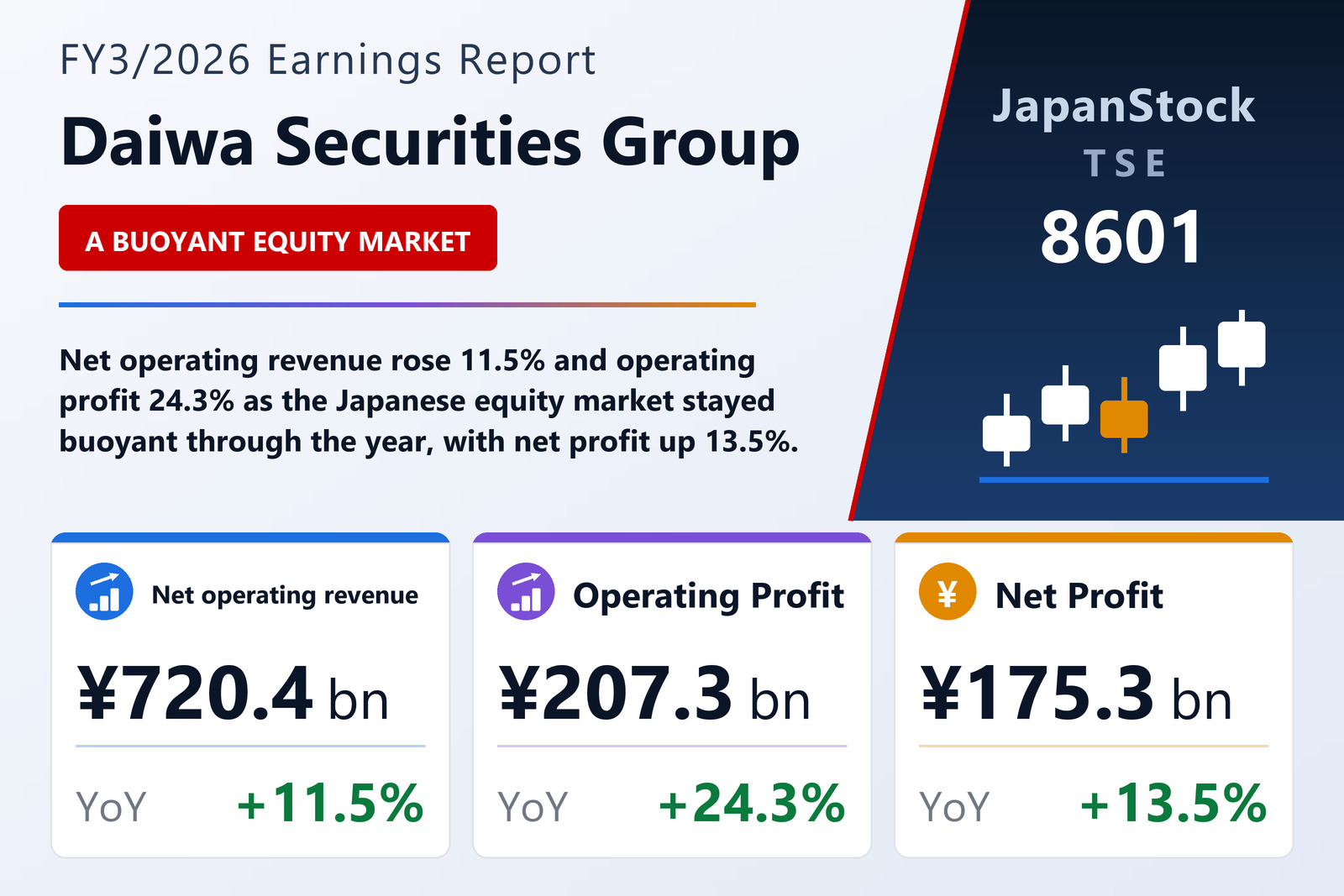
Daiwa Securities Group Inc. (TSE: 8601), Japan's second-largest brokerage and investment banking group (behind Nomura) with strong franchises in retail, wholesale, asset management and online securities, reported FY3/2026 consolidated J-GAAP results showing a strong operating result amid an unusually supportive Japanese equity-market environment. Gross operating revenue rose 7.0% to ¥1,468.0 billion, but the more meaningful net operating revenue (after interest expense and commissions paid to other brokerages) climbed 11.5% to ¥720.4 billion. Operating profit jumped 24.3% to ¥207.3 billion, ordinary profit rose 4.4% to ¥234.5 billion, and profit attributable to shareholders climbed 13.5% to ¥175.3 billion. Basic EPS came in at ¥126.04 (vs ¥109.53).
Operating leverage works — but ordinary profit lags
The divergence between operating profit (+24.3%) and ordinary profit (+4.4%) is worth unpacking. The strong operating-line growth reflects clean revenue growth dropping disproportionately to the bottom line — fixed-cost businesses (retail branches, IB platform) leverage well when revenue accelerates. The slower ordinary-profit growth reflects lower equity-method investment income: ¥22.3 billion in FY26 vs ¥47.3 billion in FY25, a ¥25 billion decline (likely from Daiwa Next Bank consolidation pull-through and JV mark-to-market). Stripping out this comparison effect, ordinary profit would have grown roughly in line with operating profit.
Comprehensive income surges on AFS portfolio
Comprehensive income climbed 70.5% to ¥271.9 billion — far ahead of net profit — reflecting strong mark-to-market gains on the group's available-for-sale equity and bond holdings during a year of rising Japanese equity values and lower credit spreads. This is typical for a brokerage with a large proprietary book in a positive market backdrop.
Balance sheet and capital
Total assets grew to ¥38,077.6 billion from ¥36,024.3 billion (the bulk being securities held for customers and the trading book). Net assets rose to ¥2,045.8 billion. Owners' equity reached ¥1,763.6 billion. The equity ratio of 4.6% looks low at face value but is normal for a securities firm given the leveraged trading-book nature of the asset base — Daiwa's regulatory consolidated capital ratio remains well above the FSA minimum and consistent with global investment-banking standards. BPS reached ¥1,272.72 (vs ¥1,158.82). ROE expanded slightly to 10.3% from 9.8%.
Cash flow swings; financing activities turn positive
Operating cash flow was a positive ¥439.0 billion (vs prior-year outflow of -¥454.1 billion — a major swing reflecting customer-asset and trading-book working-capital dynamics). Investing cash outflow widened to ¥583.6 billion (vs ¥353.4 billion). Financing inflow was ¥199.4 billion (broadly flat). Cash and equivalents finished at ¥3,772.6 billion, up from ¥3,739.7 billion.
Dividend lifted to ¥64; FY27 floor at ¥44
The annual dividend was set at ¥64 per share (¥29 interim + ¥35 year-end), up from ¥56 in the prior year (¥28 + ¥28). The payout ratio of 50.8% (vs 51.1% prior) is consistent with Daiwa's policy of returning 50%+ of consolidated profit to shareholders semiannually. For FY3/2027, the group sets a ¥44 per-share annual minimum as the floor (no specific full-year forecast disclosed — typical for brokerages whose earnings depend heavily on market direction).
Outlook: cyclical, but the Japan equity revival is structural
Brokerages cannot meaningfully guide forward earnings because their revenue depends on market activity. However, structural tailwinds support Daiwa beyond pure cyclical commission income: (i) the post-NISA expansion of retail equity investment in Japan continues to add households and AUM; (ii) the corporate-governance reform cycle is driving record cross-shareholding unwinds and buyback announcements — fueling IB advisory and equity-block fee streams; (iii) the BOJ rate normalization environment supports net interest income on customer deposits and margin lending. The cyclical risk remains a sharp Nikkei reversal, but FY26 confirmed the durability of the franchise. No material going-concern issues or significant subsequent events noted.
| Metric | FY3/2026 | FY3/2025 | YoY |
|---|---|---|---|
| Operating revenue (¥ billion) | 1,468.0 | 1,372.0 | +7.0% |
| Net operating revenue (¥ billion) | 720.4 | 646.0 | +11.5% |
| Operating profit (¥ billion) | 207.3 | 166.7 | +24.3% |
| Ordinary profit (¥ billion) | 234.5 | 224.7 | +4.4% |
| Profit attrib. to owners (¥ billion) | 175.3 | 154.4 | +13.5% |
| Basic EPS (¥) | 126.04 | 109.53 | +15.1% |
| Comprehensive income (¥ billion) | 271.9 | 159.5 | +70.5% |
| ROE | 10.3% | 9.8% | +0.5pp |
| Annual dividend (¥) | 64.00 | 56.00 | +14.3% |
JapanStockPulse provides informational content only and does not constitute investment advice. Figures are taken from the company's published earnings short report and may be subject to subsequent revision.