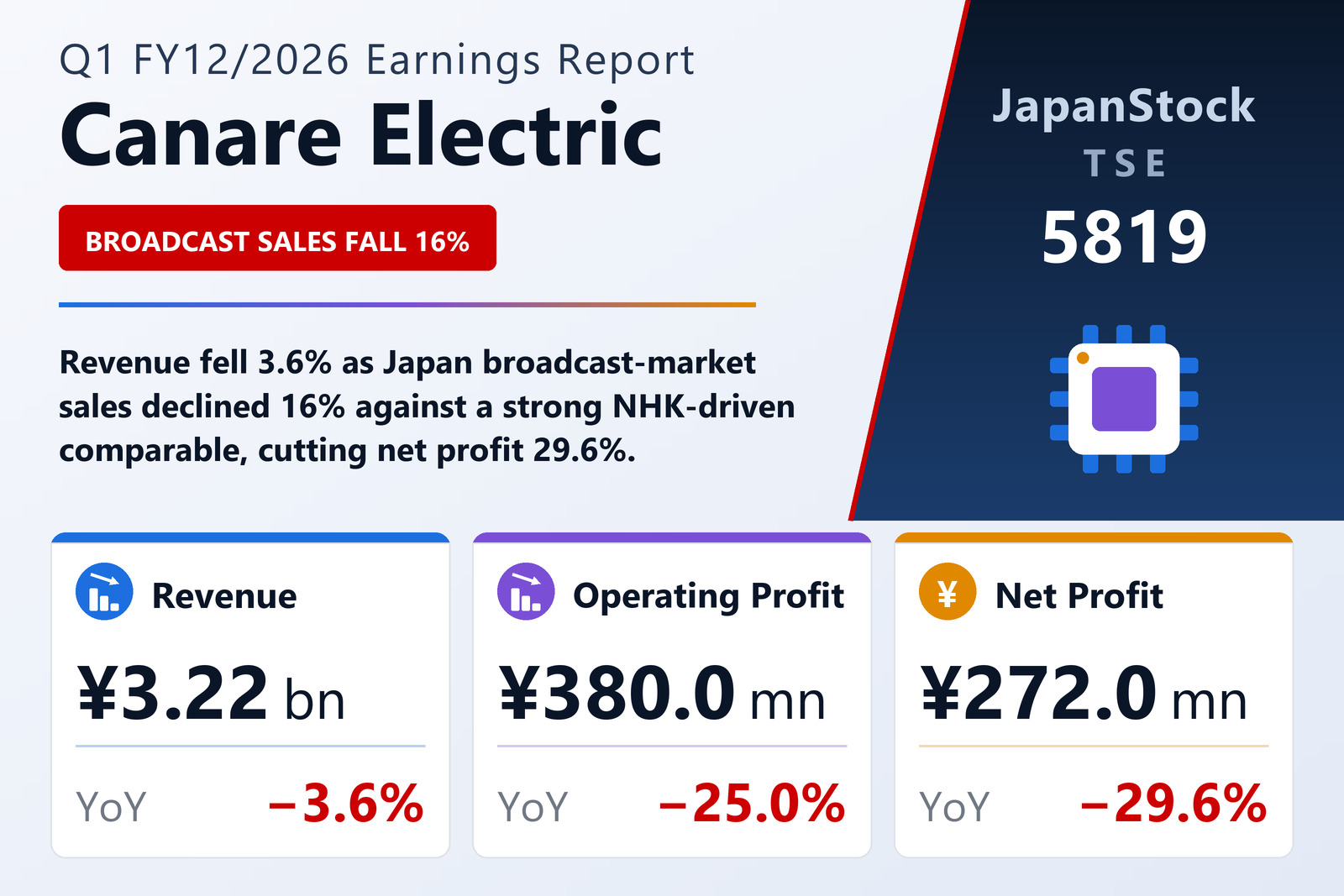
Canare Electric Co., Ltd. (TSE: 5819), the Yokohama-based specialist in professional audio/video cables, BNC connectors and broadcast infrastructure, reported Q1 FY12/2026 consolidated J-GAAP results showing a domestically-led pullback even as the overseas portfolio continued to expand. Revenue fell 3.6% year-on-year to ¥3,218 million, operating profit dropped 25.0% to ¥380 million, ordinary profit fell 23.5% to ¥393 million, and net profit attributable to shareholders declined 29.6% to ¥272 million. The company attributed the operating-profit compression to a combination of subdued domestic broadcast activity, active sales-promotion investment, and continued spending on product development and human capital.
Segment performance: overseas outperforms a weakening Japan
The Japan segment recorded revenue of ¥1,610 million (-16.0%) and segment profit of ¥336 million (-26.7%). While the electrical-installation market ran broadly in line with plan — supported by the Nagoya International Conference Center renovation and a normal cluster of fiscal-year-end deliveries — the broadcast market could not replace the previous year's NHK project base, dragging down overall domestic sales.
Overseas, the picture was strikingly different. China grew revenue 22.8% to ¥316 million with segment profit up nearly 4× to ¥17 million, driven by broadcast equipment refresh cycles and a major 4K racetrack system delivery. Korea grew revenue 15.5% to ¥241 million across broadcast, electrical and distribution markets, with segment profit more than doubling to ¥15 million. Singapore (the regional hub for Southeast Asia) grew 7.0% to ¥138 million, with live-sports and event-related demand robust. The U.S. grew 3.2% to ¥423 million in revenue, but segment profit fell 49.7% to ¥14 million owing to U.S. tariff-policy headwinds and equipment-spending caution at integrators and dealers.
Overseas sales ratio at a new high
Total overseas revenue in Q1 FY12/2026 reached ¥1,648 million versus ¥1,459 million a year earlier, lifting the overseas sales ratio to 51.2% from 43.7% — a notable inflection point at which non-Japanese demand now accounts for more than half of the company's top line. By region, the Americas contributed 13.1% of consolidated revenue (vs. 12.3%), Asia 25.6% (vs. 21.9%) and "other regions" 12.5% (vs. 9.5%).
Balance sheet and FY12/2026 guidance
Total assets eased to ¥20,904 million (-¥171 million) on lower cash and lower tax-payable balances, total liabilities fell to ¥1,821 million (-¥205 million), and net assets edged up to ¥19,082 million (+¥34 million). The H1 and full-year guidance issued in the January 29, 2026 FY12/2025 results release was left unchanged; the company flagged Middle East political risk as a watch item without yet quantifying any impact. No cash-flow statement is prepared for the interim period; quarterly depreciation totaled ¥58 million versus ¥53 million in the prior year.
| Metric | Q1 FY12/2026 | Q1 FY12/2025 | YoY |
|---|---|---|---|
| Revenue (¥ million) | 3,218 | 3,339 | −3.6% |
| Operating profit (¥ million) | 380 | 508 | −25.0% |
| Ordinary profit (¥ million) | 393 | 514 | −23.5% |
| Net profit (¥ million) | 272 | 387 | −29.6% |
| Overseas revenue (¥ million) | 1,648 | 1,459 | +13.0% |
| Overseas sales ratio | 51.2% | 43.7% | +7.5pp |
| Japan segment revenue (¥ million) | 1,610 | 1,917 | −16.0% |
| Total assets (¥ million) | 20,904 | 21,075 | −0.8% |
| Net assets (¥ million) | 19,082 | 19,048 | +0.2% |
JapanStockPulse provides informational content only and does not constitute investment advice. Figures are taken from the company's published earnings short report and may be subject to subsequent revision.