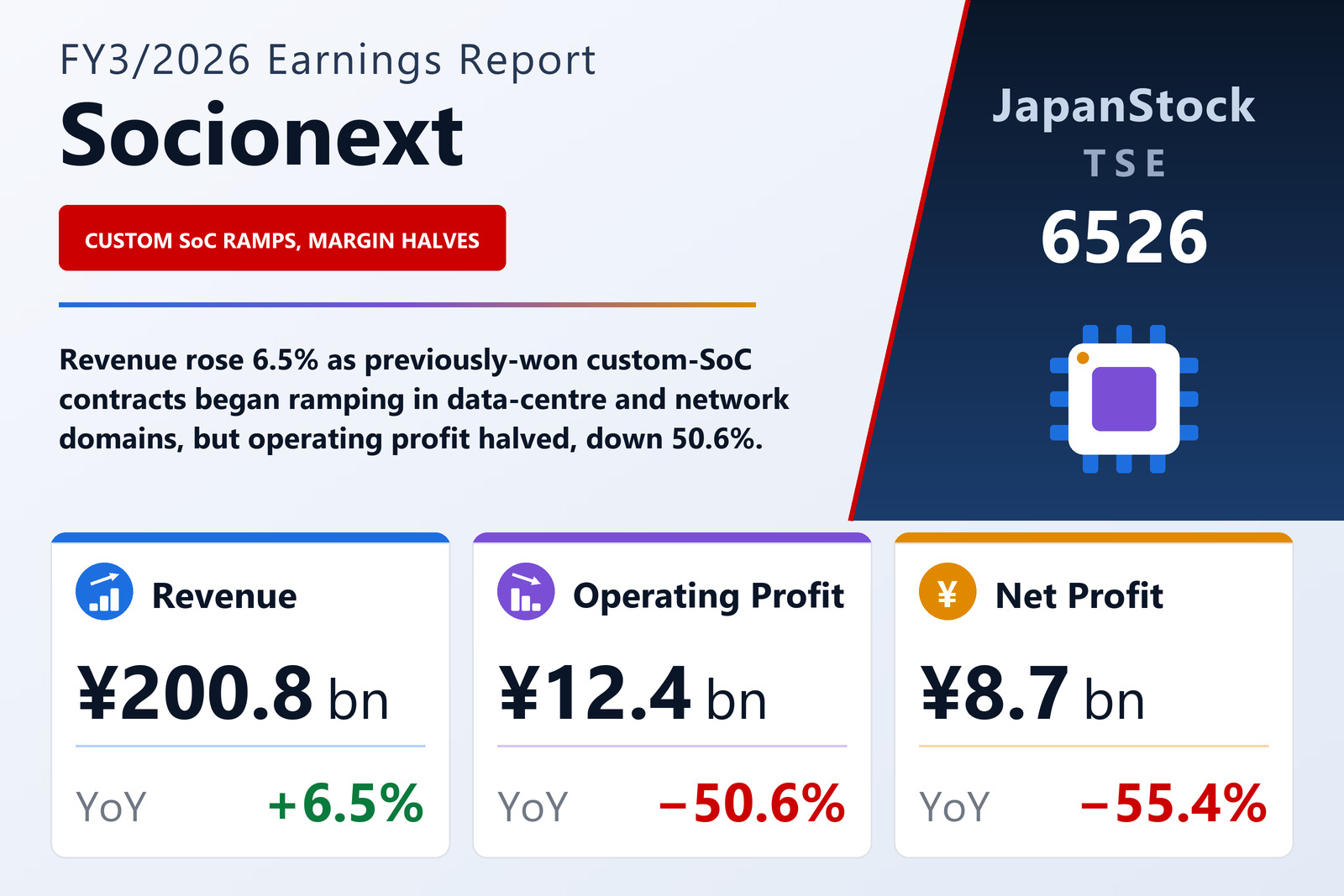
Socionext Inc. (TSE: 6526), the Yokohama-based fabless custom-SoC design house spun off from Fujitsu and Panasonic's semiconductor operations, reported FY3/2026 consolidated J-GAAP results showing revenue growth but a steep profit contraction from the unusually high prior-year base. Revenue rose 6.5% to ¥200.8 billion, operating profit halved (−50.6%) to ¥12.4 billion, ordinary profit fell 53.2% to ¥11.8 billion, and profit attributable to shareholders of the parent dropped 55.4% to ¥8.7 billion. Basic EPS was ¥49.74 (vs ¥109.78 prior — itself a record level). ROE compressed to 6.5% from 14.6%, and the operating margin slipped to 6.2% from 13.3%.
Why the OP halved: mix and elevated development costs
The profit contraction reflects three concurrent dynamics. First, the prior fiscal year's record OP (¥25.0 billion at 13.3% margin) had benefited from a particularly favorable mix of mature, high-volume production deals approaching end-of-life — generating high gross margin with minimal incremental development cost. Second, the current year saw the start of multiple newly-won large custom-SoC engagements in data-center, network and automotive domains — these consume substantial up-front NRE, EDA license costs, advanced-node mask sets (3nm and 5nm), and prototype-bring-up expenses before they begin generating production-ramp revenue. Third, Socionext continued to invest in expanding its global engineering footprint and standardizing its "Solution SoC" development platform — costs which precede the eventual revenue.
Deal pipeline: ¥310 billion, with data-center / network strength
Annual deal-acquisition value (calculated at ¥120/USD) was approximately ¥310 billion, down from the record ¥360 billion in the prior year, but well above the structural-reform-era baseline of around ¥110 billion. Management emphasized that data-center and network was the strongest acquisition theme — consistent with the AI-infrastructure capex super-cycle. Multiple existing large contracts also began their volume-ramp phases, contributing to the +6.5% revenue growth despite the lower deal-acquisition value year-on-year. The combination of strong existing deal backlog and continued large-deal pipeline supports management's mid-cycle revenue trajectory; the FY26 margin compression is presented as a transitional cost rather than a structural deterioration.
Balance sheet, cash flow and dividend held
Total assets eased slightly to ¥167.6 billion from ¥170.3 billion, and net assets slipped to ¥133.1 billion from ¥137.0 billion. The equity ratio remains high at 79.4% (vs 80.5%), with BPS of ¥759.09. Operating cash flow narrowed substantially to ¥7.7 billion from ¥31.9 billion, reflecting both lower earnings and higher working-capital absorption tied to the new project ramp phase. Investing outflow widened to ¥22.9 billion (vs ¥14.6 billion) for NRE / EDA-related capex. The annual dividend was held at ¥50 per share (¥25 + ¥25), unchanged from prior, pushing the payout ratio to 100.5% from 45.5%. FY3/2027 dividend forecast is also ¥50 (interim ¥25 confirmed).
| Metric | FY3/2026 | FY3/2025 | YoY |
|---|---|---|---|
| Revenue (¥ billion) | 200.8 | 188.5 | +6.5% |
| Operating profit (¥ billion) | 12.4 | 25.0 | −50.6% |
| Ordinary profit (¥ billion) | 11.8 | 25.1 | −53.2% |
| Profit attrib. to owners (¥ billion) | 8.7 | 19.6 | −55.4% |
| Basic EPS (¥) | 49.74 | 109.78 | −54.7% |
| Operating margin | 6.2% | 13.3% | −7.1pp |
| ROE | 6.5% | 14.6% | −8.1pp |
| Equity ratio | 79.4% | 80.5% | −1.1pp |
| Annual dividend (¥) | 50.00 | 50.00 | flat |
| Annual deal acquisition (¥ billion) | ~310 | ~360 | −14% |
JapanStockPulse provides informational content only and does not constitute investment advice. Figures are taken from the company's published earnings short report and may be subject to subsequent revision.