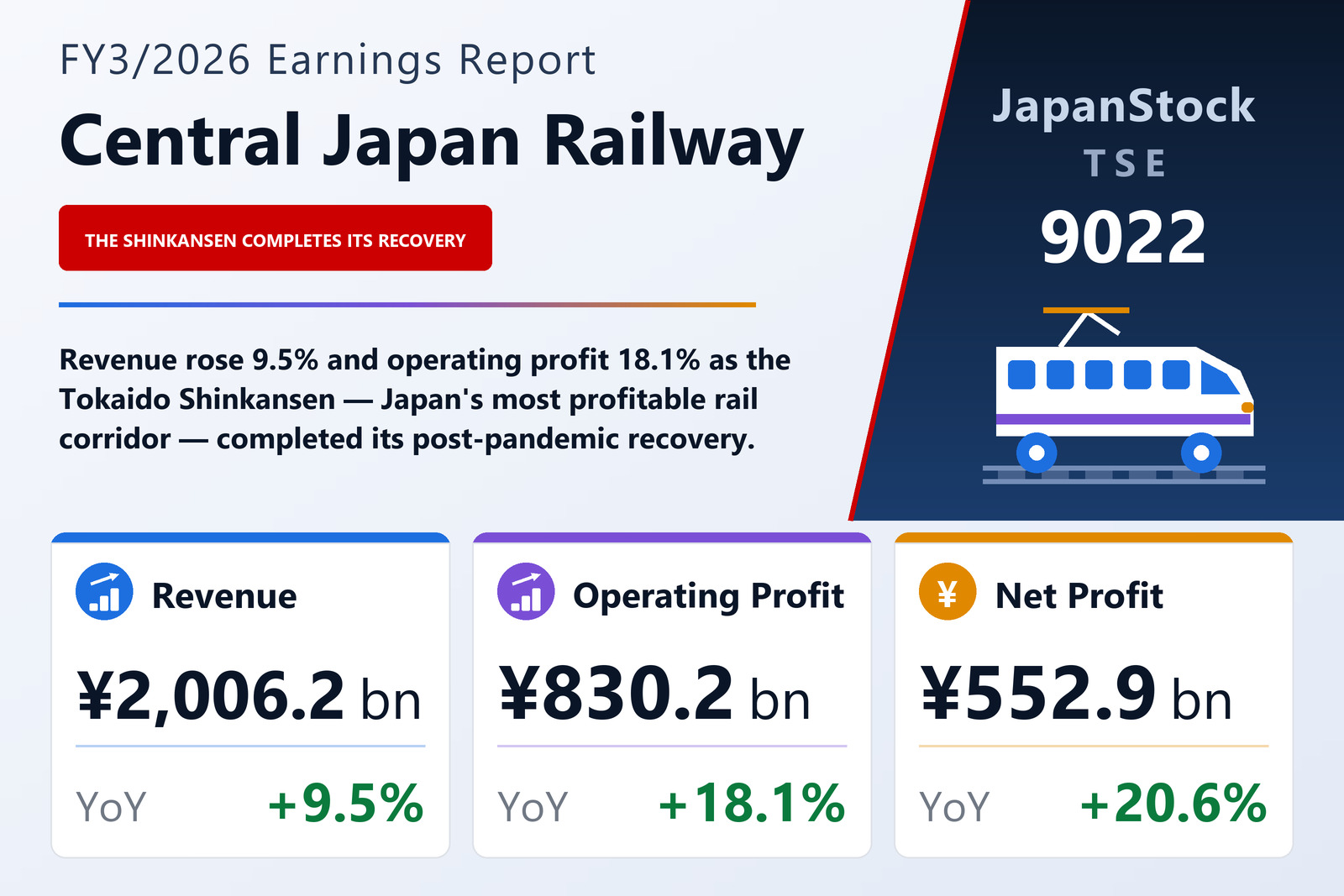
Central Japan Railway Company (TSE: 9022), commonly known as JR Central or JR Tokai, operates the Tokaido Shinkansen — the high-speed rail corridor between Tokyo, Nagoya and Osaka that is among the most profitable rail assets in the world — and is the lead developer of the Linear Chuo Shinkansen, the maglev project linking Tokyo and Nagoya. The company reported FY3/2026 consolidated J-GAAP results showing a strong cyclical year on top of an already structurally profitable core business. Revenue rose 9.5% to ¥2,006.2 billion, operating profit climbed 18.1% to ¥830.2 billion, ordinary profit advanced 20.3% to ¥780.9 billion, and profit attributable to shareholders of the parent rose 20.6% to ¥552.9 billion. Basic EPS came in at ¥570.84 (vs ¥465.88 prior), ROE climbed to 11.4% from 10.5%, and the operating margin expanded to 41.4% from 38.4%.
Tokaido Shinkansen drives the headline
The standout driver was passenger volume on the Tokaido Shinkansen. The 2025 fiscal year benefited from the completion of post-pandemic recovery across business travel and a record inbound-tourism wave tied to the Osaka–Kansai Expo 2025 (April–October 2025), which brought ~28 million domestic and international visitors to the Kansai region — many of whom transited via the Tokaido Shinkansen between Tokyo, Kyoto and Osaka. The combination of strong yen-denominated ticket revenue from international tourists (benefitting from FX), corporate-travel normalization, and high-margin reserved-seat utilization drove a notable operating-margin step-up. Comprehensive income jumped 33.5% to ¥620.5 billion, reflecting both stronger earnings and favorable mark-to-market on the bond portfolio.
Balance sheet expands as Linear Chuo capex builds
Total assets grew to ¥10,876.2 billion from ¥10,323.3 billion, while net assets expanded to ¥5,136.6 billion from ¥4,658.6 billion. The equity ratio strengthened to 46.6% from 44.6%, with BPS reaching ¥5,306.02. Operating cash flow surged to ¥748.2 billion from ¥624.6 billion, funding investing outflows of ¥621.4 billion (narrowed from ¥956.0 billion — partly because last year's higher figure included a large debt-financed cash conservation move) and financing outflows of ¥150.9 billion. Cash and equivalents finished at ¥370.6 billion. A significant portion of the investing outflow continues to support the multi-decade Linear Chuo Shinkansen maglev project — a roughly ¥9 trillion total investment that JR Central is financing entirely without government rail subsidy.
Dividend lifted to ¥32 (¥16+¥16); FY27 guidance −15% OP
The annual dividend was ¥32 per share (¥16 interim + ¥16 year-end), up from ¥30 in the prior year. The payout ratio compressed to 5.6% on the much larger earnings base — extremely low by Japan-listed standards but consistent with JR Central's policy of preserving capital for the Linear Chuo Shinkansen build-out. FY3/2027 dividend is guided at ¥32 again (¥16 + ¥16), holding flat. For FY3/2027 overall, management guides revenue of ¥1,993.0 billion (−0.7%), operating profit of ¥702.0 billion (−15.4%), ordinary profit of ¥653.0 billion (−16.4%), and profit attributable to shareholders of ¥447.0 billion (−19.1%). EPS guidance is ¥467.98.
Why the FY27 step-down: tourism normalization + Linear costs
Three concurrent headwinds explain the cautious FY3/2027 guidance: (i) the Expo Osaka 2025 lapping eliminates a one-off ~6 month inbound surge; (ii) the post-pandemic corporate-travel recovery is now structurally complete, so further volume gains depend on underlying GDP rather than reopening tailwinds; and (iii) Linear Chuo Shinkansen construction enters a more capital-intensive phase, with annual depreciation and maintenance allocations rising as more tunnel sections complete civil works. The −15% OP guide is therefore a deliberate normalization rather than a deterioration — JR Central's structurally industry-leading rail margin remains intact, simply benchmarked against an exceptionally strong comparable. No going-concern issues or material subsequent events were noted.
| Metric | FY3/2026 | FY3/2025 | YoY |
|---|---|---|---|
| Revenue (¥ billion) | 2,006.2 | 1,831.8 | +9.5% |
| Operating profit (¥ billion) | 830.2 | 702.8 | +18.1% |
| Ordinary profit (¥ billion) | 780.9 | 649.3 | +20.3% |
| Profit attrib. to owners (¥ billion) | 552.9 | 458.4 | +20.6% |
| Basic EPS (¥) | 570.84 | 465.88 | +22.5% |
| Operating margin | 41.4% | 38.4% | +3.0pp |
| ROE | 11.4% | 10.5% | +0.9pp |
| Equity ratio | 46.6% | 44.6% | +2.0pp |
| Annual dividend (¥) | 32.00 | 30.00 | +6.7% |
| FY27 OP guidance (¥ billion) | 702.0 | 830.2 | −15.4% |
JapanStockPulse provides informational content only and does not constitute investment advice. Figures are taken from the company's published earnings short report and may be subject to subsequent revision.