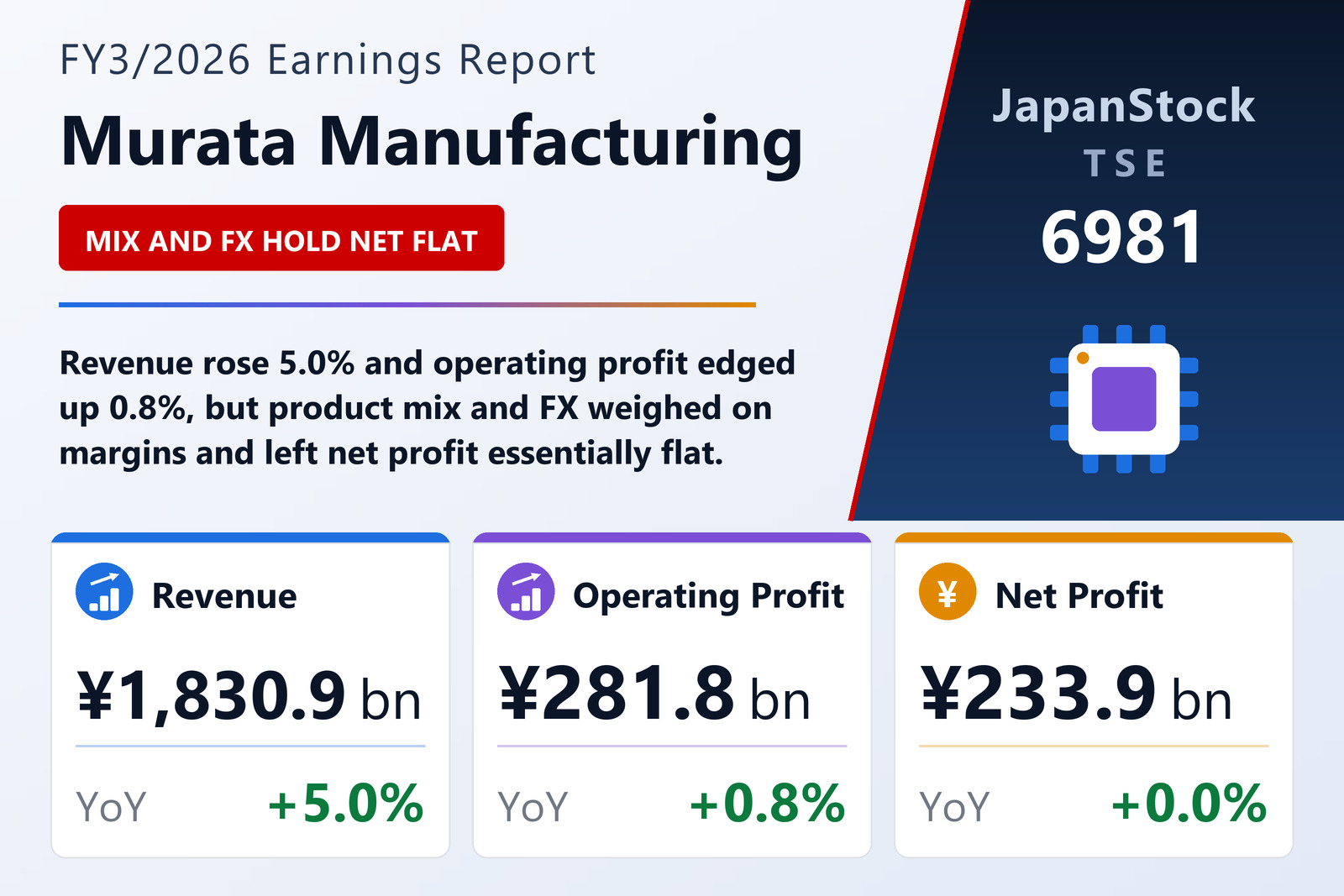
Murata Manufacturing Co., Ltd. (TSE: 6981), the Kyoto-based global leader in multilayer ceramic capacitors (MLCCs) and a critical component supplier to premium smartphones and electrified vehicles, released its FY3/2026 consolidated short report (Kessan Tanshin) under IFRS on April 30, 2026. For the year, revenue rose 5.0% year-on-year to ¥1,830.9 billion, operating profit edged up 0.8% to ¥281.8 billion, profit before tax rose 1.4% to ¥308.6 billion, and profit attributable to owners of the parent was effectively unchanged at ¥233.9 billion (+0.0%). Basic EPS came in at ¥127.66, up from ¥125.08. The operating margin held at 15.4% and ROE was 8.8%. Comprehensive income, however, jumped 69.1% to ¥347.7 billion as foreign-currency translation differences swung sharply positive.
Top line: steady 5% growth on premium smartphone and automotive content
Revenue growth of 5.0% reflects continued unit-content expansion in Murata's two flagship end-markets. In premium smartphones — where each successive flagship generation typically consumes more MLCCs by piece count — Murata remains the dominant share supplier, supplying high-end small-case, high-capacitance ceramic capacitors that AI-capable handsets require in increasing quantity. In automotive, the shift from internal combustion to xEV powertrains drives a structural step-up in passive-component content per vehicle, particularly for high-voltage and high-reliability capacitor specifications where Murata leads. The 5% growth came despite an uneven smartphone unit cycle during the year and signals share gains in higher-spec parts, even as commodity MLCC pricing remained competitive.
Profit decomposition: margin pressure from product mix and FX
Operating profit grew only 0.8% against 5.0% revenue growth, implying the operating margin compressed marginally to 15.4% from 16.0% in FY3/2025. The gap reflects two headwinds: (i) product-mix shift as growth in mid-range smartphone and standard-spec automotive parts ran ahead of the highest-margin premium-handset categories during the year, and (ii) FX translation, which clipped reported-currency revenues from Murata's large overseas customer base. Equity-method investment income fell sharply to ¥15 million from ¥109 million as joint-venture contributions normalized. Pre-tax profit nonetheless advanced 1.4% to ¥308.6 billion, and net profit attributable to owners settled at ¥233.9 billion — effectively flat, but with EPS rising to ¥127.66 from ¥125.08 as treasury-share buybacks shrank the share count.
Comprehensive income jumps 69% on FX translation
Total comprehensive income of ¥347.7 billion was 69.1% higher than the prior year's ¥205.6 billion, and the gap with the ¥233.9 billion net profit line illustrates how much foreign-currency translation moved in Murata's favor during the fiscal year. With roughly 90% of Murata's revenue generated outside Japan, a weaker yen lifts the carrying value of overseas subsidiaries and their net assets in JPY terms — flowing through other comprehensive income rather than the P&L. This is a balance-sheet positive without operational cost.
Capital allocation: dividend raised to ¥65; fresh buyback authorized
The full-year dividend rose to ¥65.00 per share (¥30 interim + ¥35 year-end), up from ¥57.00 in FY3/2025, equating to a consolidated payout ratio of 50.9%. The FY27 dividend guidance steps up further to ¥70.00 per share (¥35 + ¥35), implying a payout ratio of 43.5% on the higher guided EPS of ¥160.96. In parallel, treasury share count grew to 142.7 million shares from 100.6 million a year earlier — evidence that buybacks have been a meaningful return-of-capital lever — and the board approved a fresh repurchase resolution at its April 30 meeting. Together the higher dividend and continuing buybacks signal that management is comfortable returning excess capital while still self-funding capex through the smartphone and EV upcycle.
Balance sheet: 85% equity ratio, ¥425bn of operating cash flow
Total assets rose to ¥3,199.1 billion from ¥3,028.2 billion, while equity attributable to owners reached ¥2,718.7 billion — driving the equity ratio to a very high 85.0%, among the strongest in Japan's large-cap manufacturing universe. Operating cash flow was ¥425.2 billion, with investing activities consuming ¥193.8 billion (capex into MLCC capacity and next-generation processes) and financing activities a ¥221.8 billion outflow (dividends and buybacks). Cash and equivalents ended at ¥653.7 billion. The combination of a fortress balance sheet and high free cash flow gives Murata flexibility to fund capacity ahead of the FY27 demand cycle while continuing to return capital to shareholders.
FY27 guidance: revenue +7%, operating profit +35% on the smartphone & EV cycle
For FY3/2027, Murata guides to revenue of ¥1,960.0 billion (+7.1% YoY), operating profit of ¥380.0 billion (+34.8%), profit before tax of ¥390.0 billion (+26.4%), and profit attributable to owners of ¥293.0 billion (+25.3%), with basic EPS of ¥160.96. The implied operating margin of 19.4% would represent a four-percentage-point expansion versus FY26 — a sharp profitability inflection that hinges on (a) a meaningfully stronger premium-handset cycle, including next-generation AI-capable smartphones that push MLCC content per device higher, and (b) reaccelerating xEV adoption in key markets. Management is led by President Norio Nakajima and Vice-President / CEO South Norikazu Minami; the strong guidance and lifted dividend together suggest internal confidence that the FY26 margin softness was a cyclical mix issue rather than a structural one.
| Metric | FY3/2026 | FY3/2025 | YoY |
|---|---|---|---|
| Revenue (¥ million) | 1,830,856 | 1,743,191 | +5.0% |
| Operating profit (¥ million) | 281,835 | 279,520 | +0.8% |
| Profit before tax (¥ million) | 308,643 | 304,373 | +1.4% |
| Net profit attrib. to owners (¥ million) | 233,920 | 233,832 | +0.0% |
| Basic EPS (¥) | 127.66 | 125.08 | +2.1% |
| Equity ratio | 85.0% | 84.5% | +0.5pp |
| Annual dividend (¥) | 65.00 | 57.00 | +14.0% |
JapanStockPulse provides informational content only and does not constitute investment advice. Figures are taken from the company's published earnings short report and may be subject to subsequent revision.