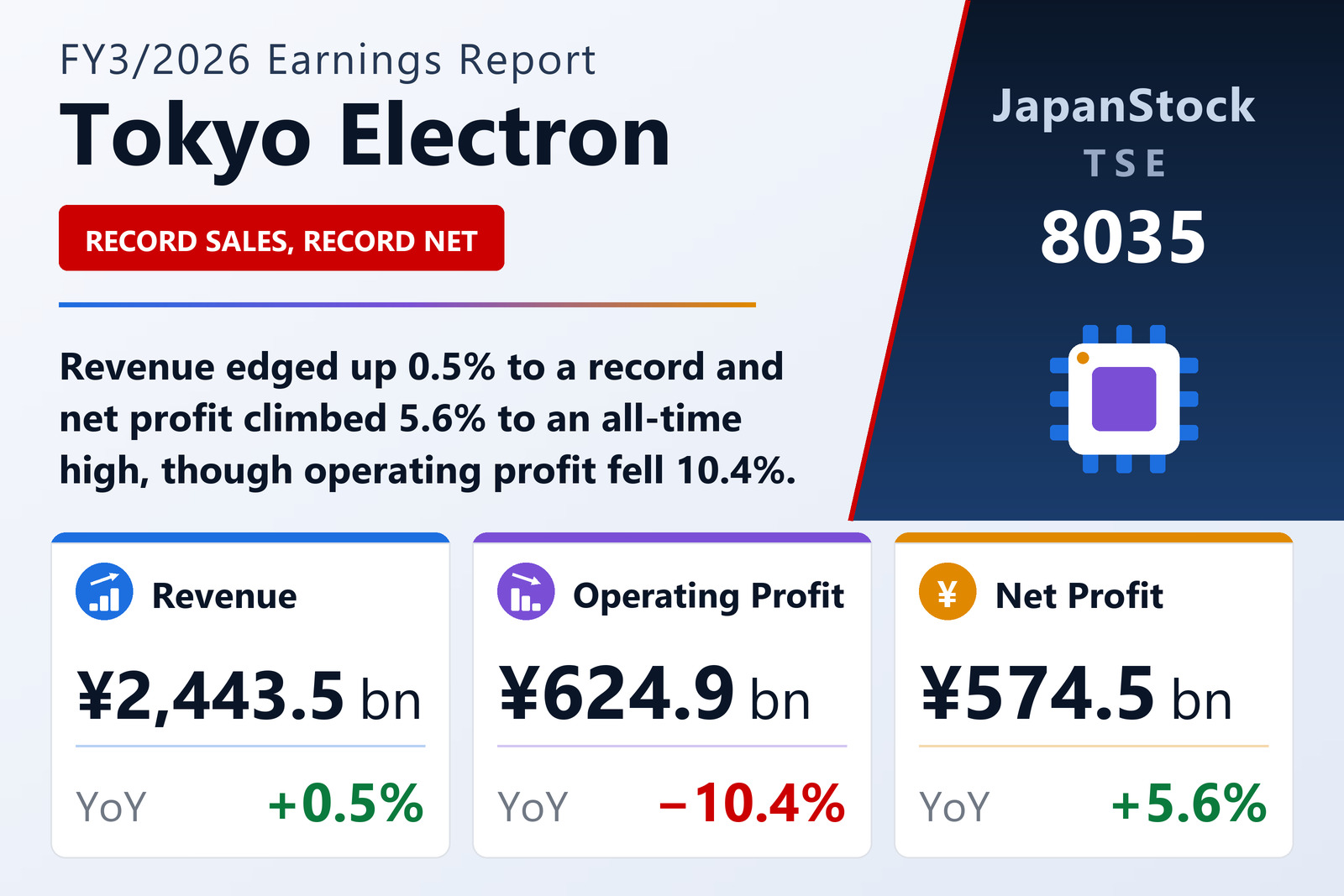
Tokyo Electron Limited (TSE: 8035), the world's #3 maker of semiconductor production equipment after ASML and Applied Materials, released its FY3/2026 consolidated short report (Kessan Tanshin) under Japanese GAAP on April 30, 2026. For the full year, revenue rose 0.5% year-on-year to a record ¥2,443.5 billion. Operating profit, however, declined 10.4% to ¥624.9 billion (from ¥697.3 billion), and ordinary profit fell 10.9% to ¥630.3 billion. Even so, profit attributable to owners of the parent climbed 5.6% to a record ¥574.5 billion, helped by a lower effective tax rate and foreign-exchange gains. Basic EPS came in at ¥1,254.57, up from ¥1,182.40. ROE was 29.6% (vs. 30.3%), and the operating margin compressed to 25.6% from 28.7%. Comprehensive income jumped 31.1% to ¥624.3 billion as currency translation and unrealized gains turned more favorable.
Why operating profit fell despite a record top line
The headline divergence — record revenue paired with a 10% operating-profit decline — is the result of a deliberate investment step-up. Tokyo Electron raised R&D and SG&A spending materially to expand leading-edge etch, deposition and cleaning capability ahead of the next wave of advanced-logic and HBM (high-bandwidth memory) capacity additions. Management has been explicit that the FY26 margin compression is a front-loaded cost line: hiring, prototype tooling, and customer demo systems for sub-2 nm logic and next-generation HBM stacks lifted operating costs faster than the revenue line could match in a transition year between cycle peaks. Net profit still hit an all-time high because below-the-line tax expense fell and yen-denominated FX gains on overseas receivables more than offset the operating squeeze.
AI/HBM demand backdrop: the wave the spending is built for
The capacity investment is being made into one of the strongest semiconductor capex cycles on record. Datacenter AI accelerator demand — anchored by hyperscaler buildouts — has lifted the entire memory and leading-edge logic supply chain, with HBM in particular requiring far more wafer-fab equipment per bit than conventional DRAM. Tokyo Electron's exposure is concentrated where this matters most: it holds top-tier share in coater/developers (effectively a monopoly with EUV-compatible track tools), and leading positions in etch, deposition and cleaning — all of which scale up in step-count and intensity at advanced nodes. President Toshiki Kawai has framed the FY26 cost step-up as the platform for capturing the FY27 demand wave, and the H1 FY27 guidance is the first quantitative confirmation that the demand is materializing.
H1 FY27 outlook: 33% revenue surge, 42% operating-profit jump
For the first half of FY3/2027, Tokyo Electron guides revenue to ¥1,570.0 billion, up 33.1% year-on-year, with operating profit of ¥431.0 billion (+42.2%), ordinary profit of ¥437.0 billion (+42.4%), and net profit attributable to owners of ¥328.0 billion (+35.7%). Half-year basic EPS is forecast at ¥721.12. Implied H1 operating margin is roughly 27.5% — already a meaningful recovery from the 25.6% full-year FY26 print. The full-year FY27 outlook is not yet disclosed; management has said it will be released alongside the H1 result, reflecting normal practice in a volatile equipment cycle. The H1 numbers alone, however, imply that the FY26 R&D / capacity outlays are about to be absorbed by a much larger revenue base.
Capital returns: ¥628 dividend and roughly ¥287bn of buybacks
Capital allocation remains aggressive. The FY3/2026 annual dividend is set at ¥628.00 per share (¥264 interim + ¥364 year-end), up from ¥592.00 in FY3/2025, equivalent to a payout ratio of 50.1%. During the year, Tokyo Electron repurchased 16.78 million treasury shares (vs. 13.52 million prior year), with total buyback value approaching ¥287 billion. For FY3/2027, the company has guided an interim dividend of ¥361.00; the year-end dividend will be set alongside the H1 results. Combined dividend plus buyback in FY26 represents one of the largest cash-return programs across Japan's large-cap tech complex.
Balance sheet and cash flow: building war chest into the upcycle
Total assets stood at ¥2,861.0 billion (vs. ¥2,626.0 billion), and the equity ratio strengthened to 71.5% from 70.1%, a notably conservative capital structure for a company of this scale. Operating cash flow was ¥539.7 billion, investing cash flow was -¥96.5 billion (reflecting the capacity outlays described above), and financing activities used ¥425.4 billion (dividends and buybacks). Cash and equivalents closed at ¥505.4 billion — a sizeable liquidity cushion entering the FY27 upcycle. The combination of a 71.5% equity ratio, half-trillion-yen cash pile and 29.6% ROE underscores why management sees room to keep both R&D outlays and the capital-return program elevated.
| Metric | FY3/2026 | FY3/2025 | YoY |
|---|---|---|---|
| Revenue (¥ billion) | 2,443.5 | 2,432.5 | +0.5% |
| Operating profit (¥ billion) | 624.9 | 697.3 | −10.4% |
| Ordinary profit (¥ billion) | 630.3 | 707.7 | −10.9% |
| Net profit attrib. to owners (¥ billion) | 574.5 | 544.1 | +5.6% |
| Basic EPS (¥) | 1,254.57 | 1,182.40 | +6.1% |
| ROE | 29.6% | 30.3% | −0.7pp |
| Equity ratio | 71.5% | 70.1% | +1.4pp |
| Annual dividend (¥) | 628.00 | 592.00 | +6.1% |
JapanStockPulse provides informational content only and does not constitute investment advice. Figures are taken from the company's published earnings short report and may be subject to subsequent revision.