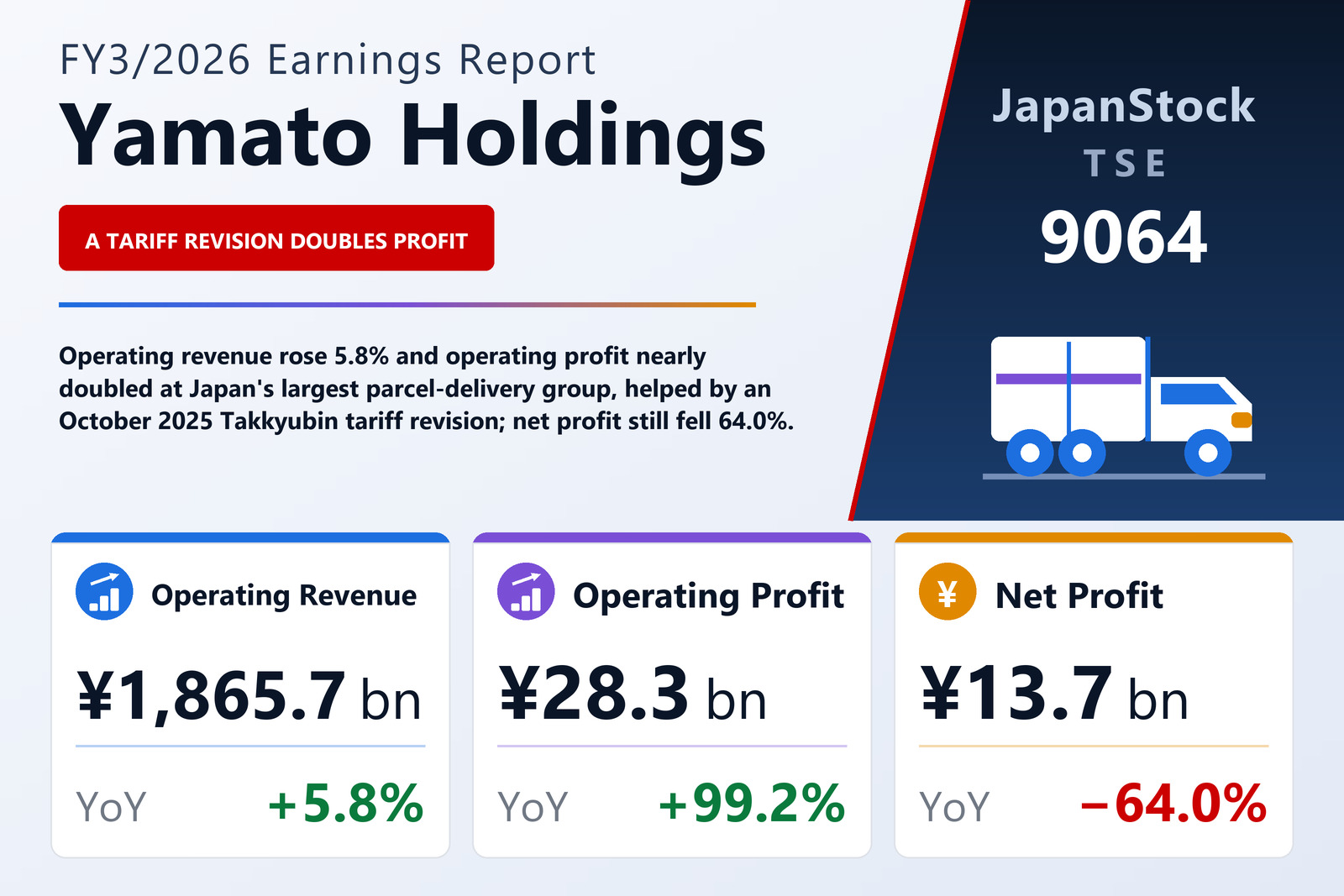
Yamato Holdings Co., Ltd. (TSE: 9064), the operator of Japan's iconic "Kuroneko" Takkyubin parcel network and the country's largest courier group, released its FY3/2026 consolidated short report (Kessan Tanshin) under Japanese GAAP on April 30, 2026. For the year ended March 2026, operating revenue rose 5.8% year-on-year to ¥1,865.7 billion (vs. ¥1,762.7 billion), operating profit nearly doubled to ¥28.3 billion (+99.2%, vs. ¥14.2 billion), and ordinary profit rose 34.1% to ¥26.3 billion. Profit attributable to owners of the parent, however, fell 64.0% to ¥13.7 billion (vs. ¥37.9 billion), a result driven almost entirely by the absence of last year's large special profit from a headquarters-building sale-and-leaseback rather than by any weakness at the operating line.
Tariff revision and a fuller service shelf drive the top line
The 5.8% revenue gain reflects three converging shifts in the way Yamato charges for its core network. The Takkyubin division expanded shipment volumes from small corporate and individual customers, while the large-corporate division pushed through value-based pricing optimization. Most visibly, Yamato revised its declared Takkyubin tariff effective October 1, 2025 — the company's first headline rate adjustment in this cycle — and in November 2025 launched a new "Takkyubin Same-Day Delivery Service" that delivers same day for parcels accepted in the morning, alongside a new intra-prefecture fare class. Across the year, Takkyubin and Takkyubin Compact / EAZY parcel volumes were ¥1,941 million (-1.0%), while smaller Nekopos / Yu-packet volumes grew sharply to ¥451 million (+15.4%) as e-commerce small-item demand strengthened.
Operating profit nearly doubles — costs rise, but pricing more than offsets
Operating expenses climbed to ¥1,837.4 billion (+¥88.9 billion), reflecting investment in human capital — most notably better compensation for Sales Drivers and partners — together with collection/delivery hub realignment based on local demand, and procurement-cost inflation. Even with those headwinds, the combination of tariff hikes and value-mix improvement was strong enough to lift operating profit by ¥14.1 billion to ¥28.3 billion, a near-doubling that points to clear pricing leverage in the core network. By segment, the Express business (Takkyubin core) recorded external revenue of ¥1,558.0 billion (+1.5%) and operating profit of ¥2.3 billion, up by ¥15.2 billion — the single largest year-on-year improvement in the group. Contract Logistics revenue jumped 69.6% to ¥164.6 billion (helped by the consolidation of Nakano Shokai), with operating profit of ¥6.2 billion. Global (international forwarding) revenue rose 13.5% to ¥97.6 billion, though operating profit eased to ¥8.2 billion. The Mobility business — Yamato's EV lifecycle and fleet-maintenance platform — grew revenue 7.5% to ¥22.0 billion and lifted operating profit by ¥1.4 billion to ¥5.2 billion.
Why net profit halved: comparing against a one-off sale-leaseback gain
The headline 64.0% drop in profit attributable to owners is almost entirely a base-effect story. In FY3/2025, Yamato recognized a sizeable special profit from a sale-and-leaseback of headquarters real estate as part of its capital-efficiency program; no comparable one-off recurred in FY3/2026. The underlying operating engine moved in the opposite direction — the doubling of operating profit, and the 34.1% rise in ordinary profit, reflect genuine improvement in the core network's earnings power. Yamato continued its capital-efficiency program through the year — additional asset monetization and sales of strategic cross-shareholdings — but at a smaller scale than the FY25 headquarters transaction. The company also bought back ¥18.9 billion of its own shares and paid ¥14.8 billion in dividends.
Sustainability: EV lifecycle service, MY MEDICA, joint-transport platform
Beyond Takkyubin, Yamato is building what it calls a "Green Mobility" business, packaging EV procurement, energy-management systems, renewable-power supply, and fleet maintenance into an EV Lifecycle Service sold to corporate fleets — addressing transport-industry decarbonization while opening a new revenue line. On the human side, the group operates MY MEDICA, an online medical-services platform aimed at the elevated health risks faced by transport-industry workers; in July 2025 it added a partnership with a transport-safety NPO to deepen the offering. Sustainable Shared Transport K.K., a joint-logistics platform majority-led by Yamato, signed a cooperation agreement in August 2025 with a federation representing roughly 1,600 regional logistics operators to broaden Japan-wide co-loading and shared trunk-line transport. The group continues to target net-zero own-emissions by 2050 and a 48% Scope 1/2 cut by FY3/2031 vs. FY3/2021.
Balance sheet and cash flow
Total assets stood at ¥1,280.2 billion (+¥12.7 billion), with cash and deposits up ¥30.2 billion and lease assets up ¥13.3 billion as the group shifted part of its vehicle fleet from purchase to lease. Land fell ¥10.5 billion under the ongoing real-estate monetization program, and goodwill was amortized by ¥13.4 billion in Contract Logistics. Liabilities rose to ¥698.1 billion (+¥31.0 billion). Net assets eased to ¥582.1 billion (-¥18.3 billion), as the ¥13.7 billion of net profit was more than offset by ¥14.8 billion of dividends and ¥18.9 billion of buybacks. The equity ratio finished at 44.6% (vs. 46.5%). Operating cash flow was a healthy ¥72.2 billion (+¥24.5 billion YoY), investing cash flow used just ¥7.3 billion as the lease shift reduced capex, and financing activities used ¥37.1 billion. Cash and equivalents ended at ¥237.8 billion.
FY27 outlook: 48% operating-profit growth penciled in
For FY3/2027 — the final year of the company's mid-term plan "Sustainability Transformation 2030 — 1st Stage" — Yamato is guiding to operating revenue of ¥1,920.0 billion (+2.9% YoY), operating profit of ¥42.0 billion (+48.4%), ordinary profit of ¥42.0 billion (+60.0%), and profit attributable to owners of ¥24.0 billion (+75.7%). The shape of the guide is significant: a flatter top-line plan combined with continued operating-margin recovery suggests management expects the tariff revision, the same-day-service launch, and the network-restructuring savings to keep compounding into the new fiscal year, while the absence of a one-off real-estate gain at last year's scale becomes the new base. Management frames the next twelve months as the year in which "AI- and data-driven management" moves from pilot to scale across operations, and in which corporate logistics (Contract Logistics + Global) is positioned as the group's primary growth lever alongside the strengthened Takkyubin core.
| Metric | FY3/2026 | FY3/2025 | YoY |
|---|---|---|---|
| Operating revenue (¥ million) | 1,865,675 | 1,762,696 | +5.8% |
| Operating profit (¥ million) | 28,304 | 14,206 | +99.2% |
| Ordinary profit (¥ million) | 26,258 | 19,587 | +34.1% |
| Net profit attrib. to owners (¥ million) | 13,662 | 37,937 | −64.0% |
| Total assets (¥ billion) | 1,280.2 | 1,267.4 | +1.0% |
| Equity ratio | 44.6% | 46.5% | −1.9pp |
| Operating cash flow (¥ billion) | 72.2 | 47.7 | +51.4% |
JapanStockPulse provides informational content only and does not constitute investment advice. Figures are taken from the company's published earnings short report and may be subject to subsequent revision.