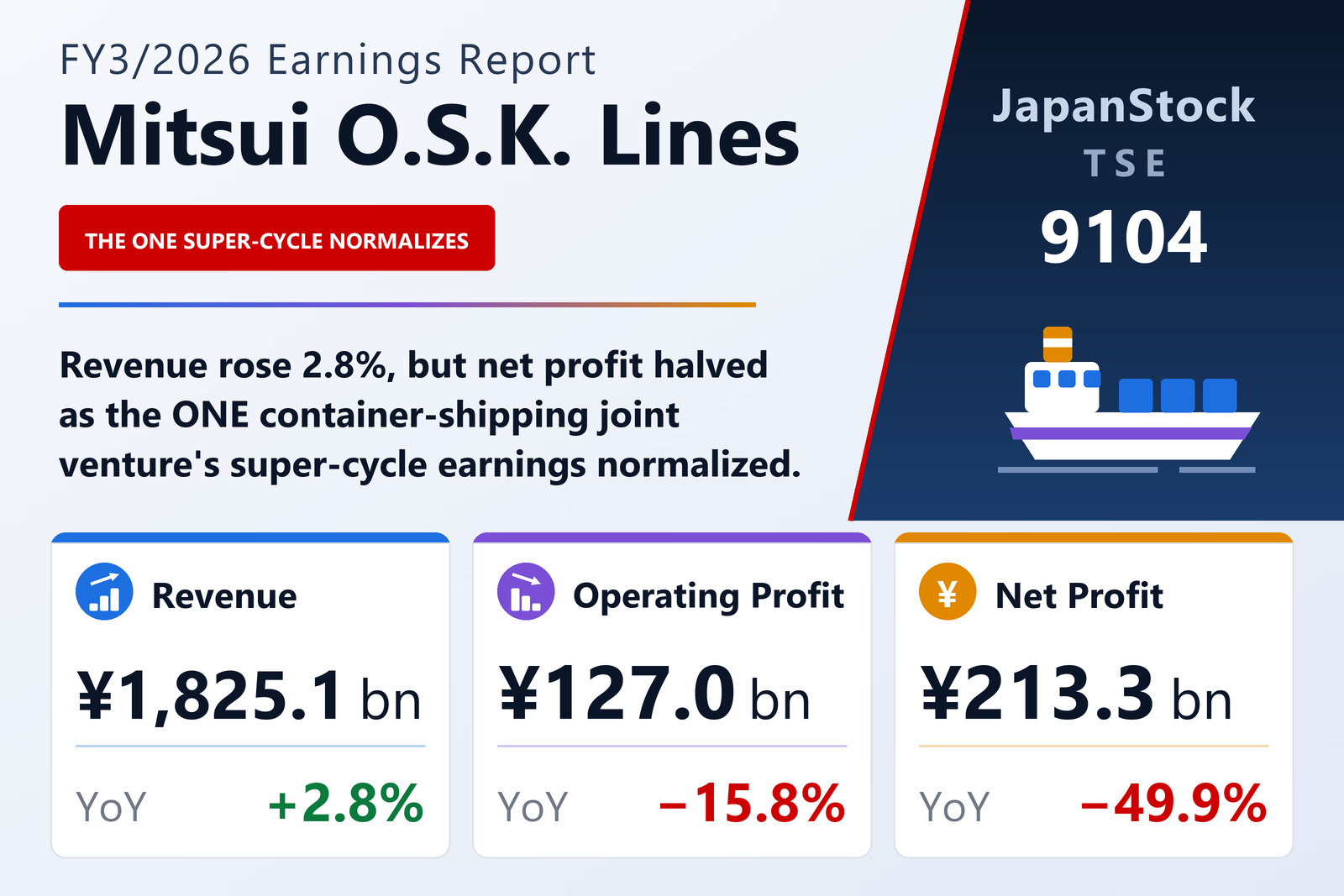
Mitsui O.S.K. Lines, Ltd. (TSE: 9104), the Tokyo Toranomon-headquartered global marine transportation conglomerate with one of the world's largest fleets by tonnage, reported FY3/2026 consolidated J-GAAP results that mark a clear cyclical turn from the container-shipping super-cycle that drove earnings to a record ¥425.5 billion in the prior year. Revenue rose 2.8% to ¥1,825.1 billion, but operating profit fell 15.8% to ¥127.0 billion, ordinary profit slid 58.1% to ¥175.8 billion, and profit attributable to owners of the parent halved to ¥213.3 billion (−49.9%). Basic EPS came in at ¥619.78 (vs ¥1,186.60), ROE compressed sharply to 7.7% from 16.9%, and the equity ratio slipped to 48.2% from 53.9% as the balance sheet expanded on acquisition financing.
The ONE container-shipping JV normalizes
The single biggest driver of the profit halving was the collapse of equity-method investment income from ¥262.4 billion to ¥41.7 billion. This income line is dominated by Ocean Network Express (ONE) — the Singapore-based container-shipping JV in which MOL holds a 31% stake alongside NYK and K Line. ONE earned super-normal profits in FY25 as global container freight rates remained elevated on Red Sea diversion routing, tight capacity and persistent strong consumer-goods demand. Through FY26, fleet capacity additions, normalization of freight rates and easier comparisons brought ONE's contribution back closer to mid-cycle levels. Container-shipping cyclicality is the fundamental backdrop, and MOL's pivot is to reduce that volatility.
LBC Tank Terminals: a structural infrastructure pivot
The strategic centerpiece of the report is the full consolidation of LBC Tank Terminals Group Holding Netherlands Cooperatief U.A. as a new consolidated subsidiary. LBC is one of Europe's leading operators of independent third-party liquid-bulk storage terminals (chemicals, petrochemicals, biofuels), with major facilities across the Antwerp-Rotterdam-Amsterdam (ARA) hub. The acquisition reflects MOL's stated medium-term strategy of shifting earnings mix away from cyclical container shipping toward stable infrastructure — alongside LNG carriers (long-term contracts), offshore wind installation vessels, and tank terminals. The transaction explains the dramatic widening of investing cash outflow to ¥721.6 billion (vs ¥450.8 billion) and the asset-base expansion from ¥4.98 trillion to ¥5.96 trillion (+19.6%).
Balance sheet expands; financing flips on acquisition debt
Total assets rose to ¥5,962.2 billion from ¥4,984.4 billion, and net assets climbed to ¥2,929.1 billion from ¥2,724.2 billion as comprehensive income — though down 37% to ¥313.4 billion — remained supportive. Operating cash flow expanded to ¥451.0 billion (vs ¥360.5 billion) on the stronger underlying business. Financing activities shifted to a net cash inflow of ¥117.1 billion (vs +¥312.9 billion prior — a smaller positive), reflecting acquisition-financing draws partially offset by dividend payments and amortization. Cash and equivalents stood at ¥201.5 billion at year-end. The owners' equity ratio compression to 48.2% reflects the consolidation of LBC's gross assets.
Dividend cut to ¥205; FY27 guides further decline before recovery
The annual dividend was reduced to ¥205 per share (¥105 interim + ¥100 year-end) from ¥360 the prior year, for a payout ratio of 32.3% on the lower FY26 net profit (vs 30.3% the prior year on a much higher base). For FY3/2027, management guides revenue of ¥2,040 billion (+11.8%) as LBC fully contributes a full year, but operating profit of ¥105.0 billion (−17.3%), ordinary profit of ¥145.0 billion (−17.5%), and profit attributable to owners of ¥170.0 billion (−20.3%). Basic EPS is guided at ¥494.77. The dividend forecast is held around ¥200 (payout ratio 41.4%), signaling management's commitment to maintain shareholder returns through the cyclical trough. The investment thesis is now explicitly multi-year: container-shipping cyclicality continues to dominate near-term, while LNG carriers, offshore wind and tank-terminal earnings build a more stable base for FY28 and beyond.
| Metric | FY3/2026 | FY3/2025 | YoY |
|---|---|---|---|
| Revenue (¥ billion) | 1,825.1 | 1,775.5 | +2.8% |
| Operating profit (¥ billion) | 127.0 | 150.9 | −15.8% |
| Ordinary profit (¥ billion) | 175.8 | 419.7 | −58.1% |
| Profit attrib. to owners (¥ billion) | 213.3 | 425.5 | −49.9% |
| Equity-method investment income (¥ billion) | 41.7 | 262.4 | −84.1% |
| Basic EPS (¥) | 619.78 | 1,186.60 | −47.8% |
| ROE | 7.7% | 16.9% | −9.2pp |
| Equity ratio | 48.2% | 53.9% | −5.7pp |
| Total assets (¥ trillion) | 5.96 | 4.98 | +19.6% |
| Annual dividend (¥) | 205.00 | 360.00 | −43.1% |
JapanStockPulse provides informational content only and does not constitute investment advice. Figures are taken from the company's published earnings short report and may be subject to subsequent revision.