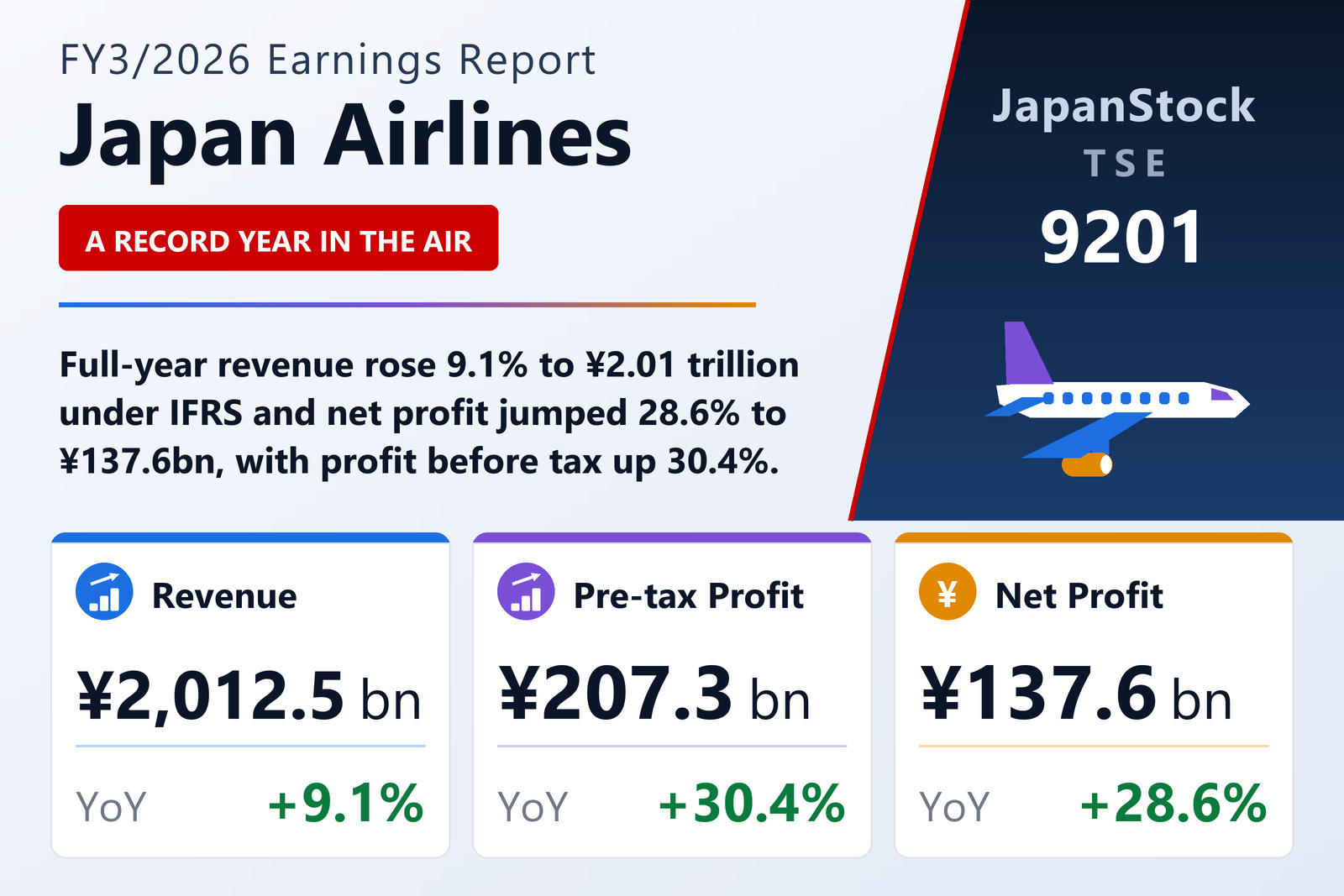
Japan Airlines Co., Ltd. (TSE: 9201), the country's flag carrier and largest international airline, released its FY3/2026 consolidated short report (Kessan Tanshin) under IFRS on April 30, 2026. For the year ended March 2026, revenue rose 9.1% year-on-year to ¥2,012,515 million, while income before financing and income taxes (the company's headline operating KPI) climbed 26.4% to ¥218,004 million. Profit before tax advanced 30.4% to ¥207,253 million, and profit attributable to owners of the parent jumped 28.6% to ¥137,604 million, equivalent to basic EPS of ¥306.96 (vs. ¥245.09). ROE based on equity attributable to owners rose to 12.2% from 11.4%. Comprehensive income nearly doubled to ¥214,321 million (+94.9%) on equity-instrument valuation gains and foreign-currency translation movements.
Expo Osaka 2025 powers a record inbound year
The year was shaped by an unusually strong inbound tourism cycle. The 2025 World Expo in Osaka, which ran from April to October 2025, drew tens of millions of overseas visitors into Kansai and onward to Tokyo, lifting load factors and yields on JAL's international network. The carrier benefitted from sustained yen weakness, which kept Japan exceptionally affordable for foreign travelers, and from continued bilateral capacity additions on U.S., European and Asian routes. Domestic demand was also firm, supported by business travel recovery and a healthy leisure mix tied to Expo-related domestic trips. Together, these tailwinds drove the 9% top-line gain and a meaningfully wider margin profile versus FY25.
Segment view: international leads, domestic steady, cargo adds upside
By business line, the international passenger franchise was the primary growth engine, with yields and unit revenues both expanding as inbound traffic surged. Domestic passenger revenue grew at a more moderate pace, with capacity discipline and a richer fare mix supporting profitability. The cargo and mail business — including LCC subsidiary ZIPAIR Tokyo's cargo activity and bellyhold capacity on long-haul widebodies — added incremental upside on firmer e-commerce and semiconductor-related freight. Equity-method investment income contributed a further ¥1,645 million, reflecting JAL's stakes in partner carriers and adjacent businesses. The income-before-finance-and-tax margin expanded by roughly 1.5 percentage points to 10.8%, in line with management's medium-term target band.
Balance sheet strengthens; cash builds to ¥1.01 trillion
Total assets stood at ¥3,198,757 million, up from ¥2,794,913 million, while equity attributable to owners rose to ¥1,289,639 million and the equity ratio improved sharply to 40.3% from 34.9% — a level that puts JAL's balance sheet meaningfully above pre-pandemic norms. Operating cash flow was a robust ¥394,879 million (vs. ¥381,527 million), more than covering investing outflows of ¥281,107 million tied to fleet, MRO and digital investment. Financing activities used ¥64,910 million on debt service, dividends and treasury share buybacks. Cash and cash equivalents closed the year at ¥1,010,185 million, up from ¥749,030 million, providing material flexibility for capacity growth, sustainability investment and further capital returns.
Dividend raised to ¥96; treasury share count jumps on buybacks
JAL raised the annual dividend to ¥96.00 per share (¥46 interim + ¥50 year-end), up from ¥86.00 in FY3/2025, implying a consolidated payout ratio of 31.3%. Treasury shares grew to 7.32 million at year-end from 0.59 million a year earlier, reflecting share repurchases executed during the period — a clear signal that management sees the elevated profit run-rate as a window for capital return. For FY3/2027, the carrier guides for the dividend to be maintained at ¥96.00 per share (¥48 interim + ¥48 year-end), explicitly de-coupling the payout from the cyclical profit dip that guidance envisages.
FY27 outlook: 20% profit decline as tourism normalizes
For FY3/2027, JAL guides revenue of ¥2,095,000 million (+4.1%), income before finance and tax of ¥180,000 million (-17.4%), and profit attributable to owners of ¥110,000 million (-20.1%). The softer profit outlook reflects three factors: (1) tourism normalization following the one-off Expo Osaka 2025 stimulus, (2) cost pressure from labor inflation, airport charges and aircraft maintenance, and (3) ongoing fuel-price and geopolitical risk tied to Middle East tensions and crude volatility. Management — led by CEO Mitsuko Tottori, JAL's first female CEO appointed in 2024 — has framed FY27 as a planned "reset year" after the Expo peak, with the underlying business volume still well above pre-pandemic FY3/2020 levels.
| Metric | FY3/2026 | FY3/2025 | YoY |
|---|---|---|---|
| Revenue (¥ million) | 2,012,515 | 1,844,095 | +9.1% |
| Income before finance & tax (¥ million) | 218,004 | 172,452 | +26.4% |
| Profit before tax (¥ million) | 207,253 | 158,919 | +30.4% |
| Net profit attrib. to owners (¥ million) | 137,604 | 107,038 | +28.6% |
| Basic EPS (¥) | 306.96 | 245.09 | +25.2% |
| Equity ratio | 40.3% | 34.9% | +5.4pp |
| Annual dividend (¥) | 96.00 | 86.00 | +11.6% |
JapanStockPulse provides informational content only and does not constitute investment advice. Figures are taken from the company's published earnings short report and may be subject to subsequent revision.