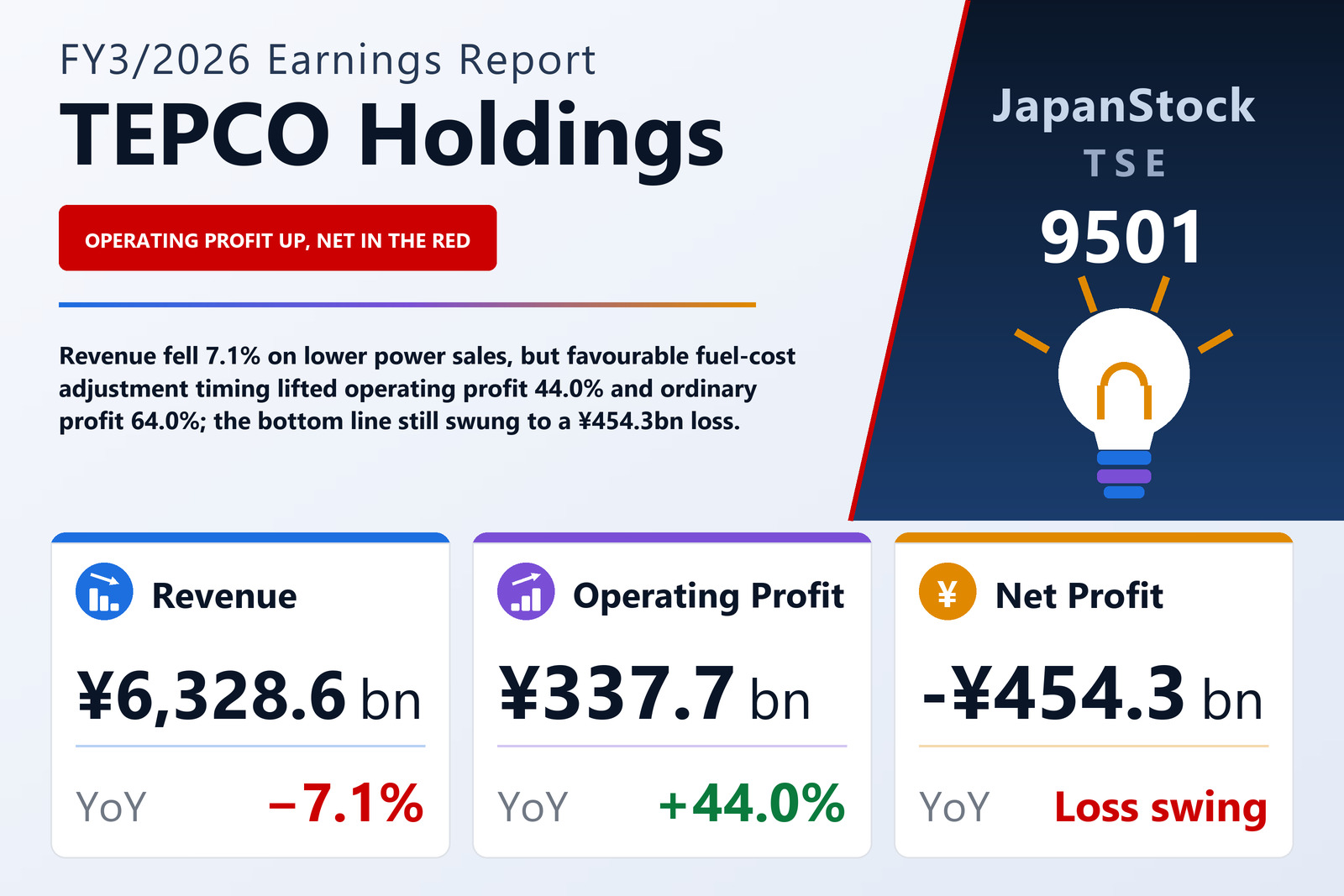
Tokyo Electric Power Company Holdings, Inc. (TSE: 9501), Japan's largest electric utility and the operator of the Tokyo metropolitan electricity grid, released its FY3/2026 consolidated short report (Kessan Tanshin) under Japanese GAAP on April 30, 2026. For the year, revenue declined 7.1% year-on-year to ¥6,328.6 billion on lower sold-electricity volumes. Operating profit, however, jumped 44.0% to ¥337.7 billion and ordinary profit surged 64.0% to ¥417.3 billion, the latter buoyed by a favorable swing in fuel-cost adjustment timing (nenryouhi chousei seido no kizure) and continuous cost discipline. Yet profit attributable to owners of the parent swung to a ¥454.3 billion loss (vs. a ¥161.3 billion profit in FY3/2025) as large special losses tied to Fukushima decommissioning and nuclear-damage compensation overwhelmed the operating recovery. Basic EPS was −¥283.51 (vs. +¥100.67), and ROE was −12.7% (vs. +4.4%). Comprehensive income was a loss of ¥371.3 billion, against income of ¥248.6 billion a year earlier.
Operating recovery: fuel-cost timing flips from headwind to tailwind
The operating-line recovery was driven almost entirely by the fuel-cost adjustment mechanism (nenryouhi chousei seido), which lags pass-through of LNG, oil and coal price moves to retail electricity tariffs by several months. After a year in which the timing gap squeezed margins, the FY3/2026 alignment flipped favorable, lifting the operating result even as kWh sold declined. Equity-method investment income — primarily from JERA, TEPCO's 50/50 fuel and thermal-generation joint venture with Chubu Electric Power — rose to ¥138.4 billion from ¥100.2 billion, providing an additional non-operating tailwind. The ordinary-profit margin reached 6.6% (vs. 3.7%) and the operating margin 5.3% (vs. 3.4%).
Why net profit swung to a ¥454 billion loss
Below ordinary profit, the income statement was reshaped by very large special items. Special profits of ¥184.9 billion included ¥103.1 billion from the sale of related-company stock and an ¥81.9 billion capital grant from the Nuclear Damage Compensation and Decommissioning Facilitation Corporation (Genshiryoku Songai Baisho・Hairo-tou Shien Kikou). These were more than offset by special losses of ¥996.7 billion, principally a ¥913.9 billion disaster-related special loss reflecting incremental Fukushima Daiichi decommissioning provisions, plus ¥82.8 billion in nuclear-damage compensation expense. The combination took pre-tax income to a ¥394.4 billion loss; after tax expense of ¥60.3 billion, net loss attributable to owners landed at ¥454.3 billion.
Balance sheet: equity ratio falls 3.3 points as net loss erodes capital
Total assets rose to ¥15,575.6 billion (+¥588.6 billion), driven by higher fixed assets. Total liabilities expanded ¥956.3 billion to ¥12,157.3 billion, lifted by an increase in the disaster-loss provision. Net assets fell ¥367.7 billion to ¥3,418.4 billion as the net loss eroded retained earnings, and the equity ratio dropped to 21.8% from 25.1% — a 3.3-point deterioration. Interest-bearing debt stood at ¥6,633.7 billion at end-March 2026, equivalent to roughly 43% of total assets, leaving TEPCO sensitive to interest-rate and refinancing dynamics over the multi-decade Fukushima remediation horizon. Net assets per share fell to ¥1,491.01 from ¥1,722.28.
Cash flow: operating cash up 55%, but financing CF more than halves
Operating cash flow rose 55.1% to ¥560.3 billion, lifted by the larger disaster-loss reserve. Investing cash flow was a net outflow of ¥663.6 billion, a 22.8% smaller drain than the prior year as recoveries on loans and investments offset capex. Financing cash flow shrank to ¥110.4 billion from ¥194.2 billion as short-term borrowing inflows declined. Cash and equivalents ended at ¥936.7 billion, up just 1.1% from a year earlier. Common-share dividend remained at ¥0.00 for the year — TEPCO has not paid a common dividend since the 2011 Fukushima accident — and both the Class A and Class B preferred shares (held by the Nuclear Damage Compensation and Decommissioning Facilitation Corporation, which controls more than half of the voting rights) also paid zero. The FY27 dividend guidance is unchanged at ¥0.00.
FY27 guidance withheld; Kashiwazaki-Kariwa restart remains the key swing factor
TEPCO did not issue revenue or profit guidance for FY3/2027. The company stated that, given Middle East tensions and the resulting opacity around LNG, oil and coal prices, it is "not in a position to present specific forecasts" for revenue, operating profit, ordinary profit, or net profit attributable to owners, and will publish guidance "promptly" when visibility improves. The dividend guidance, however, was set at ¥0.00. Two structural levers will define FY27 and beyond. First, fuel costs — JERA is expanding LNG procurement (including up to 5.5 million tons of new U.S. LNG) and using JERA Global Markets trading to manage volatility. Second, and more material, is the restart of Kashiwazaki-Kariwa Nuclear Power Station: Unit 6 has resumed power transmission, but full, stable operation still requires Niigata Prefecture and local-government consent on the broader restart path. A sustained nuclear restart would sharply reduce thermal-fuel costs and is the single largest swing factor for TEPCO's medium-term earnings and balance sheet recovery.
Outlook: Fukushima costs anchor the model; nuclear restart and structural reform remain critical
TEPCO's earnings shape is increasingly defined by two opposing forces: an operating business that benefits when fuel-cost adjustment timing aligns and when JERA delivers, against periodic large reserves for Fukushima Daiichi decommissioning (a 30-to-40-year program) and nuclear-damage compensation. The Fifth Comprehensive Special Business Plan (Go-ji Sou-toku), jointly drawn up with the Nuclear Damage Compensation and Decommissioning Facilitation Corporation, anchors the group's commitment to "fulfilling its responsibility to Fukushima" through management rationalization, asset sales, and the pursuit of alliances. CEO Tomoaki Kobayakawa continues to position Kashiwazaki-Kariwa restart, sustained ALPS-treated-water ocean release, and continued cost reform as the path to restoring financial strength and, eventually, dividend capacity.
| Metric | FY3/2026 | FY3/2025 | YoY |
|---|---|---|---|
| Revenue (¥ billion) | 6,328.6 | 6,810.4 | −7.1% |
| Operating profit (¥ billion) | 337.7 | 234.5 | +44.0% |
| Ordinary profit (¥ billion) | 417.3 | 254.4 | +64.0% |
| Net profit attrib. to owners (¥ billion) | −454.3 | 161.3 | Loss swing |
| Basic EPS (¥) | −283.51 | 100.67 | Loss swing |
| Equity ratio | 21.8% | 25.1% | −3.3pp |
| Annual dividend — common (¥) | 0.00 | 0.00 | ±0 |
JapanStockPulse provides informational content only and does not constitute investment advice. Figures are taken from the company's published earnings short report and may be subject to subsequent revision.