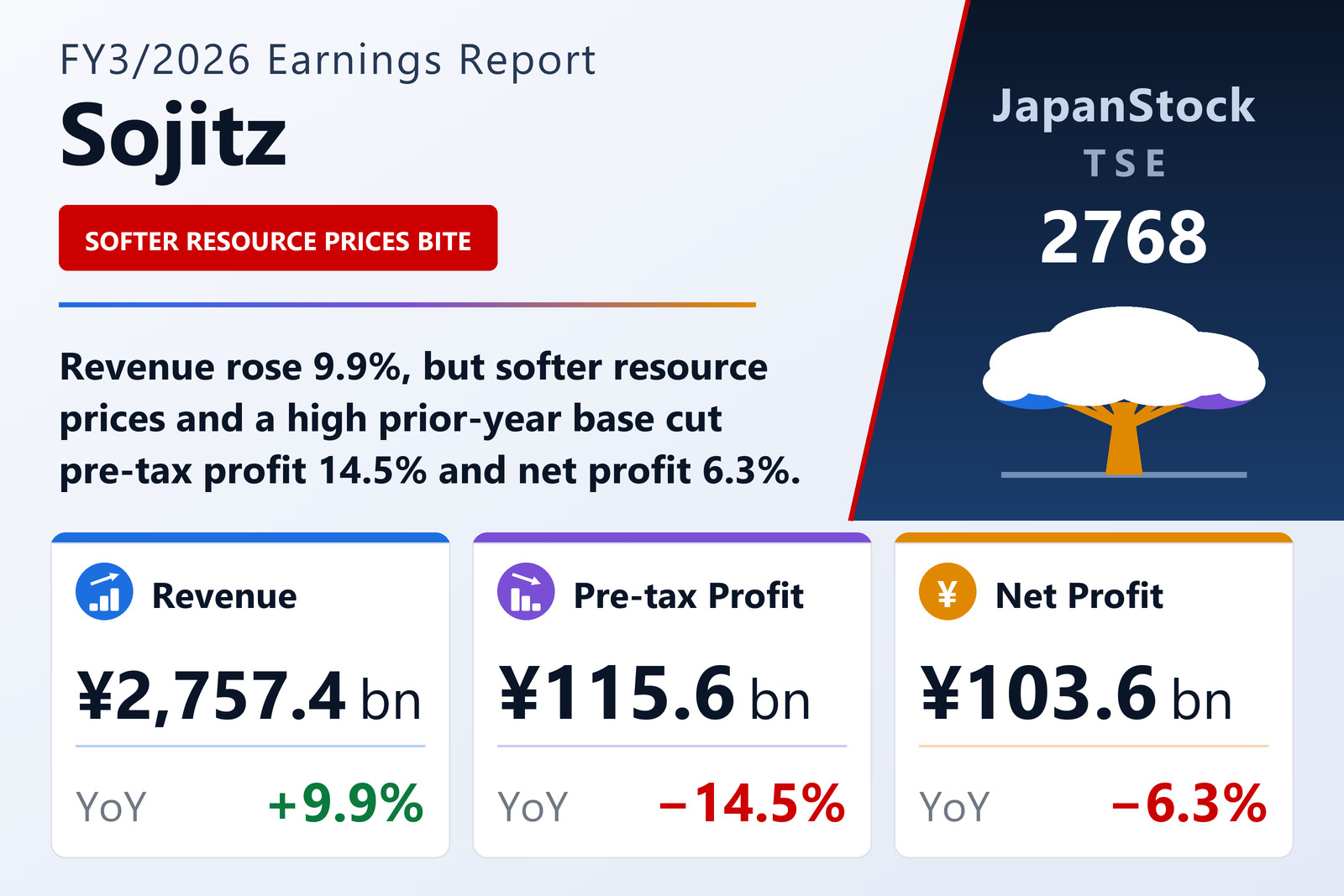
Sojitz Corporation (TSE: 2768), a mid-tier Japanese sogo shosha (general trading house) with distinctive strengths in automotive distribution across emerging markets, aerospace, chemicals, food and agribusiness, and metals and mineral resources, released its FY3/2026 consolidated earnings short report (Kessan Tanshin) under IFRS on May 1, 2026. Revenue rose 9.9% year-on-year to ¥2,757.4 billion (from ¥2,509.7 billion), but profit before tax fell 14.5% to ¥115.6 billion and profit attributable to owners of the parent eased 6.3% to ¥103.6 billion (from ¥110.6 billion). Basic EPS came in at ¥494.95, down from ¥513.74. The equity ratio attributable to owners stood at 29.9%, with total assets of ¥3,648.0 billion and owners' equity of ¥1,090.4 billion.
Revenue up 9.9% but net profit down 6.3%
The headline split between top-line growth and bottom-line contraction reflects the leverage trading houses carry to commodity cycles and equity-method affiliates. Revenue climbed nearly 10% as transaction volumes and a weaker yen lifted reported sales across the merchandise-heavy businesses. Below the gross line, however, pre-tax profit fell 14.5% to ¥115.6 billion and profit for the year declined 5.7% to ¥107.6 billion, with the portion attributable to owners easing 6.3% to ¥103.6 billion. Equity-method investment income — a key profit engine for the sogo shosha model — fell to ¥44.0 billion from ¥49.6 billion, a meaningful drag on the consolidated result.
Resource softness and a high prior-year base
Management attributed the modest profit dip primarily to softer resource and commodity prices — which compressed margins in metals, mineral resources and related affiliates — and to a high prior-year comparison base, FY3/2025 having benefited from stronger pricing and one-off gains. The decline was therefore a normalization rather than a structural deterioration: revenue growth of nearly 10% shows the underlying merchandising franchises continued to expand, even as the resource-linked and equity-method earnings that swing trading-house profits the most rolled off their prior-year highs.
Segment color: autos, aerospace, chemicals, food & agri, metals
Sojitz's portfolio is more diversified and less resource-concentrated than the top-tier majors, anchored by a distinctive automotive distribution franchise that sells, finances and services vehicles across emerging markets — a higher-growth, consumption-linked business that differentiates Sojitz from peers. Aerospace (aircraft and parts trading and leasing) and chemicals (industrial and specialty chemicals) provide steady industrial flows, while food and agribusiness spans grain, fertilizer and processed foods. The metals and mineral resources division — coking coal, base metals and related interests — is where this year's price softness was felt most, but it remains a smaller share of group profit than at the resource-heavy majors, which limited the downside.
Cash flow turned positive; balance sheet
Operating cash flow swung to a positive ¥16.8 billion from an outflow of ¥16.7 billion a year earlier — a notable improvement driven by working-capital normalization after the prior year's build-up. Total comprehensive income jumped 81.5% to ¥193.2 billion as a weaker yen drove a positive foreign-currency translation adjustment on overseas net assets, far outpacing the decline in headline profit. On the balance sheet, total assets stood at ¥3,648.0 billion and equity attributable to owners at ¥1,090.4 billion, for an owners' equity ratio of 29.9% — a solid capital position for a mid-tier trading house.
Dividend lifted to ¥165; FY27 guides a 26% rebound to ¥130bn
For FY3/2026, Sojitz raised the annual dividend to ¥165 per share (¥82.50 interim + ¥82.50 year-end, up from ¥150) for a consolidated payout ratio of 33.3%, consistent with its progressive-dividend policy. For FY3/2027, the company guides a further increase to ¥180 per share (¥90 + ¥90). On the earnings line, Sojitz forecasts profit attributable to owners of ¥130,000 million for FY3/2027 — a 25.5% rebound — with basic EPS of ¥622.55. The guidance signals management's confidence that the resource normalization and high-base effects of FY26 give way to broad-based recovery, supported by the consumption-linked automotive franchise and a steadier contribution from equity-method affiliates.
| Metric | FY3/2026 | FY3/2025 | YoY |
|---|---|---|---|
| Revenue (¥ billion) | 2,757.4 | 2,509.7 | +9.9% |
| Pre-tax profit (¥ billion) | 115.6 | 135.3 | −14.5% |
| Profit for the year (¥ billion) | 107.6 | 114.2 | −5.7% |
| Net profit attrib. to owners (¥ billion) | 103.6 | 110.6 | −6.3% |
| Basic EPS (¥) | 494.95 | 513.74 | −3.7% |
| Equity-method income (¥ billion) | 44.0 | 49.6 | −11.3% |
| Owners' equity ratio | 29.9% | — | — |
| Annual dividend (¥) | 165.00 | 150.00 | +10.0% |
JapanStockPulse provides informational content only and does not constitute investment advice. Figures are taken from the company's published earnings short report and may be subject to subsequent revision.