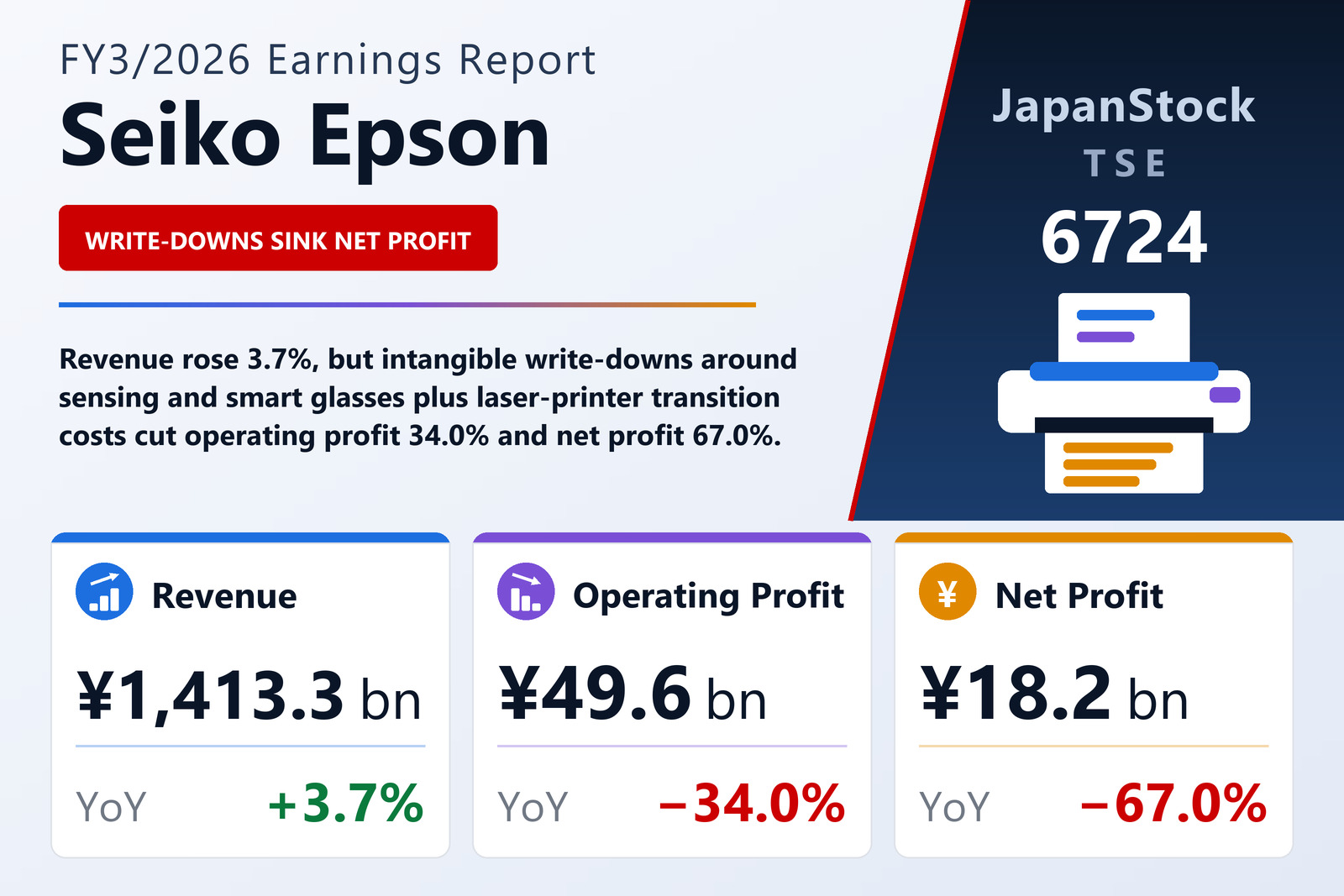
Seiko Epson Corporation (TSE: 6724), the Suwa-based global leader in inkjet printers, projectors, robotics and quartz devices, released its FY3/2026 consolidated short report (Kessan Tanshin) under IFRS on May 1, 2026. For the year, revenue rose 3.7% year-on-year to ¥1,413,251 million, but earnings quality deteriorated sharply: business profit (jigyo rieki, an Epson-defined measure that excludes one-off items) fell 6.5% to ¥83,788 million, while reported operating profit declined a much steeper 34.0% to ¥49,558 million. Pre-tax profit fell 36.2% to ¥50,023 million, and profit attributable to owners of the parent collapsed 67.0% to ¥18,201 million (from ¥55,177 million). Basic EPS came in at ¥56.81, down from ¥168.75, and ROE compressed to 2.2% from 6.8%. Comprehensive income, by contrast, rose 50.6% to ¥72,310 million as FX translation and mark-to-market securities movements recovered.
Business profit vs. operating profit: the ¥34bn wedge
The single most important number on the page is the gap between business profit and operating profit. Epson's "business profit" — revenue less cost of sales less SG&A — fell only ¥5.8 billion (-6.5%), broadly tracking modestly weaker underlying trading. Reported operating profit, however, fell ¥25.6 billion (-34.0%). The ¥19.7 billion wedge between the two reflects one-off charges recognized below the business-profit line: intangible-asset write-downs and structural-cost provisions tied to the smart-glass / sensing business, where adoption has not met plan, plus ongoing transition costs as Epson accelerates its strategic shift away from laser printers toward its PrecisionCore PageWide inkjet platform for offices. These items are non-cash or one-time in nature and are explicitly excluded from the FY27 baseline the company is guiding against.
Dividend held at ¥74 — payout ratio jumps to 130%
Despite the earnings hit, the board confirmed an unchanged annual dividend of ¥74.00 per share (¥37.00 interim + ¥37.00 year-end), identical to FY3/2025. With basic EPS of just ¥56.81, the consolidated payout ratio leapt from 43.9% to 130.3%. Management is signalling that it views FY26 earnings as cyclically and exceptionally depressed by one-off charges rather than reflective of underlying cash generation, and is prioritizing dividend stability. Crucially, the FY3/2027 guide also raises the dividend to ¥80.00 per share (¥40.00 + ¥40.00), at which the payout ratio normalizes back to 43.4% on the guided ¥184.13 EPS.
Parent-only worse than consolidated — overseas absorbed the hit
The standalone (parent-only, non-consolidated) accounts paint a starker picture than the consolidated numbers. Parent revenue fell 10.4% to ¥878,778 million, the parent posted an operating loss of ¥38,077 million (versus a positive ¥35,920 million prior year), and parent net profit collapsed 93.7% to ¥5,172 million. The pattern indicates that overseas subsidiaries — especially the inkjet and projector businesses with global commercial footprints — continued to generate the bulk of the group's earnings, while the Japan parent absorbed the bulk of restructuring and intangible-asset charges tied to product-line transitions and the sensing business.
Balance sheet and cash flow: cash up, capex contained
Total assets stood at ¥1,534,870 million (+¥78.4 billion), equity attributable to owners reached ¥853,503 million, and the equity-attributable-ratio edged up to 55.6% from 55.3%. Book value per share rose to ¥2,663.64 from ¥2,512.15. Operating cash flow was ¥112,372 million (down from ¥138,075 million), comfortably ahead of reported net profit — confirming the non-cash character of much of the earnings hit. Investing cash flow was -¥65,561 million, less than half the prior year's -¥150,787 million, reflecting a more disciplined capex stance. Financing activities used ¥39,604 million (dividends ¥23.7 billion plus modest debt service). Cash and equivalents ended at ¥288,582 million, up from ¥267,000 million.
FY27 guidance: a 224% net-profit rebound on operating leverage
For FY3/2027, management guides revenue of ¥1,450,000 million (+2.6%), business profit of ¥90,000 million (+7.4%), and crucially — with the one-off charges out of the run-rate — operating profit of ¥86,000 million (+73.5%), pre-tax profit of ¥84,000 million (+67.9%), and net profit attributable to owners of ¥59,000 million (+224.1%), equivalent to EPS of ¥184.13. The thesis is operating leverage from continued cost discipline (the non-recurrence of FY26 one-offs alone closes most of the gap to operating profit) plus a richer product mix as office-inkjet penetration progresses and the projector and quartz franchises remain steady. Achievability ultimately hinges on (a) no further write-downs around the sensing/smart-glass business, (b) stable FX, and (c) the cost actions taken in FY26 flowing through to FY27 P&L.
| Metric | FY3/2026 | FY3/2025 | YoY |
|---|---|---|---|
| Revenue (¥ million) | 1,413,251 | 1,362,944 | +3.7% |
| Business profit (¥ million) | 83,788 | 89,589 | −6.5% |
| Operating profit (¥ million) | 49,558 | 75,108 | −34.0% |
| Pre-tax profit (¥ million) | 50,023 | 78,395 | −36.2% |
| Net profit attrib. to owners (¥ million) | 18,201 | 55,177 | −67.0% |
| Basic EPS (¥) | 56.81 | 168.75 | −66.3% |
| Equity-attributable ratio | 55.6% | 55.3% | +0.3pp |
| Annual dividend (¥) | 74.00 | 74.00 | ±0.0% |
JapanStockPulse provides informational content only and does not constitute investment advice. Figures are taken from the company's published earnings short report and may be subject to subsequent revision.