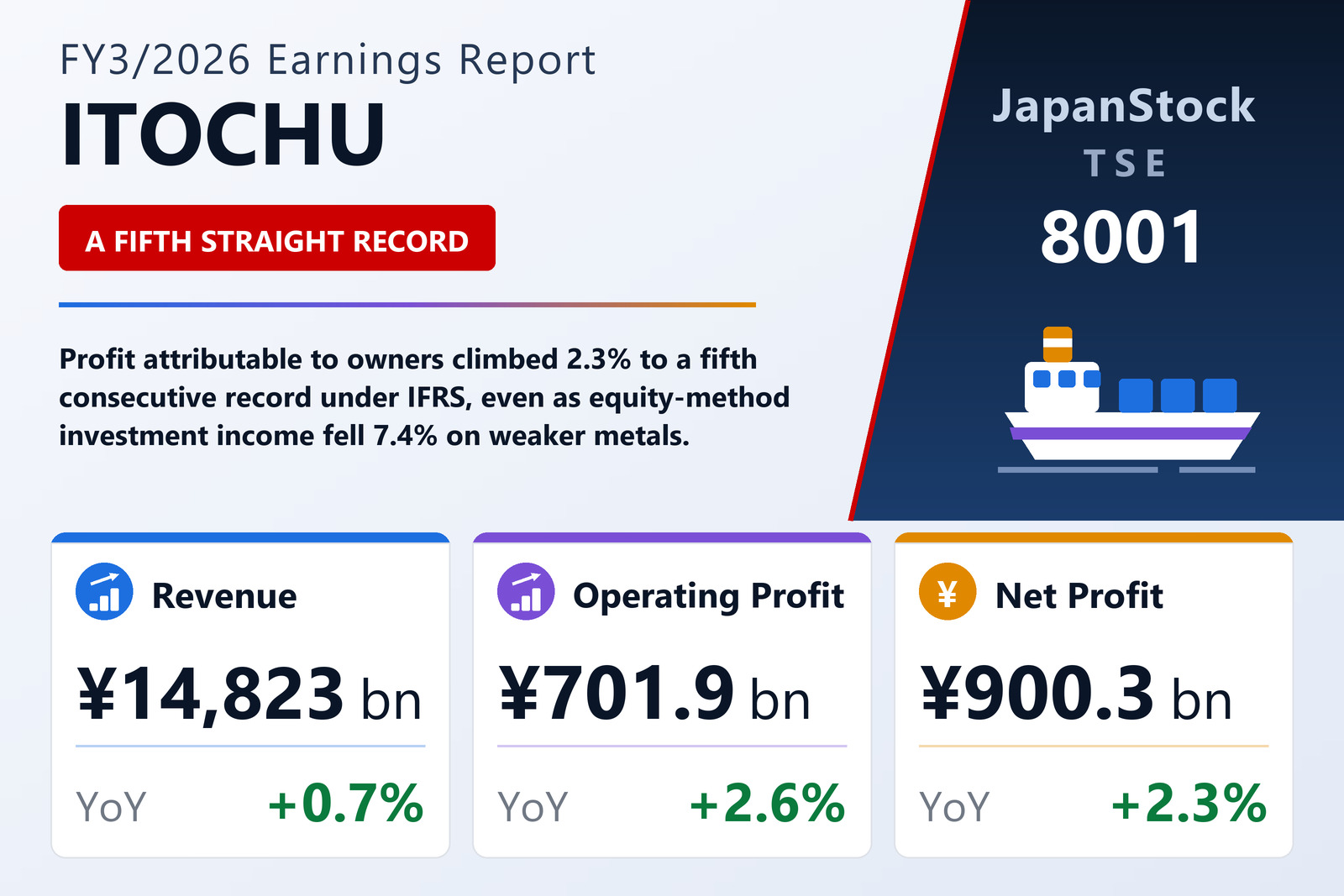
ITOCHU Corporation (TSE: 8001), one of Japan's "Big Five" general trading houses (sogo shosha) and a long-standing Berkshire Hathaway portfolio holding, released its FY3/2026 consolidated short report (Kessan Tanshin) under IFRS on May 1, 2026. For the year, revenue rose 0.7% year-on-year to ¥14,823.1 billion, operating profit rose 2.6% to ¥701.9 billion, profit before tax increased 3.8% to ¥1,199.5 billion, and — most importantly — profit attributable to owners of the parent climbed 2.3% to a record ¥900.3 billion (vs. ¥880.3 billion). Basic EPS on the post-split share count was ¥128.00, up from a restated ¥123.13. Comprehensive income attributable to owners surged 76.0% to ¥1,301.9 billion as the JPY-denominated value of overseas investments rebounded. ROE eased to 14.6% from 15.7% as the equity base expanded faster than profit, and the equity ratio improved to 39.4% from 38.0%.
Why Itochu kept growing while resource peers softened
Among Japan's five sogo shosha, Itochu is structurally the least dependent on upstream metals and energy and the most consumer- and food-facing. The franchise is anchored by the FamilyMart convenience-store chain (a majority subsidiary, ~16,000 stores in Japan), the Dole packaged-fresh business in Asia, the global Master Lock security-products platform, the textile materials and apparel value chain, and a deep machinery and industrial-finance book. That mix delivered operating profit growth of 2.6% in a year when iron ore, coking coal and LNG prices weakened — a notable divergence from rivals more levered to resource cycles. Foreign-exchange and a continued shift of profit recognition from equity-method affiliates to consolidated subsidiaries (e.g., FamilyMart and Hitachi Construction Machinery) supported the operating line.
1-for-5 stock split: mechanics and EPS restatement
Effective January 1, 2026, Itochu executed a 1-for-5 common-share split to broaden retail investor access and improve liquidity. Issued shares moved to 7,924 million on a post-split basis. The reported EPS of ¥128.00 is on the new (post-split) share count, and the prior-year comparable of ¥123.13 has been restated on the same basis (the unsplit-equivalent figure would have been roughly ¥640 and ¥616, respectively). The annual dividend is similarly disclosed on both bases: ¥42.00 per (post-split) share for FY26 — comprising a pre-split ¥100 interim plus a post-split ¥22 year-end (equivalent to ¥210 on an old-share basis) — versus ¥200.00 (old-share) in FY3/2025. The consolidated dividend payout ratio was 32.8%. The board has guided FY3/2027 to ¥44.00 per share (¥22.00 interim + ¥22.00 year-end), a further increase that maintains the company's progressive-dividend posture even as the absolute payout settles into the post-split convention.
Equity-method income mix: Dole, CITIC, food and consumer dominate
Equity-method investment income totaled ¥323.5 billion, down 7.4% from ¥349.3 billion, principally on softer contributions from the metals and energy affiliates. The portfolio retains an unusually consumer-tilted profile: the Dole International Holdings tropical-fruit platform, the CITIC Limited cross-shareholding in China (a structural strategic asset), the Itochu Energy Trading vehicles, joint ventures in apparel and lifestyle, and equity participations across food distribution and infrastructure. With the China consumer cycle still subdued and metals prices in retreat for much of the year, the equity-method line slipped — but the consolidated subsidiary book (where FamilyMart sits) more than absorbed the gap, allowing both operating profit and bottom-line profit to print new highs.
Capital allocation: buyback of 101.4 million post-split shares
Itochu remained one of the most aggressive Japanese large-caps on share repurchases. During FY3/2026, the company repurchased 101,362,300 shares on a post-split basis (equivalent to 20,272,460 shares on the pre-split count), lifting treasury stock to 934.5 million shares from a pre-split-equivalent 835.5 million. Operating cash flow reached ¥1,131.8 billion (vs. ¥997.3 billion), funding ¥388.9 billion of investing outflows (capex plus net new investment) and ¥726.5 billion of financing outflows (dividends, treasury buyback, debt service). Cash and equivalents ended at ¥593.8 billion versus ¥549.6 billion. Total assets reached ¥16,732.8 billion, with equity attributable to owners of ¥6,590.0 billion. Berkshire Hathaway, which has built and added to its position in the Big Five trading houses since 2020, remains a major holder.
Standalone view and FY27 guidance
On a non-consolidated (parent-only) basis, individual revenue was ¥4,487.7 billion (-1.2%) and individual net profit was ¥644.6 billion (+44.6%) — the parent-only profit jump reflects intra-group dividend timing rather than operating momentum at the trading-company entity itself. For FY3/2027, management guides profit attributable to owners of ¥950.0 billion (+5.5%) on basic EPS of ¥136.75, alongside the indicated annual dividend of ¥44.00. The guide implies continued mid-single-digit earnings expansion led by consumer, food and machinery, with metals and energy contributions normalizing rather than rebounding. CEO Keita Ishii has been consistent in framing Itochu as a "non-resource" sogo shosha that earns through downstream, brand and consumer assets — a positioning the FY26 result reinforces.
| Metric | FY3/2026 | FY3/2025 | YoY |
|---|---|---|---|
| Revenue (¥ billion) | 14,823.1 | 14,724.2 | +0.7% |
| Operating profit (¥ billion) | 701.9 | 683.9 | +2.6% |
| Profit before tax (¥ billion) | 1,199.5 | 1,155.1 | +3.8% |
| Net profit attrib. to owners (¥ billion) | 900.3 | 880.3 | +2.3% |
| Basic EPS, post-split (¥) | 128.00 | 123.13 | +4.0% |
| ROE | 14.6% | 15.7% | −1.1pp |
| Equity ratio | 39.4% | 38.0% | +1.4pp |
| Annual dividend, post-split (¥) | 42.00 | 40.00 | +5.0% |
JapanStockPulse provides informational content only and does not constitute investment advice. Figures are taken from the company's published earnings short report and may be subject to subsequent revision.