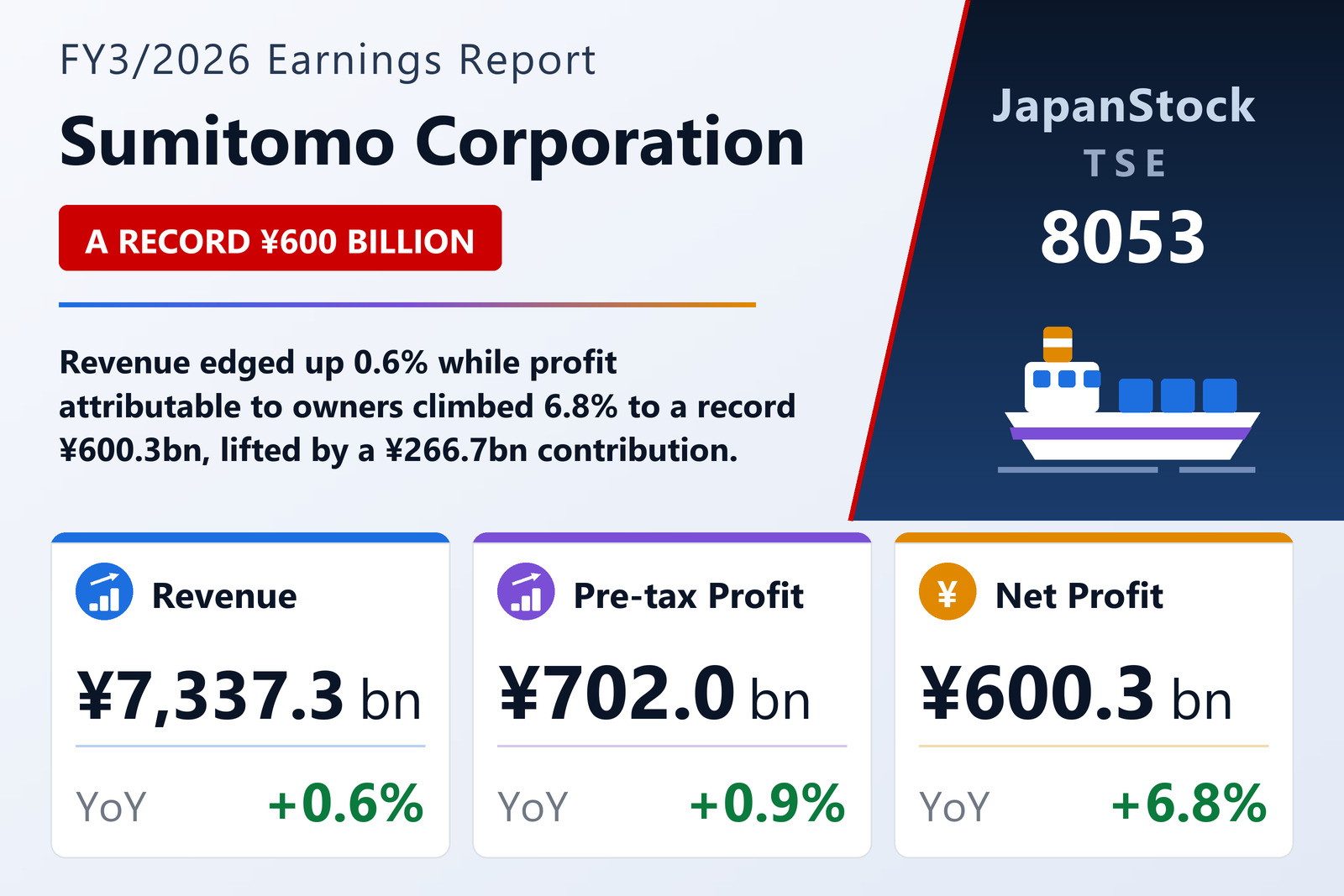
Sumitomo Corporation (TSE: 8053), one of Japan's five major sogo shosha (general trading houses) and a group with roots in the centuries-old Sumitomo zaibatsu, released its FY3/2026 consolidated earnings short report (Kessan Tanshin) under IFRS on May 1, 2026. The company posted a record net profit even as the top line barely moved — a profile that increasingly defines the modern trading house, where equity-accounted affiliates and asset recycling, not trading volume, drive the bottom line. Revenue rose 0.6% year-on-year to ¥7,337.3 billion (from ¥7,292.1 billion), pre-tax profit rose 0.9% to ¥702.0 billion, and profit for the year rose 6.8% to ¥650.3 billion. Profit attributable to owners of the parent — the headline figure — rose 6.8% to a record ¥600.3 billion (from ¥561.9 billion), with basic EPS of ¥499.09 versus ¥463.66 a year earlier.
Record net profit on flat revenue
The defining feature of Sumitomo's FY3/2026 was the divergence between a virtually flat top line and a record bottom line. Revenue growth of just 0.6% reflected the muted commodity-price environment and disciplined trading volumes, yet profit attributable to owners advanced 6.8% to ¥600.3 billion — comfortably the highest in the company's history. The gain was carried by the quality of earnings rather than their volume: stronger contributions from equity-accounted investees, a favourable mix of asset-recycling gains, and one-off items more than offset the lack of revenue momentum. Pre-tax profit of ¥702.0 billion was up 0.9%, while the wider gap between pre-tax and attributable profit growth reflects a lower effective tax burden and the contribution of associates booked below the trading line.
Equity-method earnings and comprehensive income +120%
Equity-method investment income — the structural engine of every Japanese trading house — contributed ¥266.7 billion, underscoring how much of Sumitomo's profit now flows from minority and joint-venture stakes in resources, infrastructure, leasing and overseas distribution platforms rather than from in-house trading margins. The most striking line, however, sat below net profit: total comprehensive income for the year surged 119.6% to ¥1,029.6 billion, more than double the prior year. The driver was a swing in other comprehensive income — chiefly the foreign-currency translation adjustment as a weaker yen magnified the yen value of overseas net assets, alongside fair-value remeasurement gains on the company's securities portfolio. That ¥1.03 trillion of comprehensive income flowed straight into equity, strengthening the balance sheet well beyond what the headline ¥600 billion of net profit alone would suggest.
Diversified segment base
Sumitomo's earnings rest on a deliberately broad spread of business units, which cushions the group against any single commodity or end-market cycle. The Metal Products business spans steel, tubular goods and non-ferrous trading; Transportation & Construction Systems covers ships, aircraft, automotive value chains, construction and mining equipment, and leasing; Infrastructure houses power generation, transmission and logistics; Media & Digital centres on Sumitomo's domestic cable-TV and telecom interests (notably its Jupiter Telecommunications and J:COM-linked assets); Living Related & Real Estate spans retail, food distribution, materials and property; and Mineral Resources, Energy & Chemicals captures the group's upstream copper, coal and energy interests. In FY3/2026 the balanced portfolio allowed strong equity-method earnings and asset-recycling gains in the non-resource segments to offset the flat commodity backdrop, producing the record result without reliance on any single windfall.
1-for-4 stock split, balance sheet and ¥813bn operating cash flow
On the same day as the results, the board approved a 1-for-4 stock split with an effective date of July 1, 2026, intended to improve the accessibility of the shares to individual investors by lowering the per-unit investment outlay. (All per-share figures cited above are stated on a pre-split basis.) The balance sheet ended the year solid: total assets stood at ¥13,638.3 billion, equity attributable to owners reached ¥4,628.6 billion, and the owners' equity ratio was 33.9%. Cash generation was a standout — operating cash flow jumped to ¥813.5 billion from ¥612.3 billion the prior year, giving the group ample firepower to fund both the higher dividend and continued investment across its business pillars.
Dividend lifted to ¥150; FY27 ¥40 equals ¥160 pre-split
Reflecting the record result, Sumitomo raised its FY3/2026 annual dividend to ¥150 per share (¥70 interim + ¥80 year-end, up from ¥130), for a consolidated payout ratio of 30.1%. For FY3/2027 the company forecasts a dividend of ¥40 per share (¥20 interim + ¥20 year-end) — but that figure is stated on the post-split basis that takes effect July 1, 2026. Multiplied by the four-to-one split, ¥40 post-split is equivalent to ¥160 per (pre-split) share, a further increase from the ¥150 paid in FY26. In other words, despite the headline-grabbing drop from ¥150 to ¥40, shareholders are being guided to a higher, not lower, cash return once the split mechanics are unwound.
| Metric | FY3/2026 | FY3/2025 | YoY |
|---|---|---|---|
| Revenue (¥ billion) | 7,337.3 | 7,292.1 | +0.6% |
| Pre-tax profit (¥ billion) | 702.0 | 695.7 | +0.9% |
| Profit for the year (¥ billion) | 650.3 | 608.9 | +6.8% |
| Net profit attrib. to owners (¥ billion) | 600.3 | 561.9 | +6.8% |
| Basic EPS (¥, pre-split) | 499.09 | 463.66 | +7.6% |
| Equity-method investment income (¥ billion) | 266.7 | — | — |
| Comprehensive income (¥ billion) | 1,029.6 | 468.9 | +119.6% |
| Operating cash flow (¥ billion) | 813.5 | 612.3 | +32.9% |
| Owners' equity ratio | 33.9% | — | — |
| Annual dividend (¥, pre-split) | 150.00 | 130.00 | +15.4% |
JapanStockPulse provides informational content only and does not constitute investment advice. Figures are taken from the company's published earnings short report and may be subject to subsequent revision.