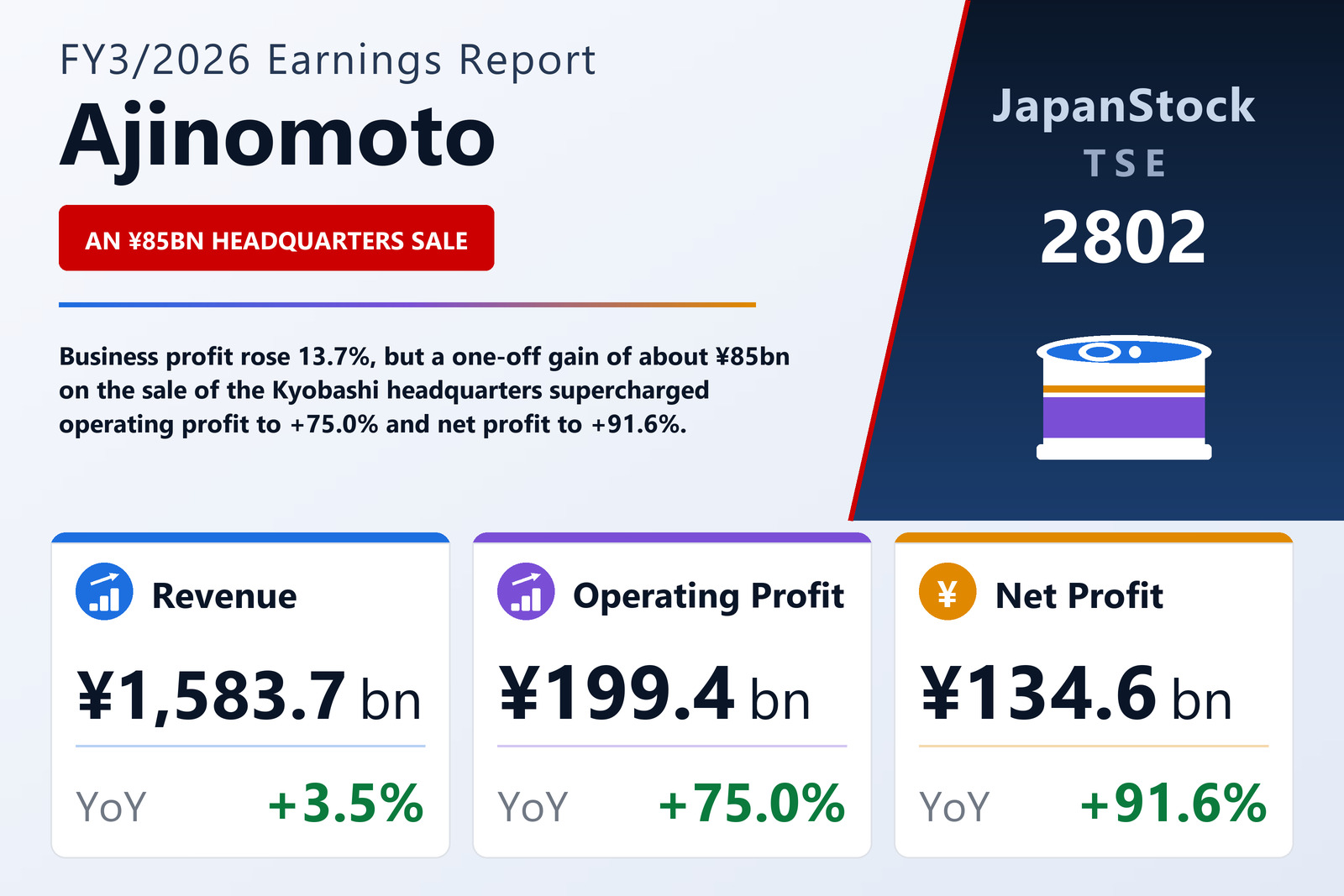
Ajinomoto Co., Inc. (TSE: 2802), the Tokyo-based global amino-acid, seasonings and frozen-foods conglomerate that pioneered MSG more than a century ago, reported FY3/2026 consolidated IFRS results that mixed solid underlying growth with an outsized one-off real-estate gain. Revenue rose 3.5% to ¥1,583.7 billion, business profit — Ajinomoto's preferred non-GAAP earnings measure that excludes "other operating income and expenses" — climbed 13.7% to ¥181.2 billion, operating profit jumped 75.0% to ¥199.4 billion, and profit attributable to owners of the parent surged 91.6% to ¥134.6 billion. Basic EPS came in at ¥138.36 (vs ¥69.77 after the April 2025 1-for-2 stock split), and ROE attributable to owners climbed to 17.7% from 9.0%.
Headquarters sale: ¥85 billion in one line
The single biggest swing factor at the operating-profit line was the disposal of part of Ajinomoto's owned headquarters real estate — the Kyobashi (central Tokyo) land and building that the group had occupied for decades. The fixed-asset disposal gain, embedded in "other operating income," accounts for the bulk of the ¥85.4 billion year-on-year increase in operating profit (which rose from ¥114.0 billion to ¥199.4 billion). At the standalone-parent level, the same transaction lifted parent ordinary profit to ¥121.2 billion and parent net profit to ¥142.8 billion (+58.5%). Management has been clear that the gain is non-recurring; the FY3/2027 net-profit guide of ¥120.0 billion (−10.9%) explicitly reflects the absence of this item, even as underlying business profit is guided to grow another 8.7% to ¥197.0 billion.
Healthcare segment leads: AA for AI substrates and biopharma
By segment, the standout was Healthcare and Others, which posted revenue of ¥341.5 billion (+4.0%) and business profit of ¥66.2 billion — up ¥20.5 billion or +45.1%. The growth came from two structurally important sub-businesses: electronic-grade amino acids, where Ajinomoto's Build-up Film (ABF) substrate insulator is a near-monopoly input for high-end AI server CPUs and accelerator packaging; and pharmaceutical amino acids used in biologics manufacturing and parenteral nutrition. Both ride directly on the AI-infrastructure capex cycle and global biopharma expansion. Seasonings and Foods, the bedrock segment, posted revenue of ¥936.9 billion (+4.6%) and business profit of ¥143.0 billion (+6.6%, +¥8.9 billion) on steady volume growth in emerging-market staples and price pass-through in developed markets.
Frozen Foods was the laggard: revenue of ¥290.3 billion was flat (+0.3%) but business profit fell 35.0% to ¥8.4 billion (a ¥4.5 billion decline), reflecting tougher conditions for the group's North American gyoza and Asian-cuisine prepared-food portfolio (the Ling-Ling and Tai Pei brands) amid private-label competition and elevated input costs. The "Other" segment was modest at ¥14.9 billion revenue (−10.6%) and ¥6.0 billion business profit.
Balance sheet, cash flow and dividend
Total assets rose to ¥1,812.3 billion from ¥1,721.1 billion, and equity attributable to owners climbed to ¥770.8 billion. The owners' equity ratio slipped slightly to 42.5% from 43.4% as the group accelerated capital returns. Operating cash flow expanded to ¥239.4 billion (up from ¥209.9 billion), funded a higher investing outflow of ¥84.2 billion and a substantially larger financing outflow of ¥225.6 billion (vs ¥137.7 billion prior) on debt repayment plus share buyback. Issued shares fell to 977.7 million from 1,005.6 million on cancellation of ~28 million treasury shares.
The annual dividend was set at ¥48 per share (post-split) — ¥24 interim + ¥24 year-end — equivalent to ¥96 pre-split, up 20% from the prior year's ¥80 pre-split-equivalent payout. The payout ratio compressed to 34.7% from 57.3% on the much higher earnings base. FY3/2027 guidance is for a further dividend increase to ¥50 per share (post-split), implying a 39.6% payout on the guided ¥120 billion net profit.
FY27 outlook: underlying growth continues, one-off fades
For FY3/2027, management guides revenue of ¥1,723.0 billion (+8.8%), business profit of ¥197.0 billion (+8.7%), and profit attributable to owners of the parent of ¥120.0 billion (−10.9%). Basic EPS is guided at ¥126.16. The optical net-profit decline reflects entirely the non-recurrence of the FY26 HQ-sale gain — underlying business momentum is constructive, with management implicitly guiding for continued mid-to-high-single-digit business profit growth and a healthcare-segment expansion. The fiscal-year report carries no going-concern issues or material subsequent events, and the consolidated scope was unchanged year-on-year.
| Metric | FY3/2026 | FY3/2025 | YoY |
|---|---|---|---|
| Revenue (¥ billion) | 1,583.7 | 1,530.6 | +3.5% |
| Business profit (¥ billion) | 181.2 | 159.3 | +13.7% |
| Operating profit (¥ billion) | 199.4 | 114.0 | +75.0% |
| Profit before tax (¥ billion) | 196.1 | 108.3 | +81.0% |
| Profit attrib. to owners (¥ billion) | 134.6 | 70.3 | +91.6% |
| Basic EPS (¥, post-split) | 138.36 | 69.77 | +98.3% |
| Business profit margin | 11.4% | 10.4% | +1.0pp |
| ROE (owners) | 17.7% | 9.0% | +8.7pp |
| Equity ratio (owners) | 42.5% | 43.4% | −0.9pp |
| Annual dividend (¥, post-split) | 48.00 | 40.00 | +20.0% |
JapanStockPulse provides informational content only and does not constitute investment advice. Figures are taken from the company's published earnings short report and may be subject to subsequent revision.