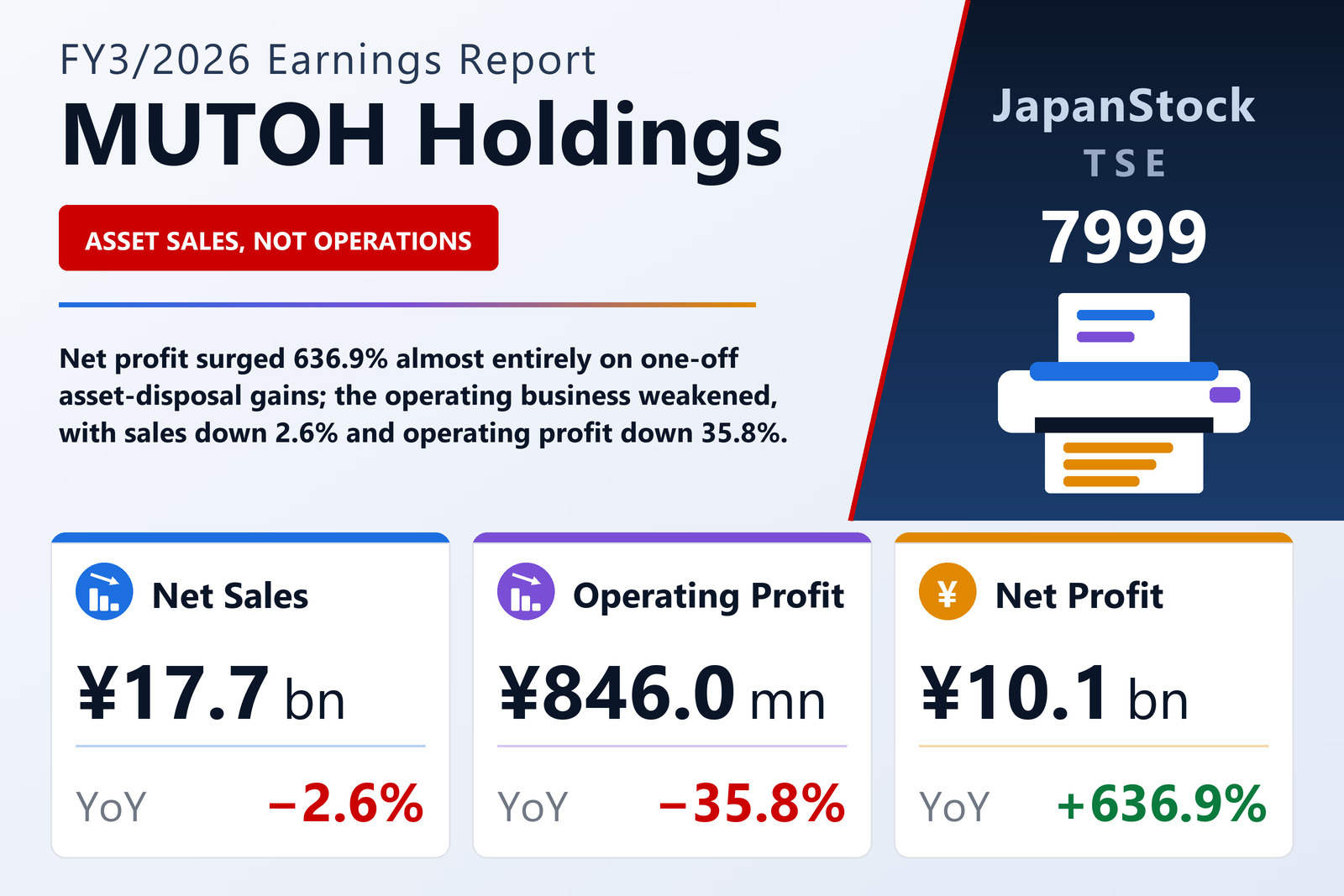
MUTOH Holdings Co., Ltd. (TSE: 7999), a Tokyo-based precision-instruments and imaging group best known for its wide-format inkjet printers and cutting plotters used in signage, apparel and textile printing, and industrial applications — and with deep roots in CAD/drafting equipment and measurement products — released its FY3/2026 consolidated earnings short report (Kessan Tanshin) under Japanese GAAP on May 7, 2026. The headline reported net profit attributable to owners of the parent leapt 636.9% year-on-year to ¥10,121 million (from ¥1,373 million), but the figure flatters a core business that contracted materially during the year and was, by period-end, in the process of changing hands.
Operating earnings fall sharply while net profit surges on one-offs
The contrast between MUTOH's operating performance and its reported bottom line could hardly be starker. Net sales slipped 2.6% to ¥17,652 million (from ¥18,128 million) on soft demand across the printer and instrument lines. Operating profit — the truest gauge of the underlying business — fell 35.8% to ¥846 million (from ¥1,317 million), and ordinary profit dropped an even steeper 44.4% to ¥708 million (from ¥1,273 million). Yet net profit attributable to owners exploded to ¥10,121 million, with basic EPS of ¥2,207.20 versus ¥300.27 a year earlier. The gap is explained almost entirely by large non-operating and extraordinary gains — chiefly the disposal of assets and securities — rather than by any improvement in trading. Investors should read the ¥10.1 billion as a balance-sheet event, not an earnings-power event: the operating engine actually shrank by more than a third.
Brother Industries' tender offer succeeds — parent-company change and likely delisting
The most consequential development of the period was corporate, not operational. Brother Industries (TSE: 6448), the Nagoya-based printing, sewing-machine and machine-tool maker, completed a tender offer (TOB) for MUTOH Holdings shares during the fiscal year. The tender offer succeeded, changing MUTOH's parent company and principal shareholder and bringing the wide-format printer specialist into the Brother group. The combination is strategically logical — both companies build inkjet and industrial printing hardware, and MUTOH's wide-format and textile portfolio is complementary to Brother's garment-printing and office-printing franchises. For MUTOH shareholders, however, the practical consequence of a successful tender offer is the loss of independent listed status: a delisting is the likely outcome, and the company has accordingly withheld FY3/2027 guidance.
Wide-format printers and precision instruments: the core business
MUTOH's commercial identity is built on wide-format inkjet printers and plotters — eco-solvent, UV, sublimation and direct-to-textile machines aimed at the signage, display, apparel, packaging and industrial-graphics markets — alongside a heritage line of CAD and drafting equipment and a portfolio of measurement and precision instruments. The group also owns and leases real estate, including its head-office building and other commercial and facility properties, which forms part of the asset base relevant to the disposal gains recorded this year. The 2.6% top-line decline reflects a softer hardware demand environment across the printer market, and the 36% operating-profit fall shows how operating deleverage bites a small-cap manufacturer when sales soften; the structural printing-industry consolidation that the Brother deal represents is in part a response to that pressure.
Fortress balance sheet and a ¥16.4bn investing inflow from disposals
MUTOH ended FY3/2026 with a notably strong balance sheet. Total assets stood at ¥42,173 million and net assets at ¥33,429 million, for an equity ratio of 79.3% — an unusually high, almost debt-light capital structure that made the company a clean acquisition target. The clearest fingerprint of the one-off gains sits in the cash-flow statement: investing activities generated a +¥16,385 million inflow for the year, reflecting the disposal of assets and securities. That inflow, rather than operating cash generation, is the mechanical source of the ¥10.1 billion reported profit, and it underscores why the headline figure should not be extrapolated as recurring earnings power.
Year-end dividend cancelled; FY27 guidance undisclosed
Reflecting the change of control, MUTOH cancelled its FY3/2026 year-end dividend. Only the ¥38 interim dividend was paid for the year, against ¥120 per share in FY3/2025 — and that prior-year figure itself included a ¥43 special dividend on top of a ¥77 ordinary payout. With the tender offer successful and the parent company changed, MUTOH has provided no FY3/2027 forecast, consistent with a company expected to be delisted and run as a Brother subsidiary rather than as an independently traded entity. For the public-market investor, the FY3/2026 report effectively closes the book on MUTOH as a standalone listed name: strong assets, a weakening core business, a windfall reported profit from disposals, and a takeover that ends the company's run on the Tokyo Stock Exchange.
| Metric | FY3/2026 | FY3/2025 | YoY |
|---|---|---|---|
| Net sales (¥ million) | 17,652 | 18,128 | −2.6% |
| Operating profit (¥ million) | 846 | 1,317 | −35.8% |
| Ordinary profit (¥ million) | 708 | 1,273 | −44.4% |
| Net profit attrib. to owners (¥ million) | 10,121 | 1,373 | +636.9% |
| Basic EPS (¥) | 2,207.20 | 300.27 | +635.1% |
| Equity ratio | 79.3% | — | — |
JapanStockPulse provides informational content only and does not constitute investment advice. Figures are taken from the company's published earnings short report and may be subject to subsequent revision.