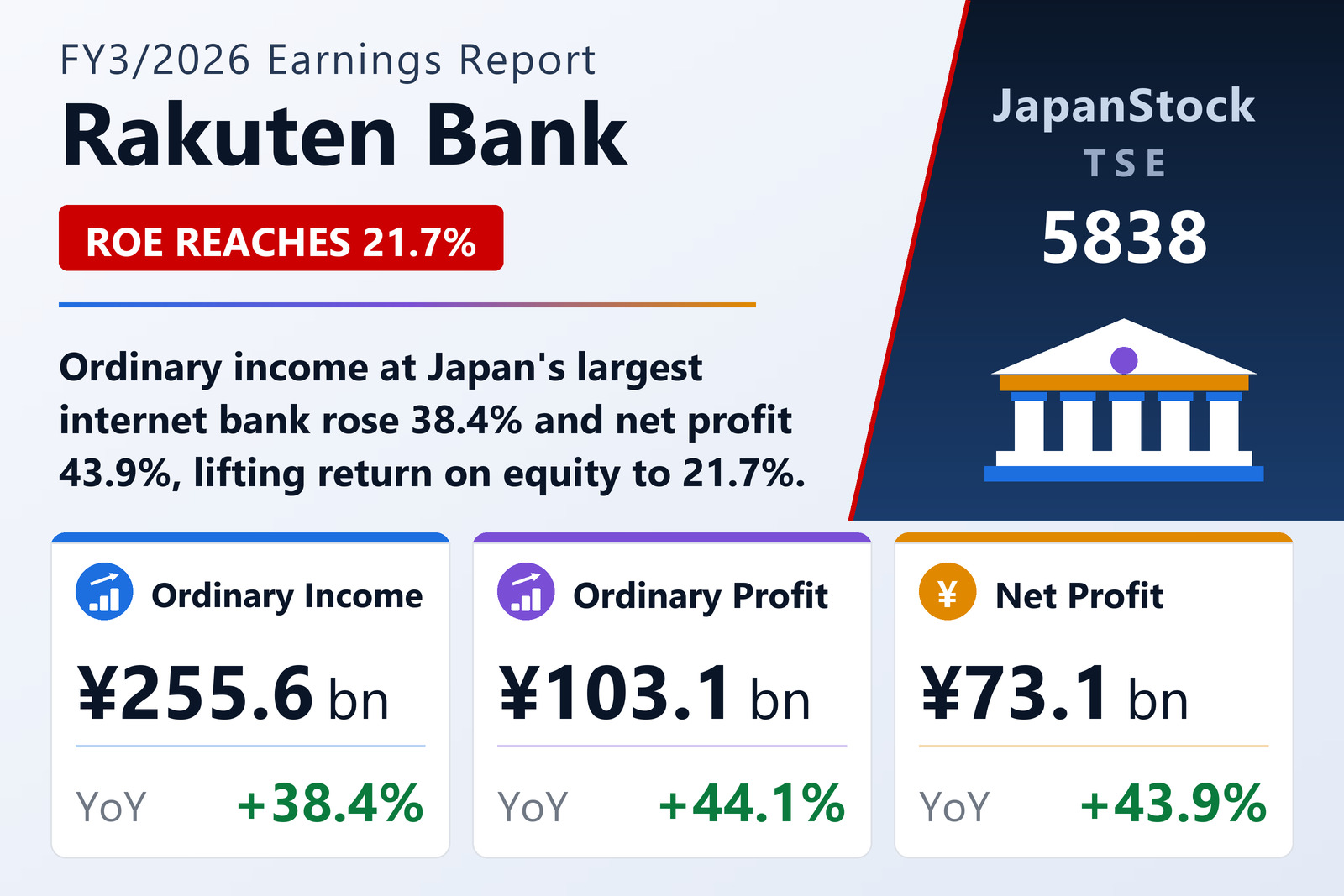
Rakuten Bank, Ltd. (TSE: 5838) — Japan's largest internet bank by number of accounts and part of the Rakuten group — reported consolidated full-year results for the fiscal year ended March 31, 2026 (FY3/2026) under Japanese GAAP. Ordinary income (operating revenue) rose 38.4% year-on-year to ¥255,579 million from ¥184,534 million, while ordinary profit climbed 44.1% to ¥103,091 million from ¥71,524 million. Net profit attributable to owners of the parent advanced 43.9% to ¥73,072 million from ¥50,779 million, and basic EPS reached ¥418.76 versus ¥291.03. Comprehensive income surged 78.7% to ¥70,015 million.
Profitability accelerates as scale builds
The headline measure of capital efficiency improved markedly: return on equity rose to 21.7% from 18.0% the prior year, a 3.7-percentage-point gain that underscores how the bank is converting its expanding account base into earnings. The pace of top-line growth — nearly 40% — outstripped the rise in costs, allowing both ordinary profit and net profit to grow faster than revenue. For an institution that has positioned itself as a digital-first challenger to Japan's incumbent megabanks, the FY3/2026 result extends a multi-year record of compounding scale.
A bank that pays no dividend — by design
Rakuten Bank declared no dividend for FY3/2026, holding the annual payout at ¥0.00, and forecasts the same ¥0.00 for FY3/2027. The policy is deliberate: rather than distribute cash, the bank reinvests its earnings into account acquisition, product expansion, and the technology platform that underpins its growth. With ROE already above 20%, management's implicit argument is that retained capital compounds more value inside the business than it would in shareholders' hands today.
Balance sheet swells past ¥16.5 trillion
Total assets reached ¥16,592,139 million — roughly ¥16.59 trillion — while net assets stood at ¥389,529 million and book value per share rose to ¥2,127.93. The reported equity ratio of 2.2% looks thin against an industrial company, but a low equity ratio is normal for a bank, whose assets consist overwhelmingly of loans and securities funded by customer deposits. The figure reflects the structure of a deposit-taking institution rather than any balance-sheet weakness.
Strong operating cash generation
Cash flow from operating activities was a robust +¥354,295 million, while investing activities used ¥457,557 million as the bank deployed funds into securities and lending, and financing activities were roughly neutral. Period-end cash and cash equivalents stood at ¥4,139,552 million. The shape of the cash-flow statement — heavy operating inflows redirected into investing outflows — is consistent with a bank channelling deposit growth into earning assets.
FY27 guidance: another double-digit advance
For the fiscal year ending March 31, 2027, management guides ordinary income of ¥314,669 million (+23.1%), ordinary profit of ¥115,622 million (+12.1%), and net profit attributable to owners of ¥81,325 million (+11.2%), with EPS of ¥466.04. The forecast keeps the dividend at zero and points to continued top-line momentum outpacing profit growth as the bank keeps investing for scale. With 174,499,180 shares outstanding, the guidance implies a further step-up in absolute earnings on top of the FY3/2026 record.
| Metric | FY3/2026 | FY3/2025 | YoY |
|---|---|---|---|
| Ordinary income (¥M) | 255,579 | 184,534 | +38.4% |
| Ordinary profit (¥M) | 103,091 | 71,524 | +44.1% |
| Net profit attrib. (¥M) | 73,072 | 50,779 | +43.9% |
| EPS (¥) | 418.76 | 291.03 | +43.9% |
| ROE | 21.7% | 18.0% | +3.7pp |
| Annual dividend (¥) | 0.00 | 0.00 | — |
| FY27 net profit guidance (¥M) | 81,325 | — | +11.2% |
JapanStockPulse provides informational content only and does not constitute investment advice. Figures are taken from the company's published earnings short report and may be subject to subsequent revision.