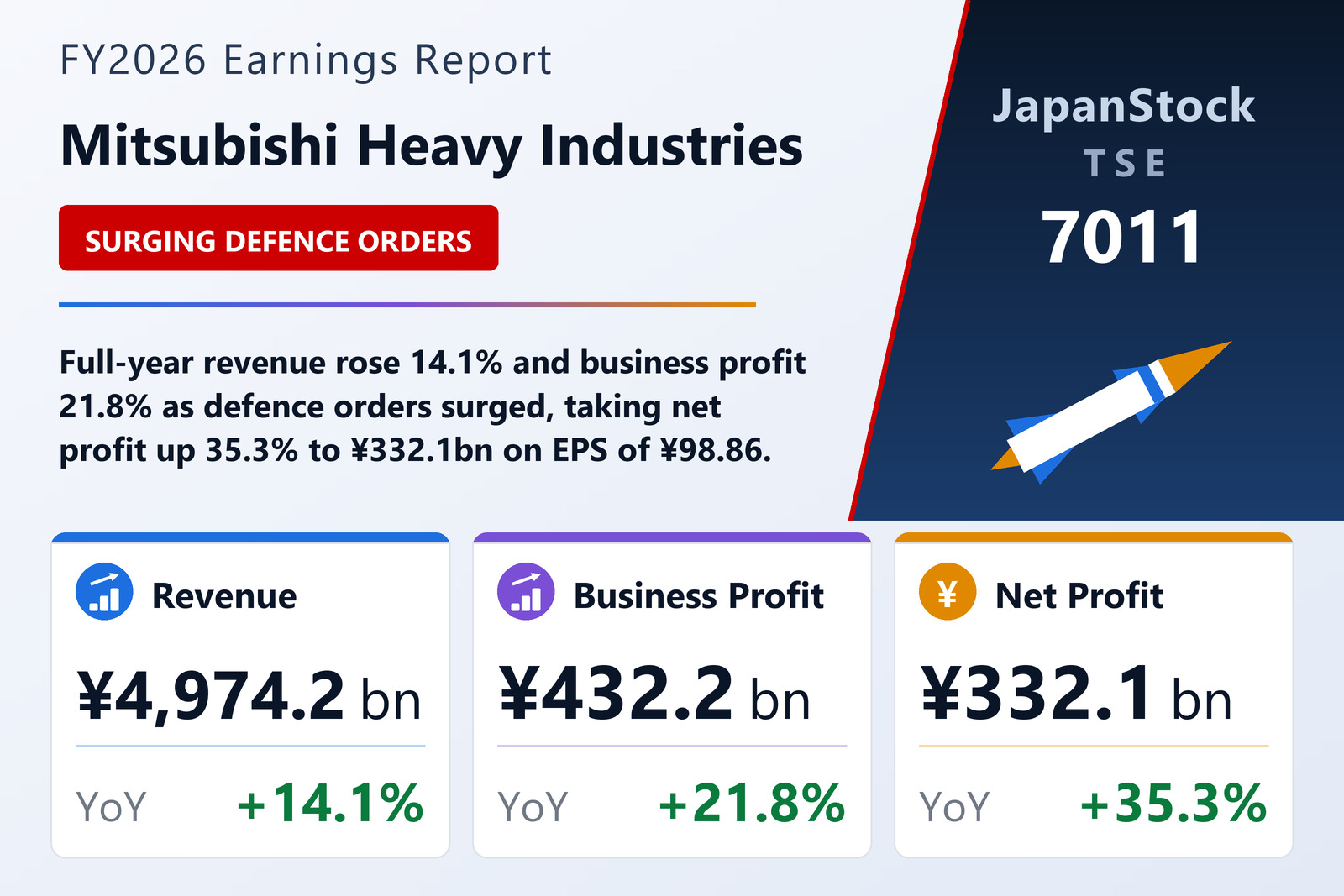
Mitsubishi Heavy Industries, Ltd. (TSE: 7011), Japan's largest integrated industrial conglomerate spanning defense systems, gas turbines, aerospace, shipbuilding, and environmental machinery, reported its full-year results for the fiscal year ended March 31, 2026 on May 12, 2026. Consolidated revenue (continuing operations, IFRS) rose 14.1% year-on-year to ¥4,974,168 million — crossing the ¥4.9 trillion threshold for the first time. Business profit advanced 21.8% to ¥432,218 million, pre-tax profit climbed 34.8% to ¥474,694 million, and net profit attributable to owners of the parent surged 35.3% to ¥332,129 million, up from ¥245,447 million a year earlier. Basic EPS rose to ¥98.86 from ¥73.04. The business profit margin widened to 8.7% from 8.1%, while the pre-tax return on revenue reached 9.5%, signalling broad-based operational leverage across the group's diverse industrial divisions.
The standout driver was a surge in defense-related orders tied to Japan's multi-year defense build-up, where MHI is the prime contractor for the F-X next-generation fighter, the Type-12 surface-to-ship missile upgrade program, and key naval platform upgrades. Simultaneously, global energy-transition investment continued to propel demand for MHI's gas turbine and combined-cycle power-plant offerings, including its flagship JAC-class and J-series turbines. The result was a business that, for the first time, crossed ¥4 trillion in orders on a rolling basis — a level that de-risks revenue visibility well into FY2028. Note: the figures above exclude discontinued operations (logistics subsidiary Mitsubishi Logisnext, now Logisnext Co., reclassified as discontinued in the current year); prior-year revenue and profit lines have been restated on the same basis.
Balance sheet strengthens as operating cash flow more than doubles
Total consolidated assets expanded sharply to ¥8,269,711 million at March 31, 2026, from ¥6,658,924 million a year earlier — a ¥1.61 trillion increase that reflects both organic growth and the consolidation of newly acquired or expanded entities. Equity attributable to owners of the parent reached ¥3,088,566 million, lifting the equity ratio to 37.3% from 35.2%, and book value per share to ¥919.16 from ¥698.91. The balance sheet strengthening was underpinned by record operating cash flow of ¥942,619 million — nearly double the ¥530,459 million generated in FY2025 — reflecting the acceleration of advance payments from government defense contracts and strong working-capital discipline. Free cash flow turned materially positive, with investing outflows of only ¥49,175 million, leaving cash and cash equivalents at a record ¥1,334,874 million at year-end.
Dividend raised to ¥29; record guidance set for FY2027
MHI raised its annual dividend to ¥29 per share for FY2026 (¥12 interim + ¥15 year-end), up from ¥23 the prior year, representing a payout ratio of 25.3% of consolidated net profit. For the coming fiscal year (FY2027, Apr 2026–Mar 2027), management issued guidance calling for revenue of ¥5,400,000 million (+8.6%), business profit of ¥540,000 million (+24.9%), pre-tax profit of ¥530,000 million (+11.7%), and net profit attributable to owners of ¥380,000 million (+14.4%), with EPS guided to ¥113.09. The FY2027 dividend is forecast at ¥29 per share (¥14 interim + ¥15 year-end), implying a similar payout ratio of approximately 25.6%. The guidance signals management's confidence that the twin tailwinds of defense spending and power-sector investment will continue to compound MHI's earnings growth into the next fiscal year.
Defense and power systems remain structural growth engines
MHI's business is organised across four principal segments: Energy Systems (gas turbines, boilers, compressors, nuclear-related equipment), Logistics, Thermal & Drive Systems (turbochargers, air-conditioning, fork-lift trucks — with Logisnext reclassified as discontinued), Defense & Space (fighter jets, missiles, naval vessels, satellites), and Commercial Aviation & Transportation Systems (Mitsubishi SpaceJet program wind-down, ATR regional aircraft support). Of these, Defense & Space has become the company's fastest-growing revenue pool, with Japan's government targeting defence expenditure of roughly 2% of GDP by FY2027 — up from below 1% historically — creating a structural multi-year demand runway. Energy Systems is the second engine: MHI's hydrogen-capable H-25 and JAC turbines are positioned at the intersection of the energy transition and base-load reliability, attracting orders from utilities in Asia, the Middle East, and Europe. Together, these two segments account for the majority of MHI's backlog expansion, and their long-cycle nature gives the revenue guidance for FY2027 and beyond a relatively high degree of visibility compared to more cyclical heavy-industry peers.
| Metric | FY2026 | FY2025 | YoY |
|---|---|---|---|
| Revenue (¥ million) | 4,974,168 | 4,361,127 | +14.1% |
| Business profit (¥ million) | 432,218 | 354,965 | +21.8% |
| Pre-tax profit (¥ million) | 474,694 | 352,073 | +34.8% |
| Net profit — total (¥ million) | 345,942 | 261,997 | +32.0% |
| Net profit attrib. to owners (¥ million) | 332,129 | 245,447 | +35.3% |
| EPS — basic (¥) | 98.86 | 73.04 | +35.4% |
| Business profit margin | 8.7% | 8.1% | +0.6pp |
| Equity ratio | 37.3% | 35.2% | +2.1pp |
| Total assets (¥ million) | 8,269,711 | 6,658,924 | +24.2% |
| Equity attrib. to owners (¥ million) | 3,088,566 | 2,346,702 | +31.6% |
| BPS (¥) | 919.16 | 698.91 | +31.5% |
| Operating cash flow (¥ million) | 942,619 | 530,459 | +77.7% |
| Cash & equivalents (¥ million) | 1,334,874 | 657,816 | +102.9% |
| Annual dividend (¥) | 29 | 23 | +26.1% |
| FY2027 guidance — revenue (¥ million) | 5,400,000 | — | +8.6% |
| FY2027 guidance — business profit (¥ million) | 540,000 | — | +24.9% |
| FY2027 guidance — net profit (¥ million) | 380,000 | — | +14.4% |
| FY2027 guidance — EPS (¥) | 113.09 | — | — |
JapanStockPulse provides informational content only and does not constitute investment advice. Figures are taken from the company's published earnings short report and may be subject to subsequent revision.