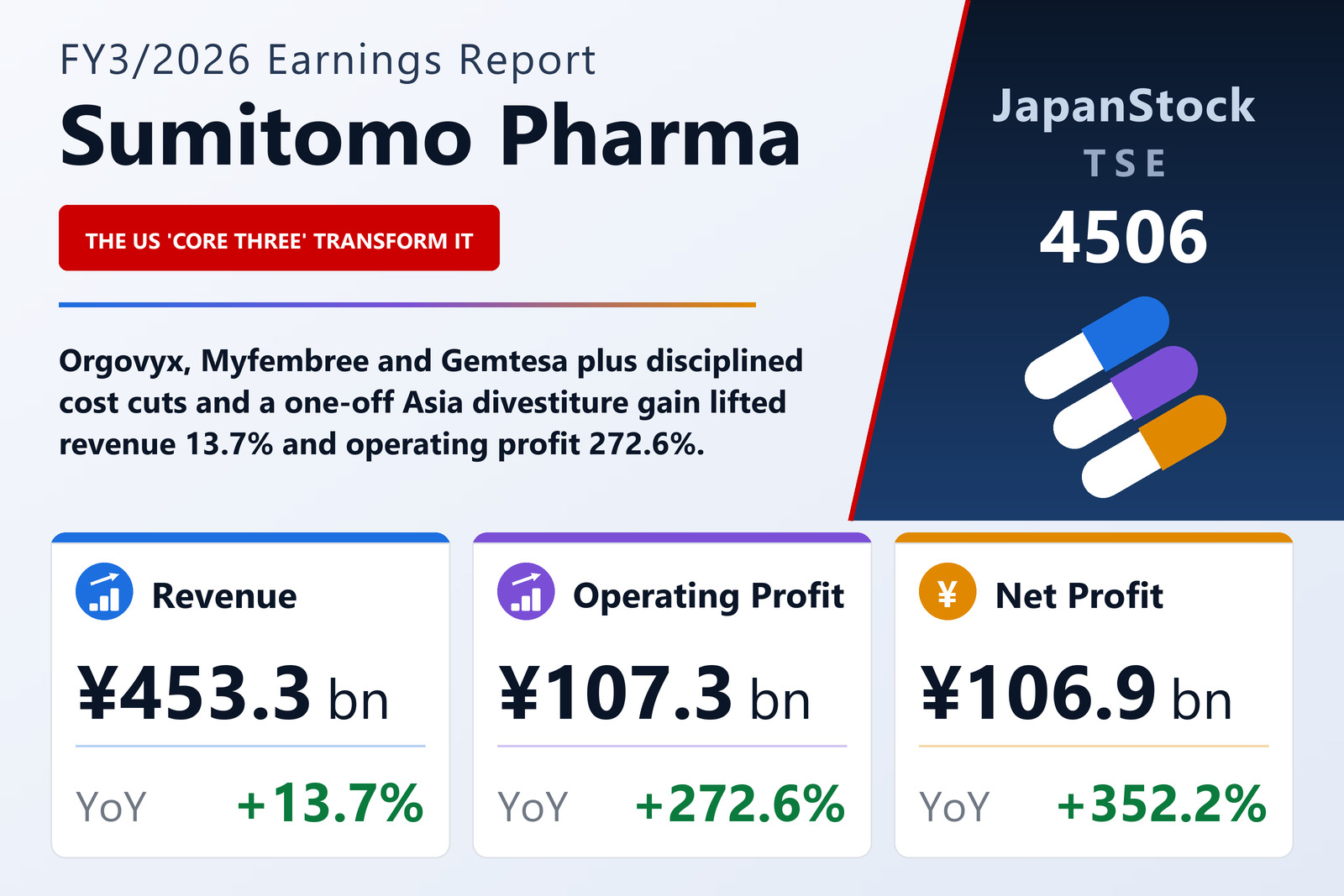
Sumitomo Pharma Co., Ltd. (TSE: 4506), the Osaka-based drugmaker within the Sumitomo Chemical group, reported consolidated full-year results for the fiscal year ended March 31, 2026 (FY3/2026) under IFRS — a dramatic recovery year that closes the chapter on the U.S. Latuda patent cliff that had pushed the company deep into the red. Revenue rose 13.7% to ¥453,294 million from ¥398,832 million, while core operating profit — the company's preferred performance measure, which strips out impairment, business-restructuring expenses and contingent-consideration fair-value swings — more than doubled to ¥105,908 million (+145.4%) from ¥43,153 million, lifting the core operating margin to 23.4%. Reported operating profit surged 272.6% to ¥107,338 million, pre-tax profit climbed to ¥100,344 million from ¥17,611 million, and net income attributable to owners jumped 352.2% to ¥106,865 million from ¥23,634 million. Basic EPS reached ¥268.99 versus ¥59.49, and ROE soared to 46.3% from 14.5%.
The U.S. "core three" carry the turnaround
The growth engine sits squarely in North America, where Sumitomo Pharma now controls the patents and substantially all assets of its three flagship products after buying them back from group subsidiaries in August 2025. Sales of prostate-cancer therapy Orgovyx (relugolix) and overactive-bladder treatment Gemtesa expanded strongly, and the company booked a sales milestone on Orgovyx, more than offsetting the loss of exclusivity on the older epilepsy drug Aptiom. The fibroid/endometriosis franchise Myfembree rounds out the "core three." Management said the U.S. core three now underpin group revenue, prompting the asset buy-back so Sumitomo Pharma directly runs the business rather than routing it through Switzerland- and Urovant-domiciled units.
Segments: North America up 34%, Asia restructured away
By reporting segment, North America revenue rose 34.2% to ¥337,923 million and core segment profit jumped 77.8% to ¥75,742 million, driven by Orgovyx and Gemtesa volume plus the Orgovyx milestone. Japan revenue eased 7.5% to ¥92,365 million as the loss of exclusive distribution on diabetes drugs Equa and Equmet outweighed gains from Twymeeg and the launch of long-acting antipsychotics Xeplion and Xeplion TRI; Japan core segment profit nonetheless rose 8.2% to ¥12,352 million on prior-year restructuring savings. Asia revenue fell 51.2% to ¥23,006 million and core segment profit dropped 60.5% to ¥9,452 million after the July 2025 sale of a stake in the China and Asia-Pacific business to Marubeni, which removed those units from consolidation. By geography, U.S. revenue alone reached ¥320,659 million (from ¥243,545 million prior year), while China shrank to ¥19,341 million.
Restructuring and divestiture gains amplify the profit swing
Beyond top-line growth, the profit jump was magnified by the company's "Reboot 2027" cost discipline and portfolio surgery. Selling, general and administrative and R&D expenses fell as the regenerative/cell-therapy business was reorganised; total R&D spend declined 11.8% to ¥44.0 billion. The partial transfer of the Asia business generated a ¥49.0 billion gain on sale of affiliate interests booked within other income, a major one-off contributor to core operating profit. Business-restructuring expenses — a drag of ¥8,786 million the prior year — fell to just ¥213 million, while impairment losses narrowed to ¥2,068 million. Together these items explain why reported operating profit rose even faster than core operating profit.
Balance sheet repaired; cash flow turns positive
Total assets grew 8.3% to ¥804,571 million as equity-method investments rose following the Asia divestiture and operating receivables and cash increased. Liabilities fell ¥61.0 billion to ¥512,104 million on debt and deferred-tax reductions, while total equity expanded ¥123.0 billion to ¥292,467 million on retained earnings. The equity-attributable-to-owners ratio jumped to 36.4% from 22.8%, and book value per share rose to ¥736.16 from ¥426.59. Operating cash flow swung to a ¥71,715 million inflow (from ¥16,500 million) on the much higher net income; investing activities produced a ¥22,549 million inflow, and financing was a ¥91,266 million outflow as borrowings were repaid. Period-end cash and equivalents stood at ¥44,310 million, up ¥21.2 billion year-on-year. Comprehensive income surged 816.7% to ¥122,990 million.
Pipeline: iPS-cell first, oncology focus
A landmark for the regenerative-medicine franchise came in March 2026, when Sumitomo Pharma secured Japanese conditional-and-time-limited manufacturing/marketing approval for Amshepri, an allogeneic iPS-cell-derived dopaminergic progenitor cell therapy for Parkinson's disease — described by the company as the world's first iPS-cell-derived regenerative product. In oncology, the next-generation growth candidates enzomenib (DSP-5336) for acute leukaemia and nuvisertib (TP-3654) for myelofibrosis were prioritised, with data presented at the December 2025 ASH meeting and trial sites being expanded across the U.S., Japan, Europe and Asia. In April 2026 the company raised about ¥97.8 billion in a public share offering (51,304,400 new shares at ¥1,907.08 paid in per share) to accelerate R&D and strengthen the balance sheet, and refinanced borrowings off the parent company's debt guarantee.
No dividend; FY27 guides to normalised earnings
Sumitomo Pharma paid no dividend for FY3/2026 (¥0, unchanged from the prior year), directing the offering proceeds and earnings toward R&D investment and financial health. The FY3/2027 dividend forecast is explicitly undecided, with the company citing U.S. pricing policy, tariff measures and conflict-related cost pressures as reasons to defer the decision pending performance. For FY3/2027 — based on a ¥155.00/USD assumption — management guides revenue of ¥540,000 million (+19.1%), core operating profit of ¥91,000 million (-14.1%), operating profit of ¥90,000 million (-16.2%), and net income attributable to owners of ¥77,000 million (-27.9%), with EPS of ¥172.89 reflecting the enlarged share count. The guided declines stem from the absence of this year's one-off Asia divestiture gain plus higher R&D spending to accelerate clinical development; the revenue lift assumes continued Orgovyx and Gemtesa growth, an Orgovyx $1 billion-sales milestone, and new Japan promotions of Xeplion, Ozempic and Wegovy.
| Metric | FY3/2026 | FY3/2025 | YoY |
|---|---|---|---|
| Revenue (¥ million) | 453,294 | 398,832 | +13.7% |
| Core operating profit (¥ million) | 105,908 | 43,153 | +145.4% |
| Operating profit (¥ million) | 107,338 | 28,804 | +272.6% |
| Pre-tax profit (¥ million) | 100,344 | 17,611 | +469.8% |
| Net income attrib. to owners (¥ million) | 106,865 | 23,634 | +352.2% |
| Basic EPS (¥) | 268.99 | 59.49 | +352.2% |
| Core operating margin | 23.4% | 10.8% | +12.6pp |
| ROE | 46.3% | 14.5% | +31.8pp |
| Equity ratio (owners) | 36.4% | 22.8% | +13.6pp |
| Annual dividend (¥) | 0.00 | 0.00 | — |
| FY27 operating profit guidance (¥ million) | 90,000 | — | -16.2% |
JapanStockPulse provides informational content only and does not constitute investment advice. Figures are taken from the company's published earnings short report and may be subject to subsequent revision.