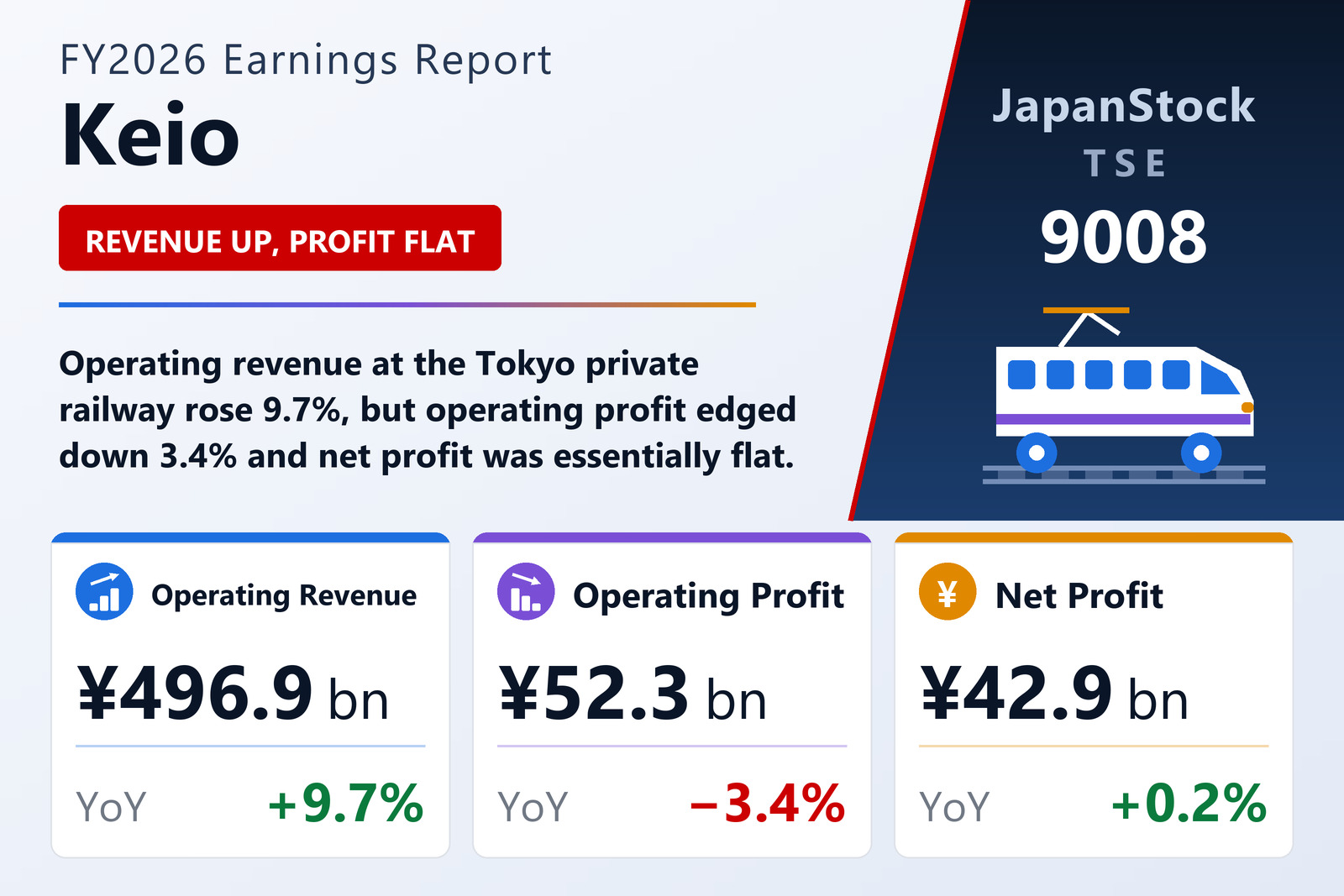
Keio Corporation (TSE: 9008), operator of the Keio and Inokashira railway lines connecting central Tokyo with Shinjuku, Shibuya and western suburbs, reported its full-year results for the fiscal year ended March 31, 2026 on May 13, 2026. Consolidated operating revenue rose a robust 9.7% year-on-year to ¥496,939 million, comfortably above the prior year's ¥452,916 million. However, margins came under pressure: operating profit declined 3.4% to ¥52,322 million and ordinary profit fell 3.9% to ¥51,172 million. Net profit attributable to owners of the parent held essentially flat, edging up 0.2% to ¥42,929 million from ¥42,857 million the previous year. Earnings per share on a post-split basis came to ¥73.00 (the company executed a five-for-one stock split effective April 1, 2026; all per-share figures are calculated as if the split occurred at the start of the prior fiscal year).
The revenue surge — the largest in recent years for the Keio group — reflected broad-based growth across transportation, retail and real estate businesses as post-pandemic visitor and commuter volumes on the Keio network continued to recover and expand. The margin compression relative to the prior year, when operating profit was ¥54,148 million (+23.5%), is partly attributable to cost inflation across labour, energy and maintenance, as well as elevated investment in station facilities and rolling stock on the Keio Line. Comprehensive income for the year reached ¥51,845 million, up 12.4% from ¥46,145 million, boosted by valuation gains on investment securities and equity-method investments.
Transportation and retail drive top-line growth
Keio's diversified railway-anchored conglomerate spans five primary segments: transportation (rail and bus), retail (department stores, supermarkets and specialty shops along the Keio corridor), real estate (residential and commercial development plus property management), leisure (hotels, restaurants, amusement parks) and other businesses. The transportation segment — the group's core — benefited from continued ridership recovery on commuter and leisure routes, reflecting an improvement in inbound tourism and normalization of hybrid-working patterns. The retail segment, anchored by the Keio department store in Shinjuku and networked commercial facilities, captured higher consumer spending. The real estate segment contributed steady recurring income from its portfolio of rental properties and development projects in the western Tokyo suburbs served by the Keio network.
Balance sheet strengthens as equity ratio holds above 37%
Total consolidated assets grew to ¥1,199,857 million at fiscal year-end, up from ¥1,122,589 million a year earlier, reflecting ongoing capital investment in the railway and real estate portfolio. Net assets rose to ¥444,207 million from ¥414,757 million, and the equity ratio held at 37.0% (versus 36.9% the prior year) — a steady capital structure for an asset-intensive private railway group. Operating cash flow came in at ¥37,078 million, with investment cash outflows of ¥35,644 million reflecting continued capex. Cash and equivalents at year-end stood at ¥47,711 million.
Dividend raised to ¥110; FY2027 guidance points to modest revenue growth
Keio raised its full-year dividend to ¥110 per share (¥55 interim + ¥55 year-end) for FY2026, up from ¥100 the prior year, representing a payout ratio of 30.1%. Following the five-for-one stock split effective April 1, 2026, the FY2027 dividend forecast is set at ¥22 per share (¥11 interim + ¥11 year-end) on a post-split basis, equivalent to the same ¥110 pre-split level. For the full year ending March 2027, management guides for operating revenue of ¥504,000 million (+1.4%), operating profit of ¥51,000 million (−2.5%), ordinary profit of ¥47,800 million (−6.6%) and net profit of ¥43,000 million (+0.2%), implying post-split EPS of ¥74.28. The cautious profit outlook reflects further cost absorption from ongoing capital projects and pressure on non-operating items, even as revenue is expected to grow modestly on the back of continued ridership gains and real estate contributions.
| Metric | FY2026 | FY2025 | YoY |
|---|---|---|---|
| Operating revenue (¥ million) | 496,939 | 452,916 | +9.7% |
| Operating profit (¥ million) | 52,322 | 54,148 | −3.4% |
| Ordinary profit (¥ million) | 51,172 | 53,253 | −3.9% |
| Net profit attrib. to owners (¥ million) | 42,929 | 42,857 | +0.2% |
| EPS (¥, post-split) | 73.00 | 70.75 | +3.2% |
| Comprehensive income (¥ million) | 51,845 | 46,145 | +12.4% |
| Total assets (¥ million) | 1,199,857 | 1,122,589 | +6.9% |
| Net assets (¥ million) | 444,207 | 414,757 | +7.1% |
| Equity ratio | 37.0% | 36.9% | +0.1pp |
| Annual dividend (¥, pre-split) | 110 | 100 | +10.0% |
| FY2027 guidance — operating revenue (¥ million) | 504,000 | — | +1.4% |
| FY2027 guidance — operating profit (¥ million) | 51,000 | — | −2.5% |
| FY2027 guidance — ordinary profit (¥ million) | 47,800 | — | −6.6% |
| FY2027 guidance — net profit (¥ million) | 43,000 | — | +0.2% |
| FY2027 guidance — EPS (¥, post-split) | 74.28 | — | — |
JapanStockPulse provides informational content only and does not constitute investment advice. Figures are taken from the company's published earnings short report and may be subject to subsequent revision.