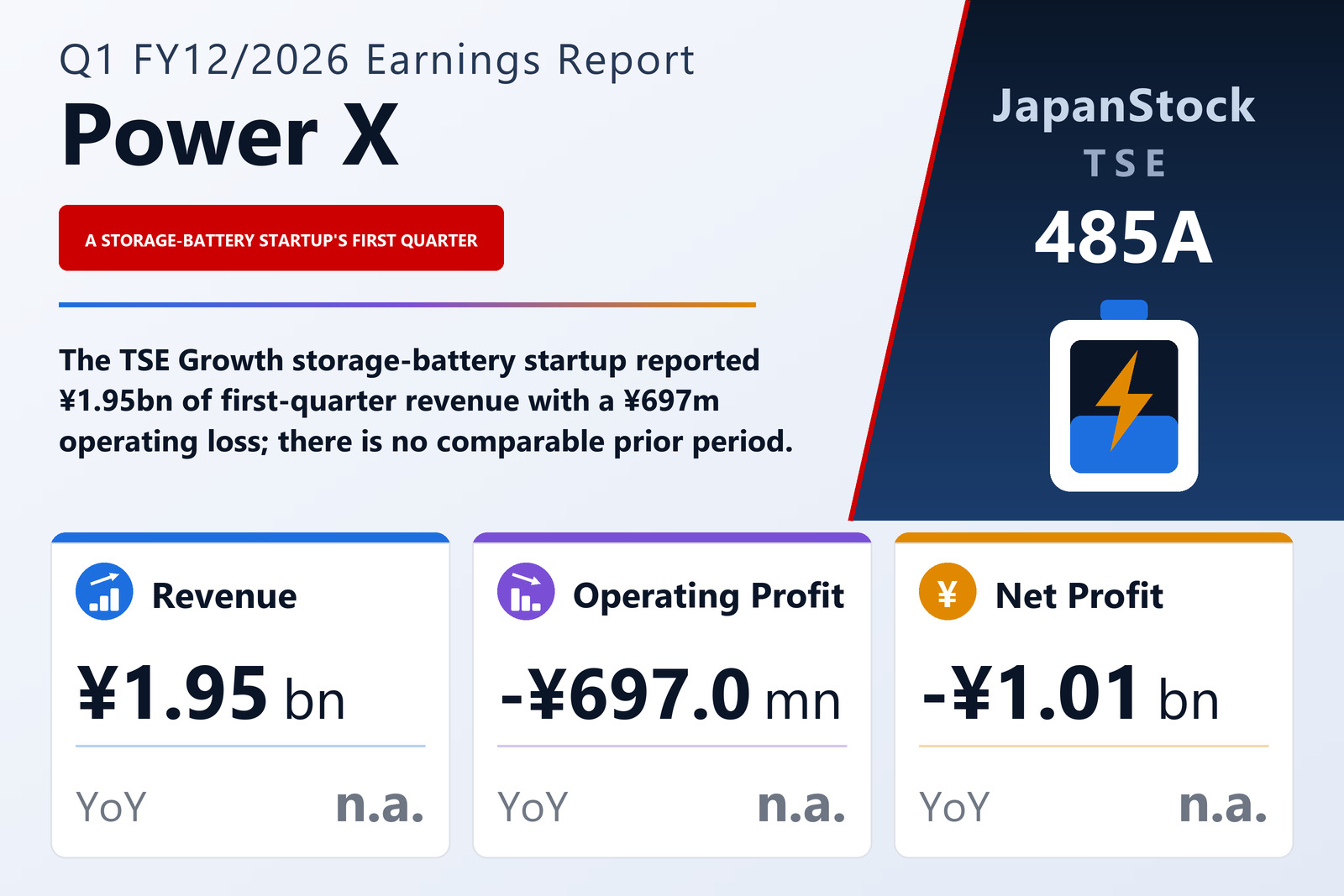
Power X, Inc. (TSE: 485A), the Tokyo-based storage-battery startup listed on the TSE Growth market, published its first-ever consolidated quarterly report on May 14, 2026, covering the first quarter (the three months from January 1 to March 31, 2026) of its fiscal year ending December 2026. Revenue came to ¥1,945 million, with EBITDA of −¥551 million, an operating loss of ¥697 million, an ordinary loss of ¥1,039 million and a net loss attributable to owners of the parent of ¥1,007 million, equivalent to a loss per share of ¥26.82. As this is the company's first consolidated quarterly disclosure, no prior-year comparatives exist and year-on-year changes are not presented.
Battery factory ramp weighs on early-year profitability
Founded in 2021, Power X develops and manufactures grid-scale storage-battery systems, EV fast-charging stations and related clean-energy products, anchored by its battery factory in Tamano, Okayama Prefecture. The company is also known for its "battery tanker" concept — a vessel designed to transport electricity by ship. The first-quarter losses reflect the early ramp of battery production and deliveries, with costs front-loaded against a revenue stream that the company expects to be heavily weighted toward the later quarters of the year as installations and shipments accelerate. At quarter-end, total assets stood at ¥24,608 million, net assets at ¥7,935 million and the equity ratio at 28.1% — a balance-sheet profile typical of a capital-intensive growth-stage manufacturer. The company pays no dividend.
Full-year guidance: ¥38bn revenue and a swing to profit
Power X maintained its full-year guidance, which calls for revenue of ¥38,000 million (+96.8%) — nearly double the prior year — with EBITDA of ¥2,500–3,000 million, operating profit of ¥2,000–2,500 million, ordinary profit of ¥1,000–1,500 million and net profit of ¥1,000–1,500 million, equivalent to EPS of ¥8.87–¥13.31. The guidance is presented in range form, reflecting the inherent timing uncertainty of large battery-system deliveries. Hitting the target would mark the company's swing to full-year profitability, making the pace of order conversion and factory utilisation over the coming quarters the key metrics for investors to watch as the startup attempts to translate its first-quarter ramp costs into second-half earnings.
| Metric | Q1 FY12/2026 | Q1 FY12/2025 | YoY |
|---|---|---|---|
| Revenue (¥ million) | 1,945 | — | — |
| EBITDA (¥ million) | −551 | — | — |
| Operating profit (loss) (¥ million) | −697 | — | — |
| Ordinary profit (loss) (¥ million) | −1,039 | — | — |
| Net profit (loss) (¥ million) | −1,007 | — | — |
| EPS (¥) | −26.82 | — | — |
| Total assets (¥ million) | 24,608 | — | — |
| Net assets (¥ million) | 7,935 | — | — |
| Equity ratio | 28.1% | — | — |
| Annual dividend (¥) | 0 | — | — |
| FY guidance — revenue (¥ million) | 38,000 | — | +96.8% |
| FY guidance — net profit (¥ million) | 1,000–1,500 | — | n.m. |
JapanStockPulse provides informational content only and does not constitute investment advice. Figures are taken from the company's published earnings short report and may be subject to subsequent revision.