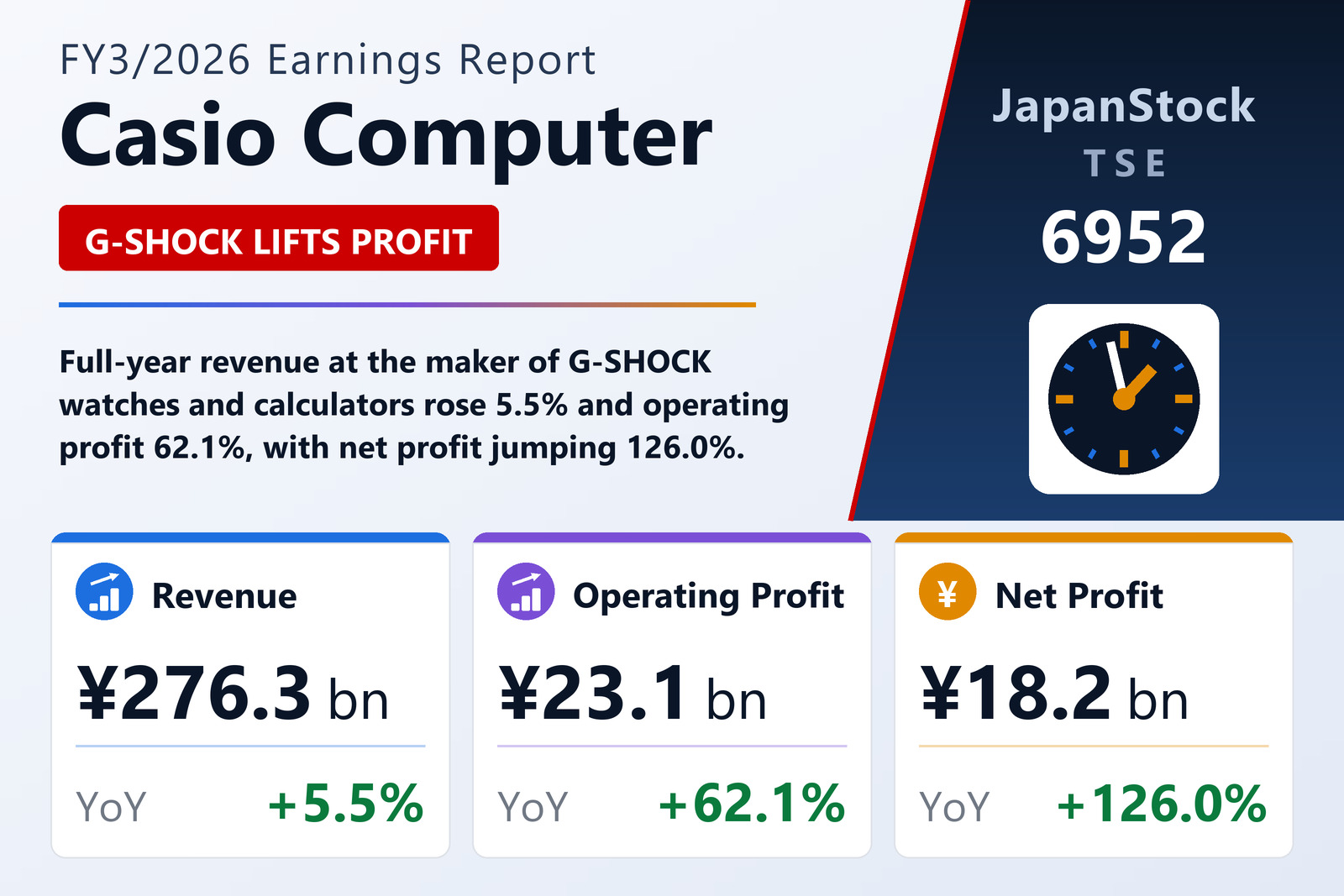
Casio Computer Co., Ltd. (TSE: 6952), the consumer-electronics group best known for its G-SHOCK watch franchise, reported a sharp profit recovery for the fiscal year ended March 31, 2026, in results published on May 14, 2026. Consolidated revenue rose 5.5% year-on-year to ¥276,267 million, but the real story was further down the income statement: operating profit surged 62.1% to ¥23,071 million, ordinary profit climbed 81.8% to ¥25,684 million, and net profit attributable to owners of the parent more than doubled — up 126.0% to ¥18,227 million from ¥8,064 million a year earlier. Earnings per share rose to ¥80.05 from ¥35.22.
Profitability metrics confirmed the breadth of the turnaround: return on equity recovered to 8.0% from 3.6%, while the operating margin expanded to 8.4% of revenue from 5.4%. Comprehensive income leapt to ¥31,468 million from just ¥2,487 million in the prior year, helped by the stronger underlying result and more favourable valuation and translation items.
G-SHOCK strength and structural reforms power the recovery
Casio's profit engine remains its timepiece business, anchored by the globally recognised G-SHOCK brand, alongside calculators, electronic dictionaries, electronic musical instruments and other consumer devices. The year's outsized profit growth reflected solid demand for timepieces — where premium G-SHOCK lines continue to command strong pricing — combined with cost discipline and structural improvements that the company has pushed through across its portfolio, all measured against a weak prior-year base. With revenue up only modestly, the 62% jump in operating profit underscores how much of the gain came from margin repair rather than volume: each incremental yen of sales dropped through to profit at a far higher rate than a year ago.
Cash-rich balance sheet underpins a ¥45 dividend
Casio's balance sheet remains conservatively financed. Total assets stood at ¥351,475 million at year-end, with net assets of ¥235,191 million and an equity ratio of 66.9% — high even by the standards of cash-generative Japanese consumer-electronics names. Book value per share was ¥1,045.90. Operating cash flow came to ¥30,153 million for the year, leaving cash and equivalents of ¥150,658 million — more than 40% of the balance sheet. The company declared an annual dividend of ¥45.00 per share (¥22.50 interim + ¥22.50 year-end), a payout ratio of 56.2% and a total distribution of ¥10,191 million. The dividend for FY2027 is undecided and will be announced at a later date.
FY2027 guidance: operating profit up a further 13%
For the fiscal year ending March 2027, Casio guides for revenue of ¥295,000 million (+6.8%) and operating profit of ¥26,000 million (+12.7%), with ordinary profit of ¥26,000 million (+1.2%) and net profit of ¥18,500 million (+1.5%), equivalent to EPS of ¥82.28. The guidance implies a further year of margin progress at the operating line, while the flatter ordinary- and net-profit projections suggest management does not expect the favourable non-operating tailwinds of FY2026 to repeat. Having more than doubled net profit in the year just ended, the company enters FY2027 with a markedly stronger earnings base than at any point since the pandemic era.
| Metric | FY3/2026 | FY3/2025 | YoY |
|---|---|---|---|
| Revenue (¥ million) | 276,267 | 261,757 | +5.5% |
| Operating profit (¥ million) | 23,071 | 14,236 | +62.1% |
| Ordinary profit (¥ million) | 25,684 | 14,131 | +81.8% |
| Net profit attrib. to owners (¥ million) | 18,227 | 8,064 | +126.0% |
| EPS (¥) | 80.05 | 35.22 | +127.3% |
| ROE | 8.0% | 3.6% | +4.4pp |
| Operating margin | 8.4% | 5.4% | +3.0pp |
| Total assets (¥ million) | 351,475 | — | — |
| Net assets (¥ million) | 235,191 | — | — |
| Equity ratio | 66.9% | — | — |
| Annual dividend (¥) | 45.00 | — | — |
| FY2027 guidance — revenue (¥ million) | 295,000 | — | +6.8% |
| FY2027 guidance — operating profit (¥ million) | 26,000 | — | +12.7% |
| FY2027 guidance — net profit (¥ million) | 18,500 | — | +1.5% |
JapanStockPulse provides informational content only and does not constitute investment advice. Figures are taken from the company's published earnings short report and may be subject to subsequent revision.