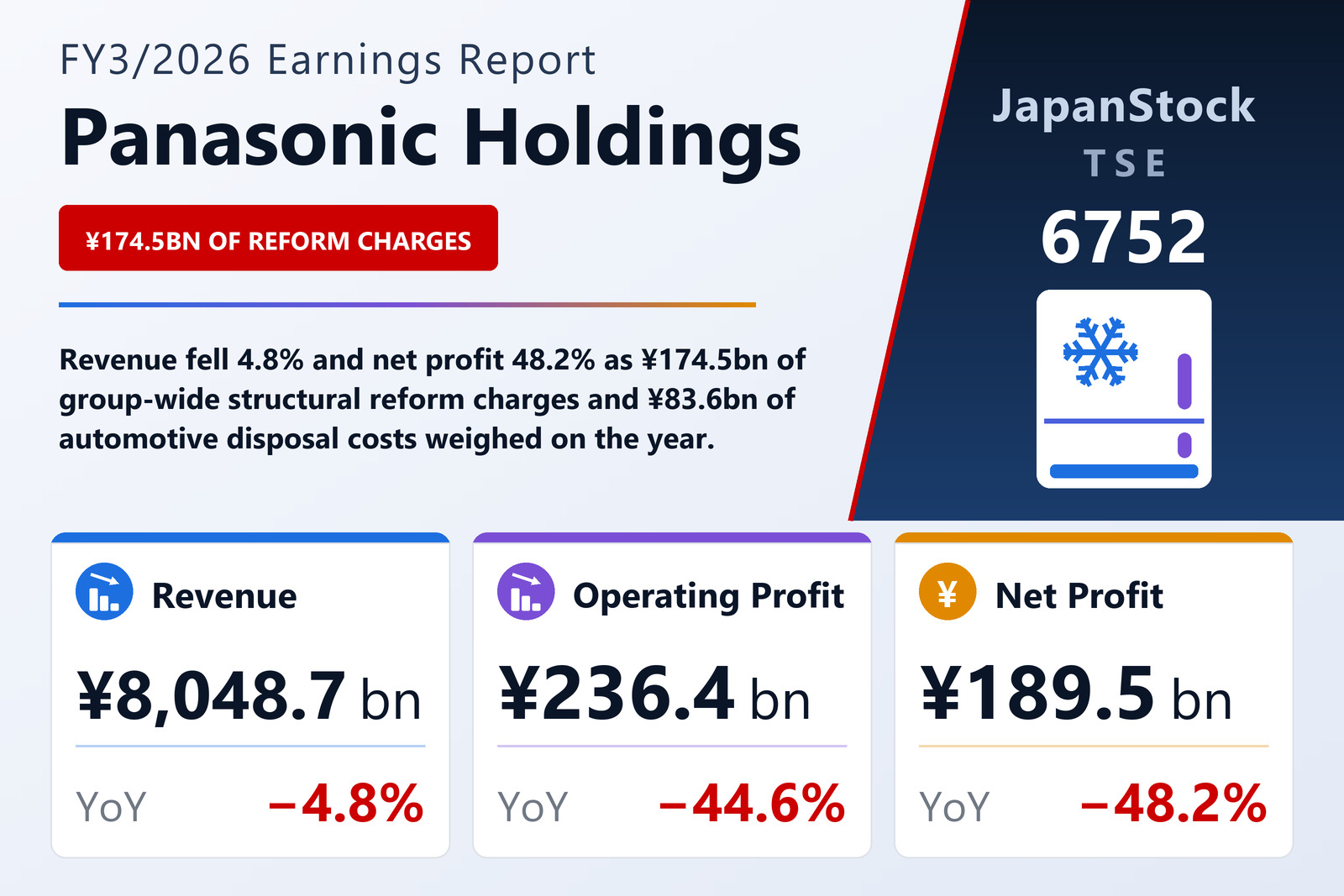
Panasonic Holdings Corporation (TSE: 6752), the Osaka-based electronics and energy conglomerate, reported FY3/2026 consolidated IFRS results showing the steepest year-on-year profit decline among Japan's blue-chip industrials this earnings season. Revenue fell 4.8% to ¥8,048.7 billion, reflecting the prior-year deconsolidation of the automotive business and partly offset by growth in Energy, Industry, Connect and Electric Works. Operating profit dropped 44.6% to ¥236.4 billion, profit before tax fell 45.9% to ¥263.1 billion, and profit attributable to owners of the parent declined 48.2% to ¥189.5 billion (vs. ¥366.2 billion). Basic EPS came in at ¥81.19 (vs. ¥156.87), ROE attributable to owners halved to 3.8% from 7.9%, and the operating margin compressed to 2.9% from 5.0%.
The charges: ¥260bn of restructuring and disposals
The headline plunge was driven by a stack of one-time items that management has signaled would not recur. Group-wide structural-reform expenses totaled approximately ¥174.5 billion, alongside additional disposal-related charges of ¥46.8 billion tied to Ficosa International and ¥36.8 billion tied to Panasonic Automotive Systems (PAS). These were partially offset by a ¥76.1 billion gain on the transfer of 80% of Panasonic Housing Solutions (PHS) to YKK Corporation, completed on March 31, 2026 — leaving PHS as an equity-method affiliate and removing 18 subsidiaries from the consolidation scope. Panasonic also entered a comprehensive partnership with Shenzhen Skyworth Display Technology for European TV sales, and — most consequentially — dissolved Panasonic Corporation, replaced effective April 2026 by three new operating companies: Panasonic HVAC & CC, Panasonic Electric Works, and a slimmer Panasonic Corporation.
Connect leads, Smart Life swings to loss
Connect was the standout, with revenue up 5% to ¥1,380.3 billion and operating profit climbing 31% to ¥100.1 billion, driven by avionics, process automation tied to generative-AI server demand, and Blue Yonder SaaS growth. Electric Works revenue grew 4% to ¥1,160.6 billion, but operating profit fell 16% to ¥57.7 billion as structural reform costs offset robust domestic electrical materials and LED lighting demand ahead of the 2027 fluorescent-lamp phase-out. HVAC & CC was broadly flat — revenue ¥1,312.4 billion (-1%), operating profit ¥23.1 billion (-¥0.1 billion) — as Japanese room ACs and European Air-to-Water heat pumps offset weakness in Asian AC sales, North American cold chain, and tariff impacts.
Energy revenue jumped 13% to ¥984.2 billion on strong data-center storage system sales, but operating profit fell 42% to ¥69.8 billion as automotive battery faced lower raw-material-linked pricing, U.S. tariff costs, Kansas plant fixed-cost ramp-up, and legacy manufacturing remediation expenses. Industry revenue rose 8% to ¥1,167.3 billion on capacitors and multilayer substrate materials for generative-AI servers, though operating profit slipped 6% to ¥40.5 billion on restructuring charges. The clearest weak spot was Smart Life: revenue fell 5% to ¥1,374.2 billion and the segment swung to an operating loss of ¥37.3 billion (vs. ¥41.6 billion profit), reflecting weak Chinese demand for refrigerators and washing machines, declining overseas TV sales, and restructuring costs.
Balance sheet expands, dividend cut to ¥40
Total assets grew to ¥10,172.4 billion from ¥9,343.2 billion, supported by higher PP&E, increased U.S. IRA-related receivables and a weaker yen on translation. Total equity rose to ¥5,381.9 billion, with the parent-owners' equity ratio improving to 51.2%. Cash flow from operating activities was ¥624.3 billion (down from ¥796.1 billion, mainly because the prior year included the monetization of U.S. IRA subsidy rights), while investing outflows narrowed to ¥607.4 billion from ¥859.9 billion thanks to lower capex and PHS divestiture proceeds — producing free cash flow of approximately ¥16.9 billion. Financing outflows totaled ¥166.8 billion, and cash and equivalents stood at ¥770.2 billion at year-end. Panasonic issued ¥55.0 billion of unsecured straight bonds in July 2025 and ¥30.0 billion in December 2025, while redeeming ¥70.0 billion and ¥30.0 billion at maturity.
The annual dividend was set at ¥40 per share (¥20 interim + ¥20 year-end), down from ¥48 in the prior year, for a payout ratio of 49.3% on the depressed earnings base and total dividends of ¥93.4 billion.
FY27 guidance: a sharp profit snap-back
For FY3/2027, management guides revenue of ¥7,600.0 billion (-5.6%) — the decline reflects the PHS deconsolidation and FX assumptions — alongside an outsized profit recovery: operating profit of ¥550.0 billion (+132.6%), pre-tax profit of ¥550.0 billion (+109.0%), and profit attributable to owners of the parent of ¥420.0 billion (+121.6%). Adjusted operating profit (revenue less COGS and SG&A) is projected at ¥600.0 billion (+34%). The bottom-line snap-back is driven by AI-infrastructure-related sales expansion (data-center lithium-ion cells and storage modules at Panasonic Energy, plus electronic-materials capacity additions at Panasonic Industry in Thailand and China), structural-reform benefits, and the non-recurrence of FY26 restructuring charges. The dividend forecast is raised to ¥54 per share annually (¥27 interim + ¥27 year-end), implying a normalized payout ratio of 30.0%. No material subsequent events or going-concern issues were noted; the report remains subject to ongoing statutory audit procedures.
| Metric | FY3/2026 | FY3/2025 | YoY |
|---|---|---|---|
| Revenue (¥ billion) | 8,048.7 | 8,458.2 | −4.8% |
| Operating profit (¥ billion) | 236.4 | 426.7 | −44.6% |
| Profit before tax (¥ billion) | 263.1 | 486.7 | −45.9% |
| Profit attrib. to owners (¥ billion) | 189.5 | 366.2 | −48.2% |
| Basic EPS (¥) | 81.19 | 156.87 | −48.2% |
| Operating margin | 2.9% | 5.0% | −2.1pp |
| ROE (owners) | 3.8% | 7.9% | −4.1pp |
| Equity ratio (owners) | 51.2% | — | — |
| Annual dividend (¥) | 40.00 | 48.00 | −16.7% |
JapanStockPulse provides informational content only and does not constitute investment advice. Figures are taken from the company's published earnings short report and may be subject to subsequent revision.