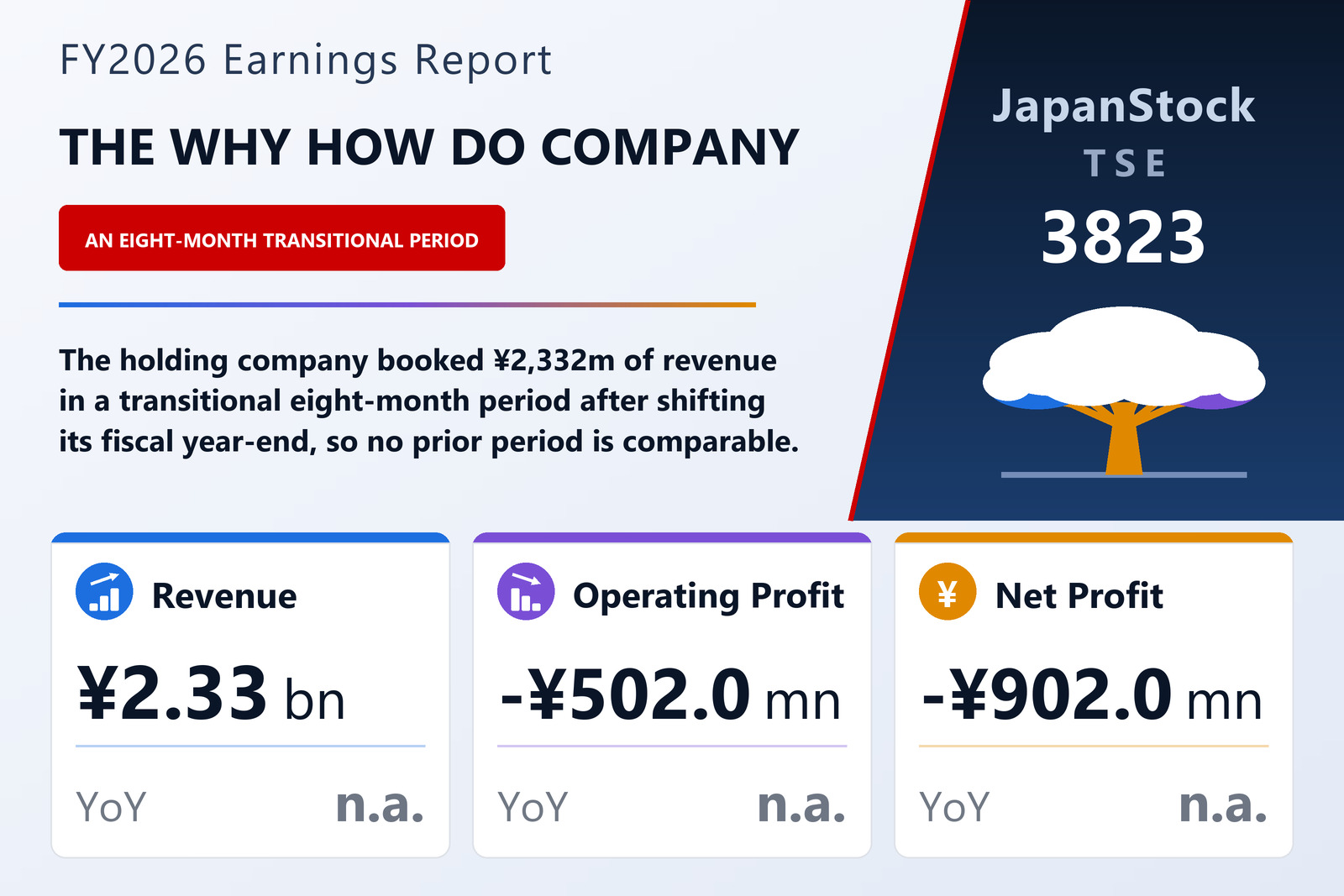
THE WHY HOW DO COMPANY, Inc. (TSE: 3823) reported consolidated results under Japanese GAAP for an irregular eight-month period from September 1, 2025 to April 30, 2026. The company changed its fiscal year-end from August to April, so the reporting period spans only eight months and is not directly comparable to the prior 12-month fiscal year ended August 2025; accordingly, the company does not disclose year-on-year percentage changes. Revenue for the period was ¥2,332 million (against ¥1,751 million in the prior 12-month year), but the group posted an operating loss of ¥502 million, an ordinary loss of ¥870 million, and a net loss attributable to owners of the parent of ¥902 million. Basic loss per share was ¥6.90.
An eight-month transitional period after a year-end change
The headline numbers must be read against the calendar shift. By moving its closing date from the end of August to the end of April, THE WHY HOW DO COMPANY produced a one-off eight-month accounting period rather than a full year. That makes a straight comparison with the prior period — the 12-month year to August 2025, during which revenue was ¥1,751 million and the operating loss was ¥72 million — misleading, and the company explicitly declines to publish year-on-year growth rates for this report. The losses also widened meaningfully on the bottom line: the prior-year net loss was just ¥69 million, against ¥902 million this period.
Goodwill and M&A costs drive the GAAP loss
THE WHY HOW DO COMPANY is a small-cap holding company running an acquisition-led, or "roll-up," growth strategy — buying and operating small and mid-sized businesses across a range of sectors. During the eight-month period it newly consolidated five companies: Stillan, Goodman, Iiyama Doken, Cowell, and Nihon Junkin-gyo. That acquisition drive is the principal reason the company remains loss-making at the GAAP level: goodwill and intangible-asset amortization tied to the deals, together with M&A-related transaction costs, weigh heavily on reported operating and net profit even where the underlying acquired businesses contribute revenue.
Management therefore emphasizes adjusted figures that strip out those non-cash and deal-related items. On an adjusted basis — excluding goodwill and intangible amortization and M&A-related costs — the group secured a positive adjusted EBITDA of ¥27 million, while the adjusted net loss narrowed to ¥426 million. The company presents this as evidence that its operating portfolio is approaching cash-generative scale even as the reported figures absorb the cost of expansion.
Balance sheet more than doubles on acquisitions
The acquisition activity sharply expanded the balance sheet. Total assets rose to ¥5,331 million from ¥2,473 million a year earlier, reflecting the goodwill and operating assets of the five newly consolidated companies. Net assets stood at ¥1,612 million, leaving an equity ratio of 29.4%. The company pays no dividend and plans to remain non-dividend-paying, prioritizing the deployment of cash into further acquisitions over shareholder distributions.
FY4/2027 guidance points to a return to operating profit
For the fiscal year ending April 2027 — its first full 12-month year on the new schedule — THE WHY HOW DO COMPANY guides revenue of ¥6,259 million and a return to a reported operating profit of ¥165 million, alongside an adjusted operating profit of ¥349 million and adjusted EBITDA of ¥464 million. The step-up reflects a full year of contribution from the businesses acquired during the transitional period, plus the absence of the one-off transaction costs that depressed the eight-month figures. Whether the reported swing to profit materializes will depend on the pace of further deals and the amortization load they bring.
| Metric | 8M ended Apr 2026 | FY ended Aug 2025 | YoY |
|---|---|---|---|
| Revenue (¥M) | 2,332 | 1,751 | — |
| Operating profit (¥M) | -502 | -72 | — |
| Ordinary profit (¥M) | -870 | -786 | — |
| Net profit attrib. to owners (¥M) | -902 | -69 | — |
| Adjusted EBITDA (¥M) | 27 | — | — |
| Total assets (¥M) | 5,331 | 2,473 | — |
| FY27 revenue guidance (¥M) | 6,259 | — | — |
| FY27 operating profit guidance (¥M) | 165 | — | — |
JapanStockPulse provides informational content only and does not constitute investment advice. Figures are taken from the company's published earnings short report and may be subject to subsequent revision.