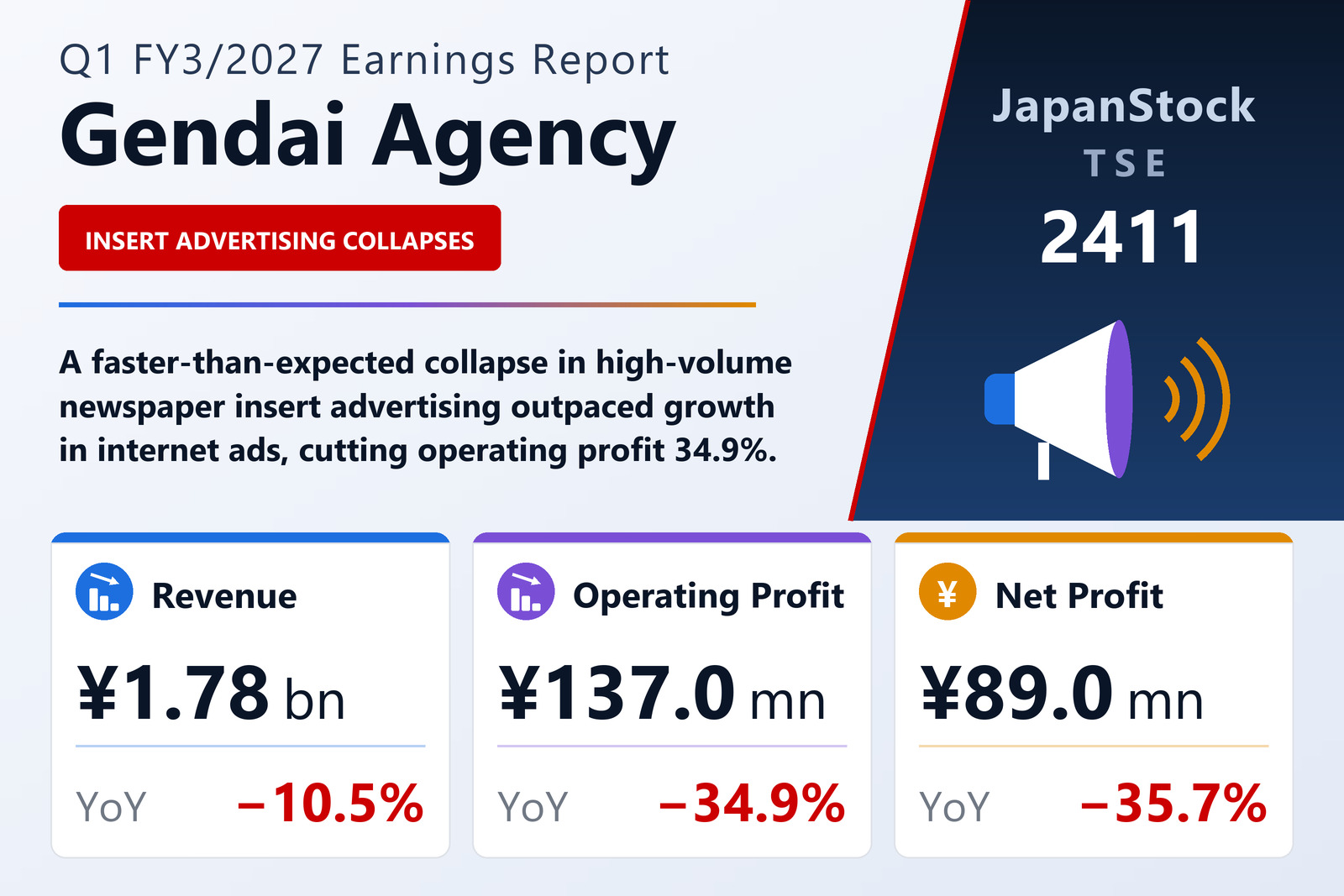
Gendai Agency Inc. (TSE: 2411) reported consolidated results for the first quarter of the fiscal year ending March 2027 (April 1 – June 30, 2026) under Japanese GAAP. Revenue fell 10.5% to ¥1,784 million, operating profit dropped 34.9% to ¥137 million, ordinary profit declined 34.6% to ¥137 million, and net profit attributable to owners of the parent fell 35.7% to ¥89 million. Quarterly earnings per share came to ¥8.15, down from ¥11.92 a year earlier.
Digital shift erodes the print advertising base faster than planned
Gendai Agency's core customers are pachinko hall operators, and management described that industry's external environment as broadly stable — the spread of "smart" gaming machines and a steady stream of new machine types have kept expectations for industry activity alive. Demand for customer-acquisition services and internet advertising is recovering gradually. The problem is the other side of the ledger: as halls shift their marketing spend to digital, the decline in insert advertising and other paper media — which carries large billings — has intensified beyond the company's initial assumptions. Gross profit fell only 4.7% to ¥669 million, a far smaller drop than the 10.5% revenue decline, reflecting the mix shift away from low-margin paper media toward higher-margin digital services. But that mix improvement was not enough to protect operating profit, which was squeezed as unallocated corporate costs rose to ¥67 million from ¥63 million.
Internet advertising grows 6.6% while inserts halve
The sales breakdown makes the transition plain. Internet advertising, now the largest single line, rose 6.6% to ¥863 million, supported by high-value-added DSP advertising and the development and sale of a real-time location-based delivery service. Insert advertising, by contrast, fell 43.9% to ¥276 million. Sales promotion materials came in at ¥243 million, creative at ¥137 million, media at ¥39 million, and other at ¥207 million.
Both segments decline; real estate laps a large one-off
The Advertising segment posted revenue down 9.0% to ¥1,767 million with segment profit down 19.3% to ¥198 million. Outside pachinko halls, advertising demand from fitness facilities — the mainstay non-hall category — continued to grow and the company pushed into buyback-industry clients, but housing-related advertising demand softened slightly as a naphtha shortage destabilised clients' paint procurement. The company also promoted original services on its owned site "Pachi7" to offset the paper decline. The much smaller Real Estate segment saw revenue drop 66.8% to ¥17 million and segment profit fall 77.2% to ¥6 million, chiefly because the year-earlier quarter included a large brokerage-commission deal; this quarter's ¥4 million of commission income came alongside rental income from land in Kashiwa, Chiba, held by consolidated subsidiary Land Support.
Guidance unchanged, dividend raised, and a buyback plus share cancellation
Total assets stood at ¥5,068 million, down ¥340 million from the previous fiscal year-end on a ¥221 million decrease in cash and deposits and a ¥99 million decline in notes and accounts receivable. Net assets were ¥3,848 million, down ¥42 million as the ¥89 million quarterly profit was more than offset by a ¥132 million year-end dividend payment; the equity ratio rose to 75.9% from 71.9%. Management acknowledged the quarter fell behind its internal plan but is maintaining the full-year forecast issued on April 17, 2026: revenue of ¥8,000 million (+6.2%), operating profit of ¥800 million (+18.6%), ordinary profit of ¥800 million (+17.6%), and net profit of ¥520 million (+9.8%), for EPS of ¥47.27. The annual dividend forecast is unchanged at ¥25.00 (¥12.00 interim, ¥13.00 year-end), up from ¥24.00. The first quarter result therefore represents only about 17% of the full-year operating profit target, leaving considerable ground to make up.
Subsequent events: capital-efficiency measures
On July 17, 2026 the board resolved to repurchase up to 700,000 shares (6.36% of shares outstanding excluding treasury stock) for up to ¥350 million, between July 21, 2026 and March 24, 2027, via market purchases including ToSTNeT-3. The same meeting approved the cancellation of 940,000 treasury shares (7.64% of shares outstanding before cancellation) on July 24, 2026, which will reduce shares outstanding to 11,360,000. Separately, a June 26 board resolution will dispose of 360,000 treasury shares at ¥447 per share (¥160,920,000 in total) on July 24, 2026 as restricted stock compensation to three directors and six executive officers.
| Metric | Q1 FY3/2027 | Q1 FY3/2026 | YoY |
|---|---|---|---|
| Revenue (¥ million) | 1,784 | 1,994 | −10.5% |
| Gross profit (¥ million) | 669 | 703 | −4.7% |
| Operating profit (¥ million) | 137 | 211 | −34.9% |
| Ordinary profit (¥ million) | 137 | 210 | −34.6% |
| Net profit (¥ million) | 89 | 139 | −35.7% |
| EPS (¥) | 8.15 | 11.92 | −31.6% |
| Advertising segment revenue (¥ million) | 1,767 | 1,941 | −9.0% |
| Advertising segment profit (¥ million) | 198 | 246 | −19.3% |
| Real Estate segment revenue (¥ million) | 17 | 52 | −66.8% |
| Total assets (¥ million) | 5,068 | 5,409 | −6.3% |
| Equity ratio (%) | 75.9 | 71.9 | +4.0pt |
JapanStockPulse provides informational content only and does not constitute investment advice. Figures are taken from the company's published earnings short report and may be subject to subsequent revision.