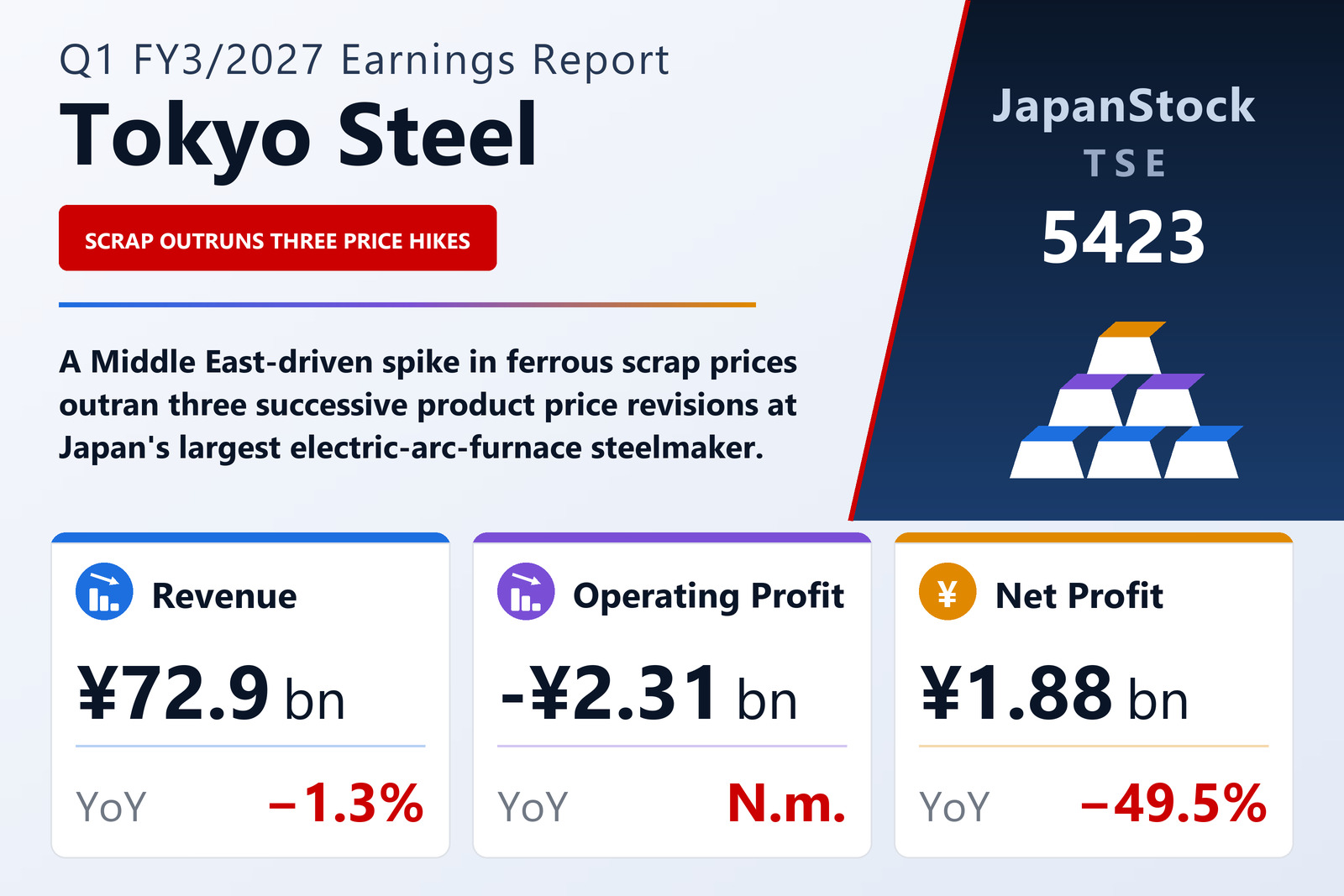
Tokyo Steel Manufacturing Co., Ltd. (TSE: 5423) reported non-consolidated results for the first quarter of the fiscal year ending March 2027 (April 1 – June 30, 2026) under Japanese GAAP. Revenue edged down 1.3% to ¥72,927 million, and the company swung to an operating loss of ¥2,307 million from a ¥4,767 million profit a year earlier. It also posted an ordinary loss of ¥1,743 million, against ¥5,314 million of ordinary profit in the year-ago quarter. Quarterly net profit fell 49.5% to ¥1,882 million, and earnings per share halved to ¥18.40 from ¥36.18.
Scrap costs move faster than product prices
The loss was a timing problem rather than a demand problem. Escalating tensions in the Middle East drove a sharp run-up in ferrous scrap — the sole raw material for Tokyo Steel's electric-arc furnaces — and the company responded with three separate product price revisions since the end of the previous fiscal year. But raw-material costs reprice immediately while announced price increases take time to work through to actual shipment prices, so the quarter absorbed higher input costs without the offsetting revenue. Cost of sales rose to ¥68,793 million from ¥62,459 million, compressing gross profit to ¥4,134 million from ¥11,403 million and turning the operating line negative.
Below the operating line, the picture was very different. Tokyo Steel sold investment securities and other assets during the quarter, booking ¥993 million of gains on sale of fixed assets and ¥3,403 million of gains on sale of investment securities within a ¥4,397 million extraordinary gain. That was enough to carry pre-tax profit to ¥2,519 million and keep the bottom line firmly in the black despite the operating loss.
Volumes broadly flat, average prices inch higher
Production was little changed year on year: billet output slipped to 838 thousand tonnes from 851 thousand, and finished steel output to 767 thousand tonnes from 774 thousand. Steel product shipments came in at 739 thousand tonnes versus 746 thousand, at an average unit price of ¥96,800 per tonne — only marginally above the ¥96,200 of a year earlier, underscoring how little of the price campaign had reached invoices by quarter-end. Exports told a sharper story: volume fell to 109 thousand tonnes from 137 thousand, but the average export price jumped to ¥95,300 per tonne from ¥81,900, narrowing the long-standing gap to domestic pricing. Total shipments including other products were 766 thousand tonnes at an average ¥95,100 per tonne. The company operates as a single steel segment, so no segment breakdown is disclosed.
Balance sheet stays fortress-like; buyback continues
Total assets fell ¥4,089 million from the previous fiscal year-end to ¥288,905 million, while liabilities rose ¥655 million to ¥71,561 million and net assets declined ¥4,745 million to ¥217,343 million. The equity ratio remains among the highest in Japanese heavy industry at 75.2%, down only slightly from 75.8%. Cash and deposits stood at ¥53,384 million. Under a board resolution of April 24, 2026, Tokyo Steel repurchased 579,300 treasury shares between May 1 and June 30, 2026, increasing treasury stock by ¥996 million. Capital expenditure on tangible fixed assets fell to ¥2.3 billion from ¥7.1 billion a year earlier, while depreciation rose to ¥2,142 million from ¥1,961 million.
Guidance cut; margin recovery pencilled in for the second half
Reflecting the first-quarter shortfall, the company revised the forecast it issued on April 24, 2026. For the first half it now guides to revenue of ¥155,000 million (+15.8%) with a ¥4,000 million operating loss, a ¥3,000 million ordinary loss and net profit of ¥1,000 million (−78.1%). Full-year guidance is revenue of ¥315,000 million (+17.5%), an operating loss of ¥4,000 million, an ordinary loss of ¥2,500 million and net profit of ¥1,000 million (−91.3%), for EPS of ¥9.81. The unchanged full-year operating loss against the first-half figure implies management expects the operating line to return to roughly breakeven in the second half as the price increases feed through to shipment prices. Tokyo Steel flagged continued cost pressure from Middle East uncertainty, electricity and fuel, and said it will prioritise margins, lift manufacturing yields, size production to demand, and push sales of its low-CO2 steel lineup including the "Almost Zero" brand. The annual dividend forecast is unchanged at ¥40.00 (¥20.00 interim, ¥20.00 year-end), down from ¥50.00 in FY3/2026. No material subsequent events were reported.
| Metric | Q1 FY3/2027 | Q1 FY3/2026 | YoY |
|---|---|---|---|
| Revenue (¥ million) | 72,927 | 73,862 | −1.3% |
| Operating profit (loss) (¥ million) | −2,307 | 4,767 | n.m. |
| Ordinary profit (loss) (¥ million) | −1,743 | 5,314 | n.m. |
| Net profit (¥ million) | 1,882 | 3,728 | −49.5% |
| EPS (¥) | 18.40 | 36.18 | −49.1% |
| Steel product shipments (thousand t) | 739 | 746 | −0.9% |
| Average steel price (¥ thousand/t) | 96.8 | 96.2 | +0.6% |
| Total assets (¥ million) | 288,905 | 292,995 | −1.4% |
| Equity ratio (%) | 75.2 | 75.8 | −0.6 pt |
JapanStockPulse provides informational content only and does not constitute investment advice. Figures are taken from the company's published earnings short report and may be subject to subsequent revision.