Regulation as a revenue line
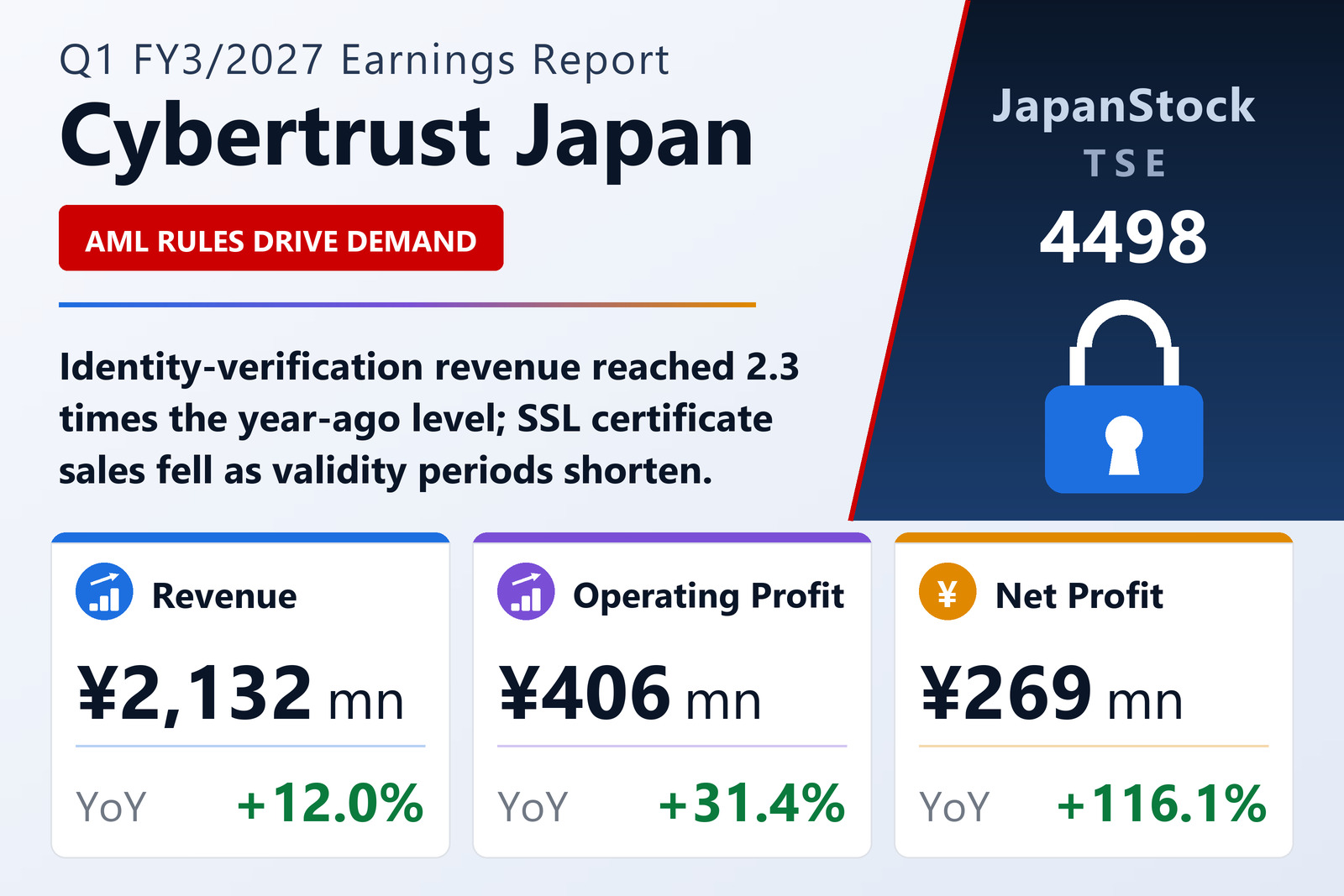
Cybertrust Japan Co., Ltd. (TSE: 4498) published consolidated first-quarter results for FY3/2027 on July 30, 2026, covering April 1 to June 30, 2026 under Japanese GAAP. Revenue rose 12.0% to ¥2,132 million, operating profit 31.4% to ¥406 million, ordinary profit 30.5% to ¥408 million and net profit attributable to owners of parent 116.1% to ¥269 million. Earnings per share reached ¥16.45 against ¥7.74, both restated for the two-for-one share split of October 1, 2025.
The company operates a single reporting segment — digital trust — but discloses revenue across two service families. Trust services grew 10.5% to ¥1,188 million. Inside it, the iTrust electronic-authentication line was the standout: identity-verification services for financial institutions and electronic-signature services for electronic-contract partners both expanded, and identity verification specifically grew to 2.3 times the year-ago level as the revised Act on Prevention of Transfer of Criminal Proceeds drove adoption. The company also completed construction of a remote-signature system for the Ministry of Justice's commercial-registration electronic certificates, ahead of a July start of operation.
Device ID, the device-certificate management service, grew through partners running cloud authentication services for enterprises, and the company won a large contract with the board of education of a government-designated city — education is becoming a real channel. But one line went backwards: iTrust SSL/TLS server certificate revenue fell, as the industry-wide move to shorten certificate validity periods, intended to raise web trust and security, cuts the term of each sale. That is a structural headwind for the oldest part of the business, not a demand problem.
Platform services grew faster, up 14.0% to ¥944 million. Linux support expanded on a large contract with a major operator that began in the prior year; EMLinux won new business in medical devices as regulation and industry cybersecurity guidelines drive demand for vulnerability management and long-term support. Professional services within the platform family grew fastest of any line, up 29.7% to ¥344 million, on security consulting tied to the EU Cyber Resilience Act and continued large-scale contract development work in automotive research and development.
Where the profit came from — and a caveat
Read across transaction types rather than services and the mix is clear. Group recurring revenue — the electronic-authentication and product-support subscriptions the company builds its model on — rose 9.4% to ¥1,462 million and remains 68.6% of the total. Professional services rose 18.3% to ¥492 million and licences 17.6% to ¥177 million. The faster-growing lines are the more project-shaped ones; the recurring base grew more slowly than the company average.
Costs rose across the board on continued headcount growth, yet revenue growth outpaced them enough to widen the operating margin by 2.80 points. Below the operating line, ordinary profit grew slightly slower than operating profit at 30.5%, as interest income and equity-method investment gains in non-operating income were partly offset by foreign-exchange losses.
The 116.1% jump in net profit deserves the caveat management itself supplies: it reflects the absence of the prior year's extraordinary loss on the head-office relocation, plus tax-effect accounting — not a doubling of operating performance. Operating profit, the cleaner measure, grew 31.4%. For scale, the prior full year (FY3/2026) produced revenue of ¥8,360 million, operating profit of ¥1,649 million and net profit of ¥989 million.
A balance sheet that barely moved, and an unrevised plan
Total assets rose just 0.6% to ¥10,764 million. Current assets grew ¥140 million to ¥7,768 million as ¥342 million more cash and ¥149 million more prepaid expenses outweighed a ¥361 million fall in receivables and contract assets; fixed assets fell ¥78 million to ¥2,996 million, with ¥46 million of added tangible assets for service-delivery infrastructure against a ¥129 million reduction in deferred tax assets. Liabilities fell ¥17 million to ¥3,243 million: contract liabilities rose ¥329 million while income taxes payable fell ¥294 million on payment and the bonus provision ¥223 million on disbursement. Net assets rose ¥79 million to ¥7,521 million and the equity ratio to 69.9%.
Cybertrust left its full-year forecast unchanged: revenue of ¥9,250 million (+10.6%), operating profit of ¥1,860 million (+12.8%), ordinary profit of ¥1,867 million (+12.6%) and net profit of ¥1,240 million (+25.3%), for earnings per share of ¥75.68. The company manages on an annual basis and therefore publishes no half-year forecast.
Progress against that plan is roughly on pace but not ahead: the first quarter delivered 23.0% of the revenue target and 21.8% of the operating-profit target, so the remaining nine months must run slightly harder than the quarter just closed — consistent with a business whose costs are front-loaded by hiring and whose recurring base builds through the year. The annual dividend is planned at ¥14.00, paid entirely at year-end, against ¥12.00 for FY3/2026.
| Metric | Q1 FY3/2027 | Q1 FY3/2026 | Change |
|---|---|---|---|
| Revenue (¥ million) | 2,132 | 1,903 | +12.0% |
| Operating profit (¥ million) | 406 | 309 | +31.4% |
| Operating margin | 19.04% | 16.24% | +2.80 pt |
| Ordinary profit (¥ million) | 408 | 313 | +30.5% |
| Net profit attrib. to owners of parent (¥ million) | 269 | 124 | +116.1% |
| Comprehensive income (¥ million) | 269 | 124 | +116.6% |
| EPS (¥) | 16.45 | 7.74 | +112.5% |
| Trust services revenue (¥ million) | 1,188 | 1,075 | +10.5% |
| Platform services revenue (¥ million) | 944 | 828 | +14.0% |
| — recurring revenue, group total (¥ million) | 1,462 | 1,336 | +9.4% |
| — professional services, group total (¥ million) | 492 | 416 | +18.3% |
| — licence revenue, group total (¥ million) | 177 | 151 | +17.6% |
| Total assets (¥ million) | 10,764 | 10,702 | +0.6% |
| Total liabilities (¥ million) | 3,243 | 3,260 | −0.5% |
| Net assets (¥ million) | 7,521 | 7,442 | +1.1% |
| Shareholders' equity (¥ million) | 7,519 | 7,440 | +1.1% |
| Equity ratio | 69.9% | 69.5% | +0.4 pt |
| FY3/2027 guidance — revenue (¥ million) | 9,250 | — | +10.6% |
| FY3/2027 guidance — operating profit (¥ million) | 1,860 | — | +12.8% |
| FY3/2027 guidance — ordinary profit (¥ million) | 1,867 | — | +12.6% |
| FY3/2027 guidance — net profit (¥ million) | 1,240 | — | +25.3% |
| FY3/2027 guidance — EPS (¥) | 75.68 | — | — |
| Annual dividend per share (¥) | 14.00 | 12.00 | +16.7% |
JapanStockPulse provides informational content only and does not constitute investment advice. Figures are taken from the company's published earnings short report and may be subject to subsequent revision.