Growth at the top, collapse at the operating line
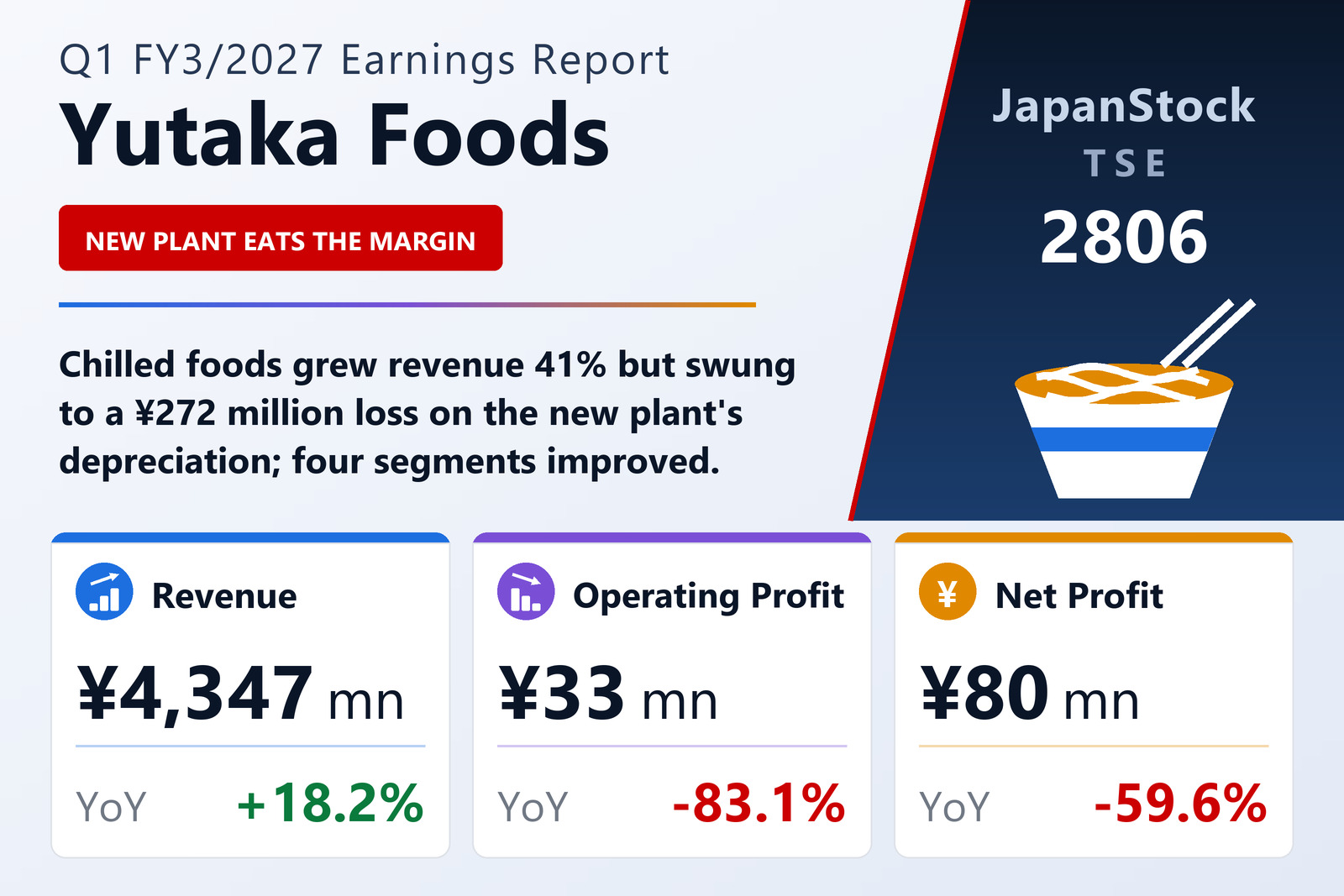
Yutaka Foods Corporation (TSE: 2806), the Aichi-based manufacturer of liquid seasonings, powdered foods, chilled products and instant noodles — much of it produced under contract for other brands — published non-consolidated first-quarter results for FY3/2027 on July 31, 2026, covering April 1 to June 30, 2026 under Japanese GAAP. Net sales rose 18.2% to ¥4,347 million. Operating profit fell 83.1% to ¥33 million.
The mechanism is visible in two lines. Cost of sales rose 25.1% to ¥4,087 million, well ahead of the 18.2% revenue gain, so gross profit fell 36.7% to ¥260 million from ¥411 million and the gross margin narrowed to 5.98% from 11.17% — a 5.19-point compression on a margin that was thin to begin with. Selling, general and administrative expenses were comparatively restrained, up 6.1% to ¥226 million from ¥213 million, but on a gross profit of only ¥260 million there was almost nothing left: the operating margin fell to 0.76% from 5.38%.
Below that, the picture improves relative to the operating line. Ordinary profit fell 59.5% to ¥110 million — a much smaller decline than operating profit's 83.1%, because non-operating income of roughly ¥100 million (rental income and other items) is a fixed contribution that does not scale with the manufacturing margin. Net profit fell 59.6% to ¥80 million, almost exactly tracking ordinary profit.
One plant explains the entire shortfall
The segment table settles the question of where the money went. Chilled foods grew revenue 40.8% to ¥666 million from ¥473 million as its new factory came on stream and contract volumes increased. And it recorded a segment loss of ¥272 million against a ¥79 million profit a year earlier, which the company attributes explicitly to the increase in depreciation accompanying the start-up of the new plant.
That is a swing of ¥351 million in a single segment. Group operating profit fell by ¥165 million. In other words the chilled-foods deterioration was more than twice the size of the group's decline, and the rest of the business offset roughly ¥186 million of it. Liquid — where sales of eel sauce grew steadily — lifted revenue 8.4% to ¥1,424 million and segment profit 231.2% to ¥135 million from ¥40 million. Powder, helped by contract work on granulated products, grew revenue 10.3% to ¥1,342 million and segment profit 85.0% to ¥139 million. Instant noodles turned a ¥1 million loss into an ¥18 million profit on revenue up 9.6% to ¥449 million. The Other category — commodity trading, chiefly frozen fish — grew revenue 75.2% to ¥465 million and profit 154.4% to ¥13 million on higher marine-product volumes.
Read that way, this is a capacity-investment quarter rather than a demand problem. Four of the five segments improved profitability, and the segment that dragged did so while growing revenue faster than any other reporting segment. Depreciation on a new plant is a fixed charge that begins at commissioning and is independent of how quickly the plant fills; the question the coming quarters answer is whether chilled-foods volume rises fast enough to cover it. Nothing in this filing quantifies the depreciation step or gives a break-even utilisation, which is the main disclosure gap for anyone trying to time that recovery.
A balance sheet that barely moved
Total assets fell 1.5% to ¥26,287 million, a decline of ¥389 million, and the composition matters more than the total. Cash and deposits rose ¥1,477 million, accounts receivable ¥159 million and inventories ¥90 million; against that, accrued consumption tax receivable within other current assets fell ¥1,469 million, short-term loans to affiliates ¥200 million, buildings (net) ¥122 million and machinery and equipment (net) ¥359 million. The last of those is the new plant's asset base already depreciating faster than it is being added to.
Total liabilities fell 9.8% to ¥3,297 million, on a ¥366 million reduction in other current liabilities and a ¥98 million drawdown of the bonus provision, partly offset by ¥106 million more in accounts payable. Net assets were flat at ¥22,989 million, down ¥29 million: retained earnings fell ¥58 million — the ¥80 million earned less the dividend paid — while the valuation difference on available-for-sale securities added ¥28 million. The equity ratio stands at 87.5%, up from 86.3%. Even after building a new factory, this is a company with almost no leverage; liabilities are one-eighth of assets.
Guidance untouched
Yutaka Foods states that the interim and full-year forecasts announced on May 15, 2026 are unchanged at this point. The published document is the attachment to the earnings report and does not restate the guidance figures, the dividend or earnings per share, so those lines are not available from this filing.
On the environment, the company describes a Japanese economy recovering gradually as wage increases lift incomes, set against continued price inflation driven by raw-material and energy costs and by geopolitical risk including the Middle East. For the food industry specifically it expects raw-material cost increases to continue and the operating environment to remain difficult. Its own response is the medium-term plan begun in FY3/2026, built on product development that exploits its proprietary technology and equipment, on strengthening and stabilising the earnings base in light of the social and environmental setting, and on sustained improvement in corporate value — which is, in effect, what the new chilled-foods plant is for.
| Metric | Q1 FY3/2027 | Q1 FY3/2026 | Change |
|---|---|---|---|
| Net sales (¥ million) | 4,347 | 3,679 | +18.2% |
| Cost of sales (¥ million) | 4,087 | 3,267 | +25.1% |
| Gross profit (¥ million) | 260 | 411 | −36.7% |
| Gross margin | 5.98% | 11.17% | −5.19 pt |
| SG&A expenses (¥ million) | 226 | 213 | +6.1% |
| Operating profit (¥ million) | 33 | 198 | −83.1% |
| Operating margin | 0.76% | 5.38% | −4.62 pt |
| Ordinary profit (¥ million) | 110 | 271 | −59.5% |
| Net profit (¥ million) | 80 | 198 | −59.6% |
| Liquid — revenue (¥ million) | 1,424 | 1,314 | +8.4% |
| Liquid — segment profit (¥ million) | 135 | 40 | +231.2% |
| Powder — revenue (¥ million) | 1,342 | 1,216 | +10.3% |
| Powder — segment profit (¥ million) | 139 | 75 | +85.0% |
| Chilled foods — revenue (¥ million) | 666 | 473 | +40.8% |
| Chilled foods — segment profit (¥ million) | −272 | 79 | profit to loss |
| Instant noodles — revenue (¥ million) | 449 | 409 | +9.6% |
| Instant noodles — segment profit (¥ million) | 18 | −1 | loss to profit |
| Other — revenue (¥ million) | 465 | 265 | +75.2% |
| Other — segment profit (¥ million) | 13 | 5 | +154.4% |
| Total assets (¥ million) | 26,287 | 26,676 | −1.5% |
| Total liabilities (¥ million) | 3,297 | 3,656 | −9.8% |
| Net assets (¥ million) | 22,989 | 23,019 | −0.1% |
| Equity ratio | 87.5% | 86.3% | +1.2 pt |
JapanStockPulse provides informational content only and does not constitute investment advice. Figures are taken from the company's published earnings short report and may be subject to subsequent revision.