A complete reversal, and most of it is real
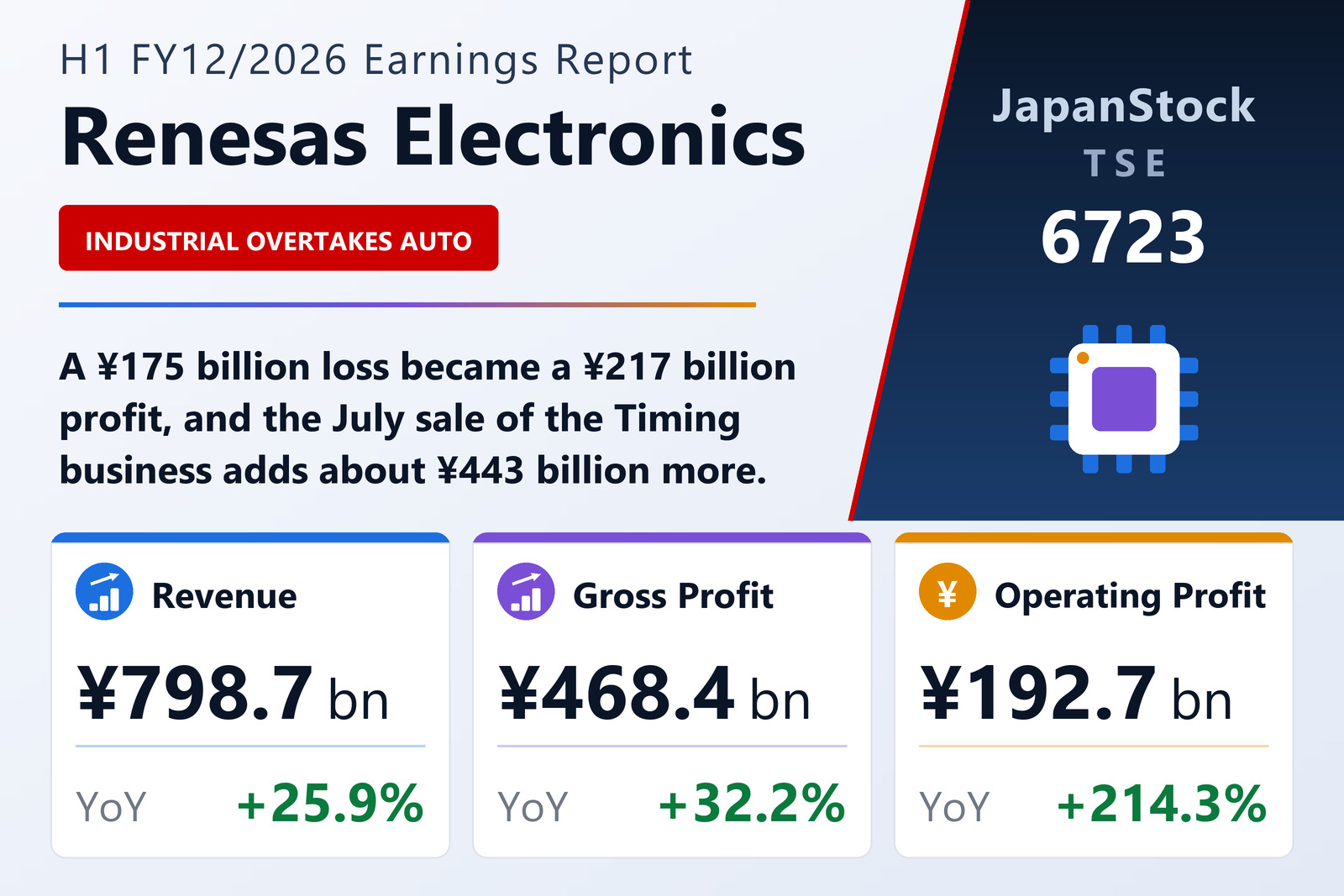
Renesas Electronics Corporation (TSE: 6723) published consolidated results for the first half of FY12/2026 on July 31, 2026, covering January 1 to June 30, 2026 under IFRS. Every line reversed. Revenue rose 25.9% to ¥798,742 million. Operating profit rose 214.3% to ¥192,680 million from ¥61,301 million. Pre-tax profit was ¥254,785 million against a ¥169,288 million loss, and profit attributable to owners of the parent ¥217,333 million against a ¥175,342 million loss. Basic earnings per share were ¥119.51 against negative ¥97.34; diluted EPS ¥117.47.
The comparison flatters, because the prior-year first half carried a ¥227,697 million impairment loss and ¥237,180 million of financial costs. But the operating improvement is genuine and does not depend on that base. Gross profit rose 32.2% to ¥468,411 million, faster than revenue, taking the gross margin to 58.64% from 55.84% — 2.80 points. And operating profit grew far faster still, so the operating margin reached 24.12% against 9.66%. On a business growing revenue 25.9%, an operating margin gain of 14.5 points is the signature of a semiconductor company whose fixed cost base is being absorbed by rising volume.
Below the operating line the swing is almost entirely financial. Financial income of ¥73,021 million against ¥6,829 million and financial costs of ¥10,664 million against ¥237,180 million together account for ¥293 billion of the ¥424 billion improvement in pre-tax profit. The equity-method loss was a negligible ¥252 million. Other expenses also normalised, falling 76.9% to ¥3,441 million from ¥14,929 million, as the prior year's ¥6,528 million impairment and ¥3,551 million litigation provision did not recur at anything like that scale.
Comprehensive income of ¥438,910 million, against a negative ¥475,677 million a year earlier, is more than double the attributable profit — the difference being currency translation and other valuation movements on a group with large overseas operations.
Industrial has overtaken Automotive
Renesas reports two business segments, and the balance between them has shifted. Industrial/Infrastructure/IoT — the businesses supporting industry, infrastructure and the connected-devices market — grew external revenue 38.1% to ¥412,206 million, segment gross profit 39.1% to ¥252,548 million and segment operating profit 96.4% to ¥131,827 million, a segment operating margin of 31.98% against 22.50%.
Automotive — semiconductors controlling engines, bodies and increasingly driver assistance — grew external revenue 13.4% to ¥358,679 million, gross profit 20.8% to ¥199,777 million and segment operating profit 50.8% to ¥126,061 million, an operating margin of 35.15% against 26.43%. Automotive remains the more profitable of the two by margin; Industrial is now the larger by revenue and the faster-growing by a factor of nearly three.
The crossover is worth stating precisely. A year ago Automotive was 49.9% of segment revenue and Industrial 47.1%; now Industrial is 53.0% and Automotive 46.1%. For a company whose identity has long been built on automotive microcontrollers, that is a structural change, and it happened inside twelve months. The 'Other' segment grew revenue 46.6% to ¥27,458 million with operating profit up 102.2% to ¥14,431 million.
A note on how the segment figures reconcile: adjustments totalling negative ¥20,730 million of revenue and negative ¥14,155 million of operating profit sit between segment totals and the group's ¥777,613 million subtotal, and a second adjustment layer of positive ¥21,129 million of revenue and negative ¥65,484 million of operating profit reconciles to the consolidated ¥798,742 million and ¥192,680 million. The second layer carries amortisation of acquisition-related intangibles and other non-recurring items that the board excludes when evaluating segment performance — which is why segment operating profits sum to far more than the consolidated figure.
A ¥443 billion gain lands in the second half
The largest number in this filing is not in the financial statements at all. Renesas had classified the assets and liabilities of its Timing business as held for sale during the first half, and the transfer to SiTime completed on July 1, 2026. Because that falls after the balance-sheet date, none of it appears in these accounts. The company states that, based on estimates at completion, the transfer is expected to produce a gain of approximately ¥443.3 billion, while cautioning that the final profit-and-loss impact — including related taxes and incidental costs — may change on further review.
To put that in scale: ¥443.3 billion is more than double the ¥217.3 billion of attributable profit Renesas earned in the entire first half, and roughly 55% of first-half revenue. It is a one-off, it is not in the Non-GAAP guidance discussed below, and it will make the reported full-year figures very hard to compare with anything.
The second subsequent event runs the other way and is not yet quantified. The 2026 Kumamoto Earthquake of July 28, 2026 affected the company's Nishiki Plant in Nishiki-machi, Kuma-gun, Kumamoto Prefecture, and the Kawashiri Plant in Kumamoto City operated by consolidated subsidiary Renesas Semiconductor Manufacturing. Renesas says details and the scale of damage at both plants are under investigation. For a semiconductor manufacturer, a fabrication interruption affects revenue with a lag and through customers' inventories; with no quantification available, this is the clearest open risk in the filing.
Wolfspeed sits outside the accounts
A structural disclosure worth understanding: Renesas's US subsidiary holds 16,852,372 Wolfspeed common shares, warrants for a further 4,943,555 shares, and convertible bonds. Those instruments carry ownership restrictions — exercise or conversion beyond 39.9% is invalid — and a voting cap of 9.9%. On that basis Renesas judges that it has neither control nor significant influence over Wolfspeed, so the company is neither consolidated nor accounted for under the equity method. The holding is therefore carried as a financial instrument, and its fair-value movements pass through the financial income and cost lines rather than through operating profit — relevant context for the ¥73,021 million of financial income recorded this half.
Separately, contingent consideration from the Panthronics AG acquisition — payable on product-development and volume-production milestones, up to US$61 million — stood at ¥1,566 million at the level-3 fair value, against ¥1,582 million at the start of the period.
A materially stronger balance sheet
Total assets rose 9.2% to ¥4,562,527 million from ¥4,177,163 million, and total equity rose faster still, up 16.6% to ¥2,855,550 million, with equity attributable to owners of the parent also up 16.6% to ¥2,849,646 million. The equity ratio improved to 62.5% from 58.5%, a four-point gain in six months driven by the profit swing and the comprehensive-income contribution.
That matters because Renesas entered this period carrying the balance-sheet consequences of the prior year's impairment. Rebuilding four points of equity ratio in half a year — before the Timing gain is recognised — restores considerable capacity, and the Timing proceeds will add to it in the second half.
Guidance is a range, and only for the third quarter
Renesas does not publish full-year guidance. It discloses a cumulative forecast for the next quarter, expressed as a range and on a Non-GAAP basis — figures adjusted from IFRS by removing non-recurring and certain other items, which the company considers more useful for understanding underlying performance.
For the nine months to September 30, 2026 it guides Non-GAAP revenue of ¥1,200,113 million to ¥1,215,113 million, up 24.0% to 25.6%, a Non-GAAP gross margin of 58.2% (up 1.1 points) and a Non-GAAP operating margin of 33.0% (up 4.1 points), both calculated at the midpoint of the revenue range.
Two observations follow. First, the implied third quarter is roughly ¥401 billion to ¥416 billion of Non-GAAP revenue against ¥798.7 billion booked in the first half — a sequential run rate broadly in line, so the guidance does not assume acceleration. Second, the guided Non-GAAP operating margin of 33.0% is well above the 24.12% IFRS operating margin just reported, which is the measure of how much amortisation and non-recurring cost the Non-GAAP presentation strips out. Readers comparing Renesas with peers should be clear which of the two they are using.
On the dividend, FY12/2025 paid ¥28.00 per share, all at the year-end. For FY12/2026 the company has declared ¥0.00 at the first and second quarter-ends and has not yet set third-quarter or year-end amounts, so no annual total is disclosed; there is no revision to the previously published dividend forecast. Given the size of the Timing gain now landing in the second half, the year-end decision is the one to watch.
| Metric | H1 FY12/2026 | H1 FY12/2025 | Change |
|---|---|---|---|
| Revenue (¥ million) | 798,742 | 634,311 | +25.9% |
| Gross profit (¥ million) | 468,411 | 354,204 | +32.2% |
| Gross margin | 58.64% | 55.84% | +2.80 pt |
| Operating profit (¥ million) | 192,680 | 61,301 | +214.3% |
| Operating margin | 24.12% | 9.66% | +14.46 pt |
| Financial income (¥ million) | 73,021 | 6,829 | +969.2% |
| Financial costs (¥ million) | 10,664 | 237,180 | −95.5% |
| Pre-tax profit (¥ million) | 254,785 | −169,288 | loss to profit |
| Net profit attrib. to owners of parent (¥ million) | 217,333 | −175,342 | loss to profit |
| Comprehensive income (¥ million) | 438,910 | −475,677 | loss to profit |
| EPS (¥) | 119.51 | −97.34 | loss to profit |
| Diluted EPS (¥) | 117.47 | −97.34 | loss to profit |
| Automotive — revenue (¥ million) | 358,679 | 316,306 | +13.4% |
| Automotive — segment gross profit (¥ million) | 199,777 | 165,342 | +20.8% |
| Automotive — segment profit (¥ million) | 126,061 | 83,598 | +50.8% |
| Industrial/Infrastructure/IoT — revenue (¥ million) | 412,206 | 298,383 | +38.1% |
| Industrial/Infrastructure/IoT — segment gross profit (¥ million) | 252,548 | 181,548 | +39.1% |
| Industrial/Infrastructure/IoT — segment profit (¥ million) | 131,827 | 67,130 | +96.4% |
| Other — revenue (¥ million) | 27,458 | 18,725 | +46.6% |
| Other — segment profit (¥ million) | 14,431 | 7,137 | +102.2% |
| Other expenses (¥ million) | 3,441 | 14,929 | −76.9% |
| Total assets (¥ million) | 4,562,527 | 4,177,163 | +9.2% |
| Total equity (¥ million) | 2,855,550 | 2,448,451 | +16.6% |
| Equity attrib. to owners of parent (¥ million) | 2,849,646 | 2,443,034 | +16.6% |
| Equity ratio | 62.5% | 58.5% | +4.0 pt |
| Q1–Q3 FY12/2026 guidance — Non-GAAP revenue, low end (¥ million) | 1,200,113 | — | +24.0% |
| Q1–Q3 FY12/2026 guidance — Non-GAAP revenue, high end (¥ million) | 1,215,113 | — | +25.6% |
| Q1–Q3 FY12/2026 guidance — Non-GAAP gross margin | 58.2% | — | +1.1 pt |
| Q1–Q3 FY12/2026 guidance — Non-GAAP operating margin | 33.0% | — | +4.1 pt |
| Expected gain on transfer of Timing business (¥ million) | 443,300 | — | new |
JapanStockPulse provides informational content only and does not constitute investment advice. Figures are taken from the company's published earnings short report and may be subject to subsequent revision.