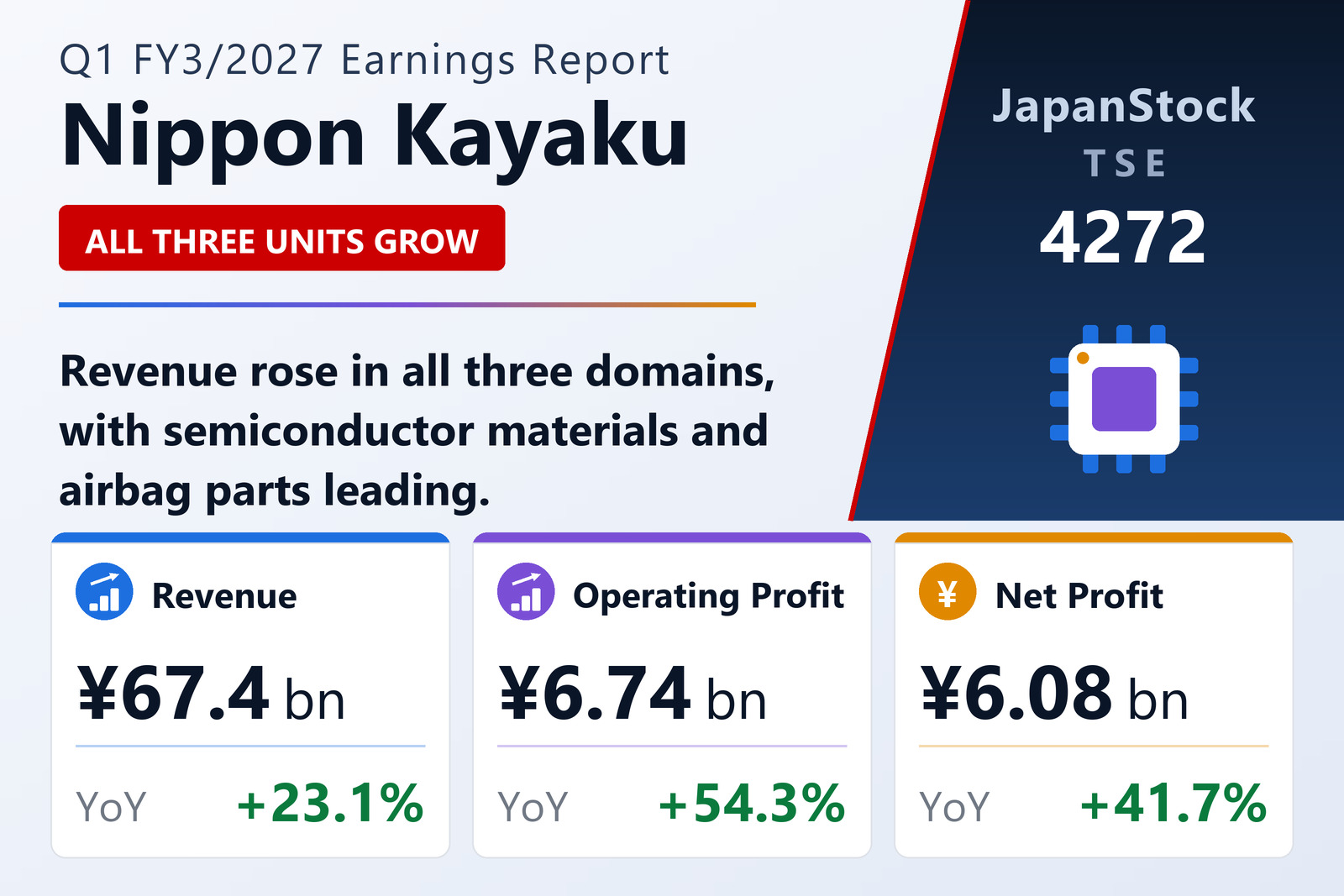
All three domains grew revenue and profit at the same time
Nippon Kayaku Co., Ltd. (TSE: 4272) disclosed consolidated results for the first quarter of the fiscal year ending March 2027 — April 1 to June 30, 2026 — under Japanese GAAP on August 3, 2026. Revenue came in at ¥67,402 million, up 23.1% year on year from ¥54,758 million, an increase of ¥12,644 million. Operating profit rose 54.3% to ¥6,740 million from ¥4,367 million, an increase of ¥2,372 million. Both lines advanced in each of the group's three business domains — Mobility & Imaging, Fine Chemicals and Life Science — a rarer alignment than it sounds: the same quarter a year earlier delivered revenue growth of just 2.1% and a 21.6% fall in operating profit. The operating margin widened to 10.0% from 8.0%.
Below the operating line, two things happened for two different reasons, and neither is purely a trading result. Ordinary profit rose 81.7% to ¥7,390 million, and the gap over operating profit belongs mainly to foreign exchange: the year-ago quarter carried a ¥929 million FX loss in non-operating expenses, while this quarter carried a ¥249 million FX gain in non-operating income — a swing of roughly ¥1.2 billion, which is most of the distance between 54.3% and 81.7%. One step further down the direction reverses. Net profit attributable to owners of parent rose 41.7% to ¥6,081 million from ¥4,292 million, for basic earnings per share of ¥41.08 against ¥27.29 (diluted identical at ¥41.08). The company cites gains on sales of investment securities, and there were ¥1,725 million of them — but that is less than the ¥2,131 million booked a year earlier. Extraordinary losses also rose to ¥334 million from ¥188 million, and the effective tax rate rose to 31.5% from 28.2%. Pre-tax profit rose 47.9% to ¥8,891 million; net profit grew more slowly still. Comprehensive income, which picks up the yen's move on overseas subsidiaries and holdings, more than doubled to ¥11,549 million from ¥5,111 million, up 125.9%.
One accounting item should be isolated before the operating line is read as pure performance. From this quarter Nippon Kayaku and its domestic consolidated subsidiaries switched the depreciation method for tangible fixed assets from mainly the declining-balance method to the straight-line method, a change the company classifies as a change in accounting policy that cannot be distinguished from a change in estimates, made after reviewing asset usage for the new medium-term plan. It lifted first-quarter operating profit, ordinary profit and pre-tax profit by ¥189 million each — about 8% of the ¥2,372 million operating-profit increase. Quarterly depreciation was ¥3,453 million against ¥3,568 million a year earlier, with goodwill amortisation of ¥36 million. No quarterly consolidated cash flow statement was prepared, and the attached quarterly statements are unreviewed.
Mobility & Imaging: capacity added in China and Malaysia beats soft global auto output
The group's largest domain by revenue, at roughly 40% of the total, produced revenue of ¥26,927 million, up 20.3%, and segment profit of ¥3,392 million, up 43.9%. Safety Systems grew despite a weak backdrop: global automobile production was soft as Chinese demand decelerated. What offset it was capacity the group had already put in place — expansions in China and Malaysia built to serve the long-run rise in the number of safety components fitted per vehicle — and sales of airbag inflators, micro gas generators for seatbelt pretensioners and squibs all came in above a year earlier. Polatechno also grew: light-shielding plates for head-up displays expanded and components for X-ray analysers rose, together more than offsetting a decline in materials for LCD projectors. The Aero business grew on drone safety devices, mainly in North America. Segment margin was 12.6%.
Fine Chemicals: AI-server demand carries functional materials as dye materials give back a tariff pull-forward
Revenue was ¥20,554 million, up 23.0%, and segment profit ¥3,324 million, up 33.2% — the highest segment margin of the three at 16.2%. Functional materials rose across every product group as semiconductor demand held firm, in leading-edge areas including AI and high-end servers as well as in commodity applications. Catalysts also rose. The one line that fell was dye materials, and the reason is a base effect rather than a demand problem: industrial inkjet inks and dyes for consumer inkjet printers both traded steadily, but the year-ago quarter had been inflated by customers pulling orders forward on worries about US tariffs. That comparison gets easier as the year progresses.
Life Science: oncology and biosimilars push domestic formulations
Revenue was ¥19,920 million, up 27.2% — the fastest growth of the three domains — while segment profit rose 17.3% to ¥2,184 million, the slowest profit growth of the three. Domestic pharmaceutical formulations grew as four products gained market penetration: the anti-cancer agent Ibtrozi® capsules 200mg, the human anti-EGFR monoclonal antibody Portrazza® injection, and the biosimilars bevacizumab BS and adalimumab BS. Exports also rose, while domestic active pharmaceutical ingredients and diagnostics declined. Agrochemicals rose in both domestic sales and exports, and the group's real-estate business rose as well. The ten-point gap between 27.2% revenue growth and 17.3% profit growth marks this as the domain where the top line is currently the most expensive to buy; segment margin was 11.0%. Across the three domains, segment profit totalled ¥8,901 million against ¥6,717 million a year earlier, bridged to reported operating profit by an adjustment of −¥2,161 million — unallocated corporate expenses of ¥2,169 million net of ¥8 million of inter-segment elimination — a slightly lighter drag than the −¥2,349 million of a year earlier.
Balance sheet: a buyback and a share cancellation, part-funded with short-term debt
Total assets stood at ¥419,884 million at June 30, 2026, up ¥21,148 million from ¥398,736 million at the March year-end. The largest single move was long-term prepaid expenses, up ¥15,562 million, followed by investment securities up ¥3,545 million and merchandise and finished goods up ¥2,567 million; securities fell ¥3,098 million. Liabilities rose ¥17,582 million to ¥136,214 million, driven almost entirely by short-term borrowings up ¥20,002 million to ¥31,015 million, with non-current deferred tax liabilities up ¥2,186 million against income taxes payable down ¥4,432 million.
Net assets rose ¥3,565 million to ¥283,669 million, but the composition is where the quarter's capital policy shows. Retained earnings fell ¥15,481 million while the treasury-share deduction shrank by ¥13,611 million, and the notes to the statements explain both: under a May 12, 2026 board resolution the company bought back 1,244,100 of its own shares for ¥2,604 million during the quarter, and on May 22, 2026 cancelled 11,300,000 treasury shares, a transaction that reduced other retained earnings and treasury shares by ¥16,216 million each. Shares issued including treasury fell to 148,700,000 from 160,000,000, and the treasury holding to 1,449,578 shares from 11,505,220. Alongside that, the foreign currency translation adjustment added ¥3,111 million and the valuation difference on available-for-sale securities ¥2,483 million. Shareholders' equity closed at ¥282,556 million and the equity ratio fell to 67.3% from 70.0% — capital returned on one side of the balance sheet while ¥20.0 billion of new short-term borrowing came in on the other. At 67.3% the ratio remains high by any industrial standard.
Guidance revised: revenue and operating profit up sharply, net profit down
The tanshin flags a revision to the full-year forecast published on May 12, 2026, with the detail carried in a separate "Notice of Revision to Earnings Forecast" also dated August 3, 2026. For the full year to March 2027 the company now guides to revenue of ¥270,900 million, up 12.0%, operating profit of ¥27,300 million, up 21.6%, and ordinary profit of ¥27,000 million, up 6.0% — but net profit attributable to owners of parent of ¥22,900 million, down 7.1%, for EPS of ¥158.66. First-half guidance is revenue of ¥133,800 million (+17.8%), operating profit of ¥13,700 million (+29.0%), ordinary profit of ¥13,800 million (+27.3%) and net profit of ¥13,100 million (+12.1%), for EPS of ¥89.35.
Set against the quarter just delivered, the shape of that guidance is conservative on the operating line and cautious below it. Q1's ¥6,740 million of operating profit already covers 24.7% of the full-year target and its ¥67,402 million of revenue 24.9% — essentially a straight-line pace, in a year the company expects to grow 12% on revenue and 21.6% on operating profit. Net profit is the outlier in the other direction: the ¥6,081 million booked in Q1 is 26.6% of the full-year target, and the first-half target of ¥13,100 million implies only about ¥9,800 million across the whole second half, materially less than the first. Read together, the operating business is guided to keep compounding while the lines beneath it are guided to hand back what one-off gains lent them.
The group began its medium-term plan "Evolution2035 Phase 1" this fiscal year, targeting higher capital efficiency and stronger sustainable growth through company-wide priority measures — a frame the quarter's buyback and cancellation sits comfortably inside. Management flags downside risk to the economy from geopolitical tension, higher US tariffs and elevated crude prices, and says it will optimise management capital, expand existing businesses in global growth markets and accelerate new businesses and products. The dividend forecast for FY3/2027 is unchanged at ¥66.00 per share, split ¥33.00 interim and ¥33.00 year-end, level with the ¥66.00 paid for FY3/2026 (¥30.00 plus ¥36.00) and implying a payout ratio of about 42% on forecast EPS. There was no significant change in the scope of consolidation, and no special accounting treatments were applied for the quarter.
| Metric | Q1 FY3/2027 | Q1 FY3/2026 | Change |
|---|---|---|---|
| Revenue (¥ million) | 67,402 | 54,758 | +23.1% |
| Operating profit (¥ million) | 6,740 | 4,367 | +54.3% |
| Operating margin | 10.0% | 8.0% | +2.0 pt |
| Ordinary profit (¥ million) | 7,390 | 4,067 | +81.7% |
| Net profit attrib. to owners of parent (¥ million) | 6,081 | 4,292 | +41.7% |
| Comprehensive income (¥ million) | 11,549 | 5,111 | +125.9% |
| Basic EPS (¥) | 41.08 | 27.29 | +50.5% |
| Mobility & Imaging revenue (¥ million) | 26,927 | 22,387 | +20.3% |
| Mobility & Imaging segment profit (¥ million) | 3,392 | 2,357 | +43.9% |
| Fine Chemicals revenue (¥ million) | 20,554 | 16,710 | +23.0% |
| Fine Chemicals segment profit (¥ million) | 3,324 | 2,496 | +33.2% |
| Life Science revenue (¥ million) | 19,920 | 15,659 | +27.2% |
| Life Science segment profit (¥ million) | 2,184 | 1,863 | +17.3% |
| Total assets (¥ million; vs Mar 31, 2026) | 419,884 | 398,736 | +5.3% |
| Net assets (¥ million; vs Mar 31, 2026) | 283,669 | 280,104 | +1.3% |
| Equity ratio (vs Mar 31, 2026) | 67.3% | 70.0% | −2.7 pt |
JapanStockPulse provides informational content only and does not constitute investment advice. Figures are taken from the company's published earnings short report and may be subject to subsequent revision.