A swing to profit on every line below revenue
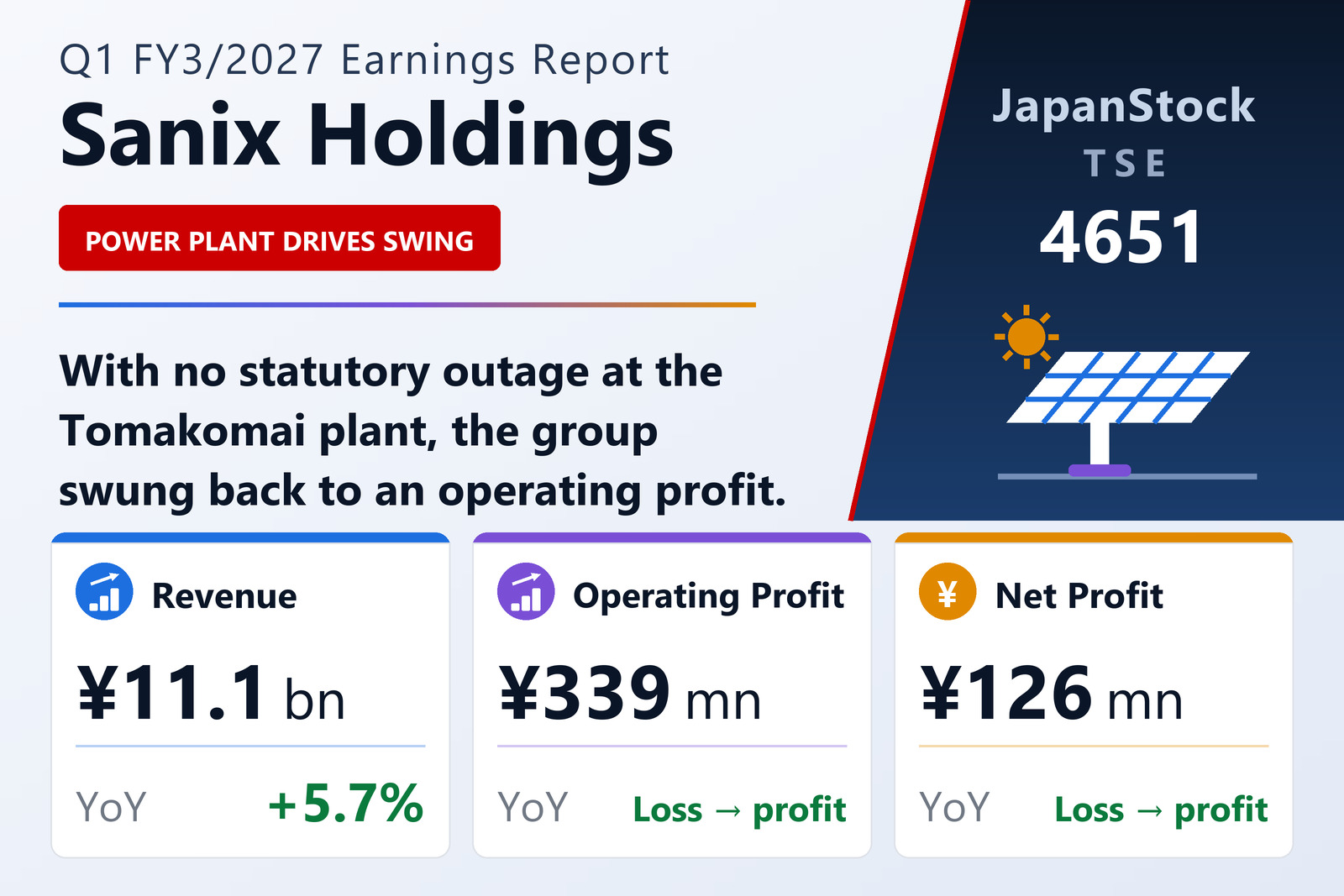
Sanix Holdings Co., Ltd. (TSE and Fukuoka Stock Exchange: 4651), the Fukuoka-based environmental services group, disclosed consolidated first-quarter results for the fiscal year ending March 2027 — April 1 to June 30, 2026 — under Japanese GAAP on August 17, 2026. Revenue rose 5.7% to ¥11,127 million from ¥10,531 million. Every profit line below it swung from loss to profit: operating profit of ¥339 million against an operating loss of ¥343 million a year earlier, ordinary profit of ¥280 million against an ordinary loss of ¥539 million, and net profit attributable to owners of parent of ¥126 million against a net loss of ¥640 million.
Earnings per share came in at ¥2.64 against a loss of ¥13.40; the company reports no diluted figure. Comprehensive income was ¥39 million against a loss of ¥592 million — a narrower swing than the net line, because a ¥96 million negative remeasurement on retirement benefits absorbed most of the quarter's profit inside other comprehensive income. The quarterly consolidated statements were not reviewed by an accounting auditor, and there were no changes to the scope of consolidation, no special quarterly accounting treatments and no accounting-policy changes.
The mechanics of the turn sit in the cost line rather than the top line. Revenue added ¥596 million year on year, but cost of sales fell ¥134 million to ¥7,134 million from ¥7,268 million — lifting gross profit 22.4% to ¥3,993 million and the gross margin to 35.9% from 31.0%. Selling, general and administrative expenses were broadly flat at ¥3,653 million against ¥3,607 million. On its own, that gross-margin move accounts for the entire ¥682 million improvement at the operating line.
Why it turned: no statutory outage at Tomakomai
The single explanation the company offers for the profit swing is the power-generation business inside its Resource Recycling domain. The statutory inspection of the Tomakomai power plant — the group's waste-plastic-fired generating station — was carried out in the prior fiscal year, so this quarter carried no comparable repair bill. The plant's stable operation through the quarter did a second job as well: it burned plastic fuel steadily enough to draw down inventory, which fed back into the margin. Power-generation revenue rose 129.9%, to ¥1,312 million from ¥571 million, and Resource Recycling as a whole turned an operating profit of ¥569 million against a ¥164 million loss.
Management frames the group's work under the corporate philosophy "A comfortable environment for the next generation", spread across three domains — Living Environment, Energy and Resource Recycling. The structure behind them changed recently: Sanix completed its full transition to a holding-company format in October 2025, leaving the holding company to set group strategy and allocate capital while the operating companies run each business. Japan's economy grew moderately over the quarter, supported by recovering output and exports behind a global pickup in AI-related investment and by firm capital spending, though the company flags geopolitical risk and its supply-chain effects, price movements and the currency market as reasons the outlook remains cloudy.
Living Environment holds a high gross margin; Energy slides deeper into loss
Living Environment, the domestic housing business, produced revenue of ¥4,092 million, up 3.8%, and operating profit of ¥726 million, up 32.6% — profit growth running more than eight times the revenue growth rate. The company attributes it to expansion of existing businesses on the back of its sales capability and customer base, with house repair and reinforcement work and renovation for detached homes both trading well. The core detached-housing service business, it says, drove that growth while holding a high gross margin, which is what converts a 3.8% revenue gain into a 32.6% profit gain.
Energy went the other way, and it is the one part of the group still losing money. Revenue fell 19.3% to ¥1,417 million, and the operating loss widened to ¥303 million from ¥60 million a year earlier — a five-fold deterioration on a roughly one-fifth revenue decline. The business sells and installs self-consumption solar systems for corporate customers, proposes PPA schemes to local governments, sells land-attached solar plants, and handles equipment replacement and maintenance on installed systems. Tighter regulation and higher required standards have changed the solar market, and competition has intensified. Sanix says it kept converting the business structure through project-by-project profitability control and cost review, but the lost revenue left fixed costs unabsorbed — the plain arithmetic of a fixed-cost base meeting a ¥339 million revenue decline.
Inside Resource Recycling: power generation doubles, plastics slips
Resource Recycling is now the group's largest domain by revenue at ¥5,537 million, up 16.5%, and the composition of that growth is strikingly uneven. Power generation supplied almost all of it — ¥1,312 million against ¥571 million, or ¥741 million of the ¥784 million the domain added in total. Landfill treatment rose 7.6% to ¥249 million and the new-electricity retail business rose 6.8% to ¥702 million. The plastics business, still the domain's largest single line at ¥2,693 million, slipped 0.5%: the company raised processing unit prices, but intake volumes fell, partly because of the Middle East situation. Liquid-waste treatment was roughly flat at ¥579 million.
That concentration is worth holding onto. A domain that swung ¥733 million at the operating line did so largely because one plant was not taken offline for its statutory inspection and ran steadily instead — a genuinely better quarter of operation, but one whose year-on-year comparison flatters it, and one that will face a harder base whenever the next inspection cycle comes round.
Balance sheet: smaller on both sides, equity ratio up
Total assets stood at ¥39,531 million at June 30, 2026, down ¥492 million from ¥40,024 million three months earlier. Current assets fell ¥508 million to ¥14,593 million: cash and deposits rose ¥335 million and other current assets rose ¥317 million on higher prepaid expenses, against a ¥1,294 million fall in notes and accounts receivable. Non-current assets were essentially unchanged at ¥24,937 million, up ¥15 million, mainly on an ¥81 million increase in other property, plant and equipment reflecting construction in progress.
Total liabilities fell ¥436 million to ¥28,581 million. Current liabilities rose ¥257 million to ¥18,637 million as short-term borrowings increased ¥953 million, against a ¥271 million fall in income taxes payable and a ¥182 million fall in other accrued payables. Non-current liabilities fell ¥694 million to ¥9,943 million on a ¥486 million reduction in long-term borrowings and a ¥212 million fall in other non-current liabilities as long-term payables came down, partly offset by a ¥38 million rise in net defined benefit liability. The shift from long-term to short-term borrowing is the main funding change in the quarter.
Net assets fell ¥55 million to ¥10,950 million: retained earnings rose only ¥31 million once the prior year's ¥2.00 year-end dividend had been paid out of the ¥126 million of quarterly profit, and accumulated other comprehensive income fell ¥86 million. Owners' equity was the same ¥10,950 million, and the equity ratio improved to 27.7% from 27.5% — rising because the asset base shrank faster than equity did rather than because equity grew. Net assets per share slipped to ¥229.07 from ¥230.24. Shares issued stood at 48,919,396 with 1,115,631 held in treasury, for a weighted average of 47,803,803 over the quarter. Depreciation and amortisation was ¥455 million against ¥410 million; no quarterly consolidated cash-flow statement was prepared.
Guidance untouched, dividend forecast lifted 50%
Sanix left its FY3/2027 guidance exactly as issued on May 15, 2026. For the first half it expects revenue of ¥22,178 million, up 3.1%, with operating profit of ¥461 million, ordinary profit of ¥335 million and net profit of ¥217 million for EPS of ¥4.54 — all four profit lines are swings from prior-year losses, so the company gives no percentage. For the full year it expects revenue of ¥47,301 million, up 4.4%, operating profit of ¥1,837 million, up 44.4%, ordinary profit of ¥1,578 million, up 116.8%, and net profit of ¥1,002 million, up 137.6%, for EPS of ¥20.96.
Set the quarter against those targets and the shape of the year becomes clear. Q1's ¥339 million of operating profit is 18.5% of the ¥1,837 million full-year figure and its ¥126 million of net profit only 12.6% of the ¥1,002 million target — both short of a straight-line quarter. The guidance also implies the second quarter contributes just ¥122 million of operating profit against Q1's ¥339 million, so the bulk of the year's profit is guided into the second half. Revenue is on an easier path: ¥11,127 million is 23.5% of the ¥47,301 million target.
On shareholder returns, the FY3/2027 dividend forecast is ¥3.00 per share, all of it at the year-end with nothing at the interim, against ¥2.00 paid for FY3/2026 — a 50% increase, and unrevised from the previous announcement. Against forecast EPS of ¥20.96 that implies a payout ratio of roughly 14%, leaving the raise well covered even if the second-half weighting in the guidance proves demanding.
| Metric | Q1 FY3/2027 | Q1 FY3/2026 | Change |
|---|---|---|---|
| Revenue (¥ million) | 11,127 | 10,531 | +5.7% |
| Gross profit (¥ million) | 3,993 | 3,263 | +22.4% |
| Operating profit / loss (¥ million) | 339 | −343 | Swing to profit |
| Ordinary profit / loss (¥ million) | 280 | −539 | Swing to profit |
| Net profit attrib. to owners of parent (¥ million) | 126 | −640 | Swing to profit |
| Comprehensive income (¥ million) | 39 | −592 | Swing to profit |
| EPS (¥) | 2.64 | −13.40 | +¥16.04 |
| Living Environment revenue (¥ million) | 4,092 | 3,942 | +3.8% |
| Living Environment segment profit (¥ million) | 726 | 547 | +32.6% |
| Energy revenue (¥ million) | 1,417 | 1,756 | −19.3% |
| Energy segment loss (¥ million) | −303 | −60 | Loss widened |
| Resource Recycling revenue (¥ million) | 5,537 | 4,753 | +16.5% |
| Resource Recycling segment profit / loss (¥ million) | 569 | −164 | Swing to profit |
| Power generation revenue (¥ million) | 1,312 | 571 | +129.9% |
| Total assets (¥ million; vs Mar 31, 2026) | 39,531 | 40,024 | −1.2% |
| Net assets (¥ million; vs Mar 31, 2026) | 10,950 | 11,006 | −0.5% |
| Equity ratio (vs Mar 31, 2026) | 27.7% | 27.5% | +0.2 pt |
JapanStockPulse provides informational content only and does not constitute investment advice. Figures are taken from the company's published earnings short report and may be subject to subsequent revision.