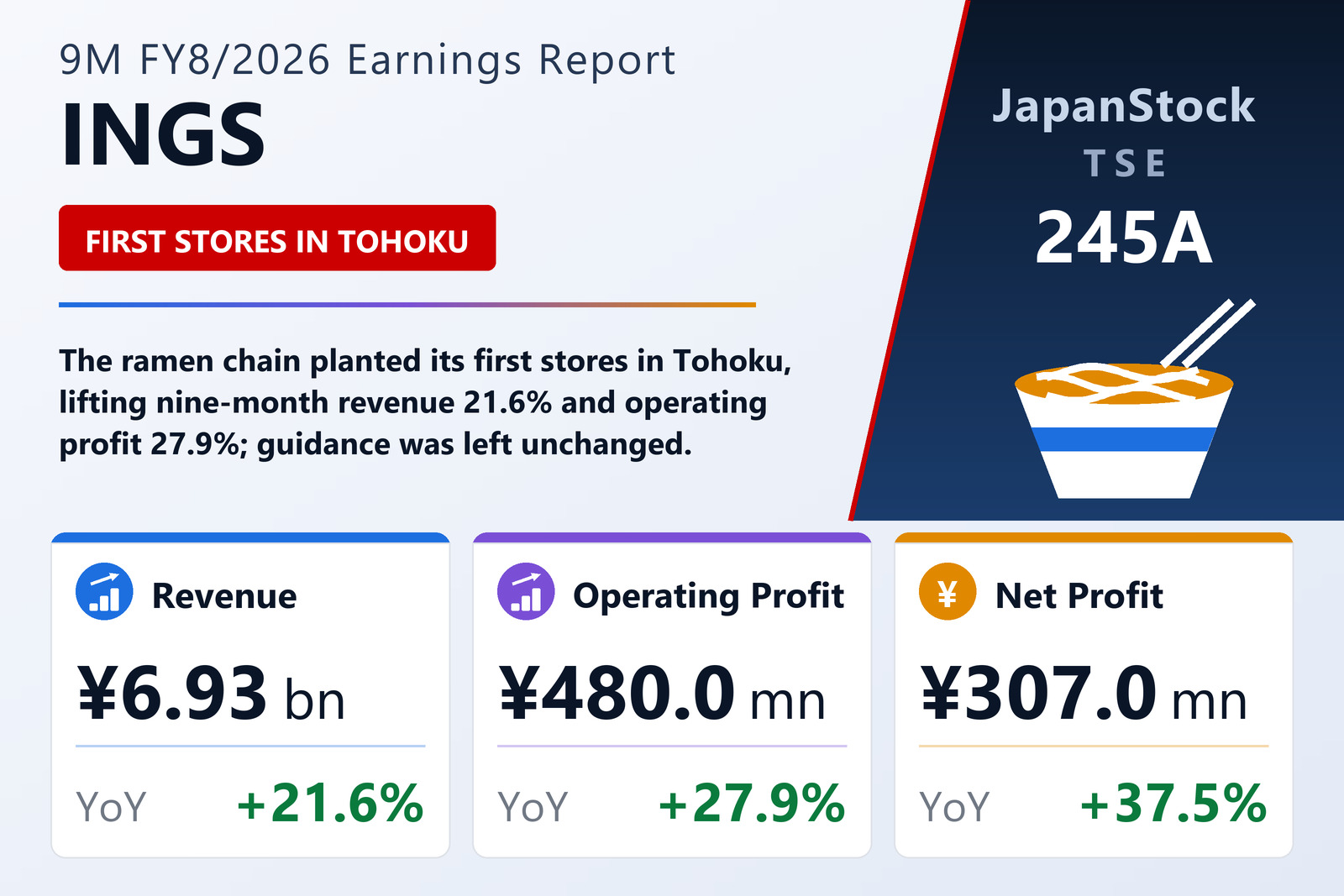
INGS Inc. (TSE: 245A), the Tokyo-based ramen and restaurant operator led by President Masaki Aoyagi, reported non-consolidated results for the first nine months of the fiscal year ending August 2026 (September 1, 2025 – May 31, 2026) under Japanese GAAP. Revenue rose 21.6% to ¥6,926 million, operating profit 27.9% to ¥480 million, ordinary profit 36.4% to ¥463 million and quarterly net profit 37.5% to ¥307 million. Earnings per share climbed to ¥121.83 from ¥90.96, with diluted EPS at ¥119.20 against ¥88.77. The figures are not subject to auditor review.
Ramen business adds three stores and crosses into Tohoku
The ramen segment, INGS's larger business, generated revenue of ¥3,763 million, up 25.6%, and segment profit of ¥359 million, up 21.7%. Three directly operated stores opened during the period: a "Ra-men Hayashida" (らぁ麺 はやし田) in front of Sendai Station, and two "Yokohama Iekei Ramen Midori" (横浜家系ラーメン みどり) outlets at Sasazuka in Tokyo and on Sendai's Hirosedori. The two Sendai openings are the chain's first stores in the Tohoku region, extending a network that now counts 45 directly operated ramen stores. Existing directly operated stores were not simply diluted by the new capacity: same-store sales ran at 101.6% of the prior-year period. Franchised ramen stores edged down by one to 72, purely because a single franchise was converted into a directly operated outlet rather than closed.
Restaurant segment profit rises 50% on CONA conversion
The restaurant business — the non-ramen formats — posted revenue of ¥3,164 million, up 17.1%, and segment profit of ¥122 million, up 50.5%, the fastest profit growth in the company. INGS rebranded its "Shumai no Joe" (焼売のジョー) store at Yokohama West Exit into a "CONA" outlet, taking CONA to 23 directly operated stores, Shumai no Joe to 11 and other formats to 3, for a segment total of 37 directly operated restaurants. Existing store sales ran at 103.4% of the prior-year period, ahead of the ramen chain. Franchise numbers were unchanged on a net basis at 27 CONA and 4 Shumai no Joe, with one opening offset by one closure. The segment continues to carry ¥81 million of goodwill and customer-related intangible amortisation in SG&A, a legacy of the October 2018 acquisition of Candy BOX Inc. and its absorption-type merger in August 2021.
Balance sheet expands with the store rollout
Total assets rose ¥547 million from the previous fiscal year-end to ¥5,110 million. The increase came from cash and deposits up ¥176 million, accounts receivable up ¥47 million, other current assets up ¥66 million, tangible fixed assets up ¥235 million on new store openings, and lease and guarantee deposits up ¥38 million. On the other side, accounts payable rose ¥47 million and the current portion of long-term borrowings ¥25 million. Net assets improved to ¥2,271 million from ¥1,960 million, lifting the equity ratio to 44.4% from 43.0%. Issued shares stood at 2,524,660 against 2,517,900 a year earlier, with no treasury stock; the weighted average count used for EPS was 2,520,653. The dividend remains at ¥0.00, unchanged from FY8/2025 and unchanged in the FY8/2026 forecast, with earnings retained to fund the store pipeline.
Guidance held despite the profit target being nearly met
INGS reiterated the full-year FY8/2026 forecast it issued previously: revenue of ¥9,590 million (+24.0%), operating profit of ¥596 million (+21.4%), ordinary profit of ¥565 million (+25.7%), net profit of ¥339 million (+24.8%) and EPS of ¥135.03. The arithmetic leaves an unusual gap: nine-month revenue of ¥6,926 million represents 72.2% of the annual target, broadly in line with elapsed time, but nine-month net profit of ¥307 million is already 90.6% of the full-year figure, implying either a conservative stance or a heavier cost load penciled in for the final quarter. Management described a Japanese economy in gradual recovery on improving employment and income, with inbound visitor numbers still growing although the pace of growth from China has slowed, and foodservice customer counts recovering alongside foot traffic. Against that, raw-material price inflation and rising labour costs from a persistent labour shortage remain the principal headwinds; the company says it is responding with menu changes, price revisions and reviews of store operations. There were no material subsequent events. Note that prior-year comparatives for the nine months of FY8/2024 do not exist, as INGS did not prepare quarterly statements before its TSE Growth listing on September 26, 2024, and the FY8/2025 diluted EPS was computed using the average share price from the listing date onward.
| Metric | 9M FY8/2026 | 9M FY8/2025 | YoY |
|---|---|---|---|
| Revenue (¥ million) | 6,926 | 5,697 | +21.6% |
| Operating profit (¥ million) | 480 | 375 | +27.9% |
| Ordinary profit (¥ million) | 463 | 339 | +36.4% |
| Net profit (¥ million) | 307 | 223 | +37.5% |
| EPS (¥) | 121.83 | 90.96 | +33.9% |
| Diluted EPS (¥) | 119.20 | 88.77 | +34.3% |
| Ramen segment revenue (¥ million) | 3,763 | 2,996 | +25.6% |
| Restaurant segment revenue (¥ million) | 3,164 | 2,702 | +17.1% |
| Total assets (¥ million, vs prior FY-end) | 5,110 | 4,563 | +12.0% |
| Equity ratio (%, vs prior FY-end) | 44.4 | 43.0 | +1.4 pt |
JapanStockPulse provides informational content only and does not constitute investment advice. Figures are taken from the company's published earnings short report and may be subject to subsequent revision.