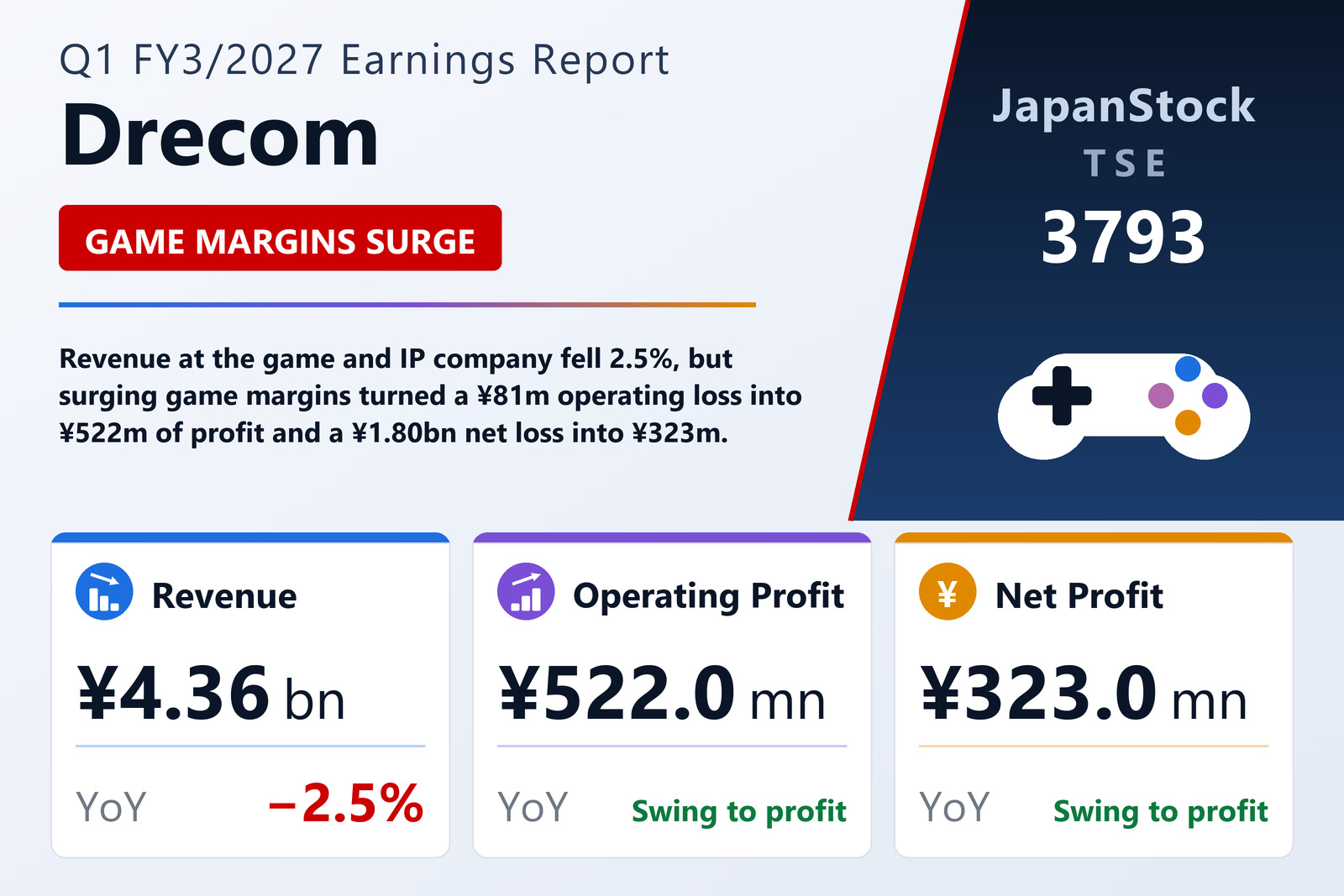
Drecom Co., Ltd. (TSE: 3793), the Tokyo-based game developer and IP producer behind the Wizardry franchise, reported consolidated results for the first quarter of the fiscal year ending March 2027 — the three months from April 1 to June 30, 2026 — under Japanese GAAP. Revenue slipped 2.5% to ¥4,355 million from ¥4,466 million, but every profit line reversed: operating profit came in at ¥522 million against a year-earlier operating loss of ¥81 million, ordinary profit at ¥512 million against a ¥107 million ordinary loss, and profit attributable to owners of the parent at ¥323 million against a net loss of ¥1,799 million. Earnings per share were ¥11.21, versus a loss of ¥62.60 a year earlier; diluted EPS was also ¥11.21.
The same revenue base, a very different cost base
The top-line decline is easily mistaken for weakness. It is measured against a first quarter a year ago in which revenue had more than doubled, rising 110.4% on the launch wave of new titles. Against that elevated base, this quarter's ¥4,355 million is broadly flat — and it now converts into profit rather than loss. Comprehensive income was ¥323 million, reversing a comprehensive loss of ¥1,799 million.
The gap between the two years' bottom lines is far wider than the gap between their operating lines, and the reason sits below the operating result. In the first quarter of the previous fiscal year the group booked an impairment loss of ¥1,563 million as an extraordinary item, recorded in the game segment. That single charge turned an ¥81 million operating loss into a ¥1,799 million net loss. This quarter carried no impairment loss at all, which is why EPS swings by more than ¥73 per share on an operating result that improved by roughly ¥600 million.
Games: fewer titles, far better economics
The game business generated segment revenue of ¥4,145 million, down 4.2%, but segment profit of ¥793 million — up 545.7% from ¥122 million. Revenue fell because two consolidated subsidiaries in the segment were sold at the end of the year to March 2026, cutting the number of live-operated titles from eleven to nine; the two remaining flagship titles, led by the self-published Wizardry Variants Daphne released in October 2024 and an IP title marking its twelfth anniversary, performed well on anniversary campaigns.
Profitability improved for three stated reasons: software amortisation and advertising expenses that had accompanied the prior year's new-title launch fell away, losses on unprofitable titles narrowed, and — the principal factor, according to management — payment-processing fee rates came down. Depreciation and amortisation for the quarter, including amortisation of intangibles, was ¥264 million, against ¥428 million a year earlier. The company has also begun developing PC and console games and publishing indie titles, aimed at creating IP inside the game segment rather than only licensing it in.
Content: publishing grows, but the segment stays in the red
The content business — light novels and comics publishing, the "Drecomi+" web-manga site, anime planning and production, merchandising, and a location-linked walking-points app — lifted segment revenue 35.3% to ¥209 million. Management attributed the growth mainly to publishing, where a reinforced editorial organisation raised the number of titles released, including original comics, and where several series have passed 400,000 cumulative copies.
Profitability moved the other way. The segment loss widened to ¥270 million from ¥204 million as the group kept investing ahead of revenue: production costs rose with the increased number of new series, and the company continued hiring IP-production staff. Management expects this front-loading of costs to continue while it builds out publishing, anime and merchandising.
A smaller balance sheet and a stronger equity ratio
Total assets fell to ¥11,067 million at the quarter end from ¥11,876 million at the March 2026 year-end. Current assets declined ¥658 million, driven by a ¥921 million fall in cash and deposits, while fixed assets fell ¥149 million on a ¥240 million reduction in software. Liabilities came down faster: current liabilities dropped ¥894 million — income taxes payable fell ¥337 million, the current portion of long-term borrowings ¥273 million and accounts payable–other ¥165 million — and non-current liabilities fell ¥140 million, mostly on a ¥156 million reduction in long-term borrowings.
Net assets rose ¥226 million to ¥5,269 million, essentially the quarter's ¥323 million of net profit. The combination of debt repayment and retained earnings lifted the equity ratio to 47.0% from 42.0%, and book value per share to ¥181.44 from ¥172.26. Issued shares stood at 29,446,212, of which 780,495 were treasury shares, up from 516,395 at the year-end.
Guidance untouched despite a fast start — and a ¥5.00 dividend plan
Drecom left its full-year forecasts unchanged: revenue of ¥18,000 million (+2.6%), operating profit of ¥1,000 million (+144.7%), ordinary profit of ¥900 million (+182.2%) and net profit of ¥600 million (+180.8%), for EPS of ¥21.05. That is a conservative stance on the face of it: the quarter's ¥522 million of operating profit is already 52% of the full-year plan, and its ¥323 million of net profit is 54% of the ¥600 million target, with three quarters still to run. Management's stated priorities for the year — maintaining revenue across the nine live titles, adding revenue from premium PC and console releases, improving margins by shrinking losses on unprofitable titles and optimising advertising spend, while content-segment investment keeps running ahead of its revenue — leave both the upside and the spending risk intact.
The dividend is the clearest signal of confidence. For the year to March 2026 Drecom paid nothing — an interim of ¥0.00 and a year-end of ¥0.00. For the year to March 2027 it forecasts an interim of ¥0.00 and a year-end of ¥5.00, for an annual total of ¥5.00 per share, unchanged from its previous announcement. The company said it set the forecast after weighing the expected level of profit against the stabilisation of its financial base achieved through the transformation of its business structure. Separately, management said it is reshaping the organisation around AI, using it for routine work so staff can concentrate on decision-making and creative output, while handling copyright and other AI-related risks carefully. The quarterly consolidated statements were not subject to review by a certified public accountant or auditing firm.
| Metric | Q1 FY3/2027 | Q1 FY3/2026 | YoY |
|---|---|---|---|
| Revenue (¥ million) | 4,355 | 4,466 | −2.5% |
| Operating profit (¥ million) | 522 | −81 | Swing to profit |
| Ordinary profit (¥ million) | 512 | −107 | Swing to profit |
| Net profit attrib. to owners (¥ million) | 323 | −1,799 | Swing to profit |
| Comprehensive income (¥ million) | 323 | −1,799 | Swing to profit |
| Basic EPS (¥) | 11.21 | −62.60 | Swing to profit |
| Game segment revenue (¥ million) | 4,145 | 4,327 | −4.2% |
| Game segment profit (¥ million) | 793 | 122 | +545.7% |
| Content segment revenue (¥ million) | 209 | 155 | +35.3% |
| Content segment loss (¥ million) | −270 | −204 | Loss widened |
| Total assets (¥ million, Q1-end vs FY3/26-end) | 11,067 | 11,876 | −6.8% |
| Net assets (¥ million, Q1-end vs FY3/26-end) | 5,269 | 5,043 | +4.5% |
| Equity ratio (%, Q1-end vs FY3/26-end) | 47.0 | 42.0 | +5.0 pt |
| Book value per share (¥, Q1-end vs FY3/26-end) | 181.44 | 172.26 | +5.3% |
| Annual dividend (¥, FY3/27 forecast vs FY3/26 actual) | 5.00 | 0.00 | Payout initiated |
| FY3/27 guidance — revenue (¥ million) | 18,000 | — | +2.6% |
| FY3/27 guidance — operating profit (¥ million) | 1,000 | — | +144.7% |
| FY3/27 guidance — ordinary profit (¥ million) | 900 | — | +182.2% |
| FY3/27 guidance — net profit (¥ million) | 600 | — | +180.8% |
| FY3/27 guidance — EPS (¥) | 21.05 | — | — |
JapanStockPulse provides informational content only and does not constitute investment advice. Figures are taken from the company's published earnings short report and may be subject to subsequent revision.