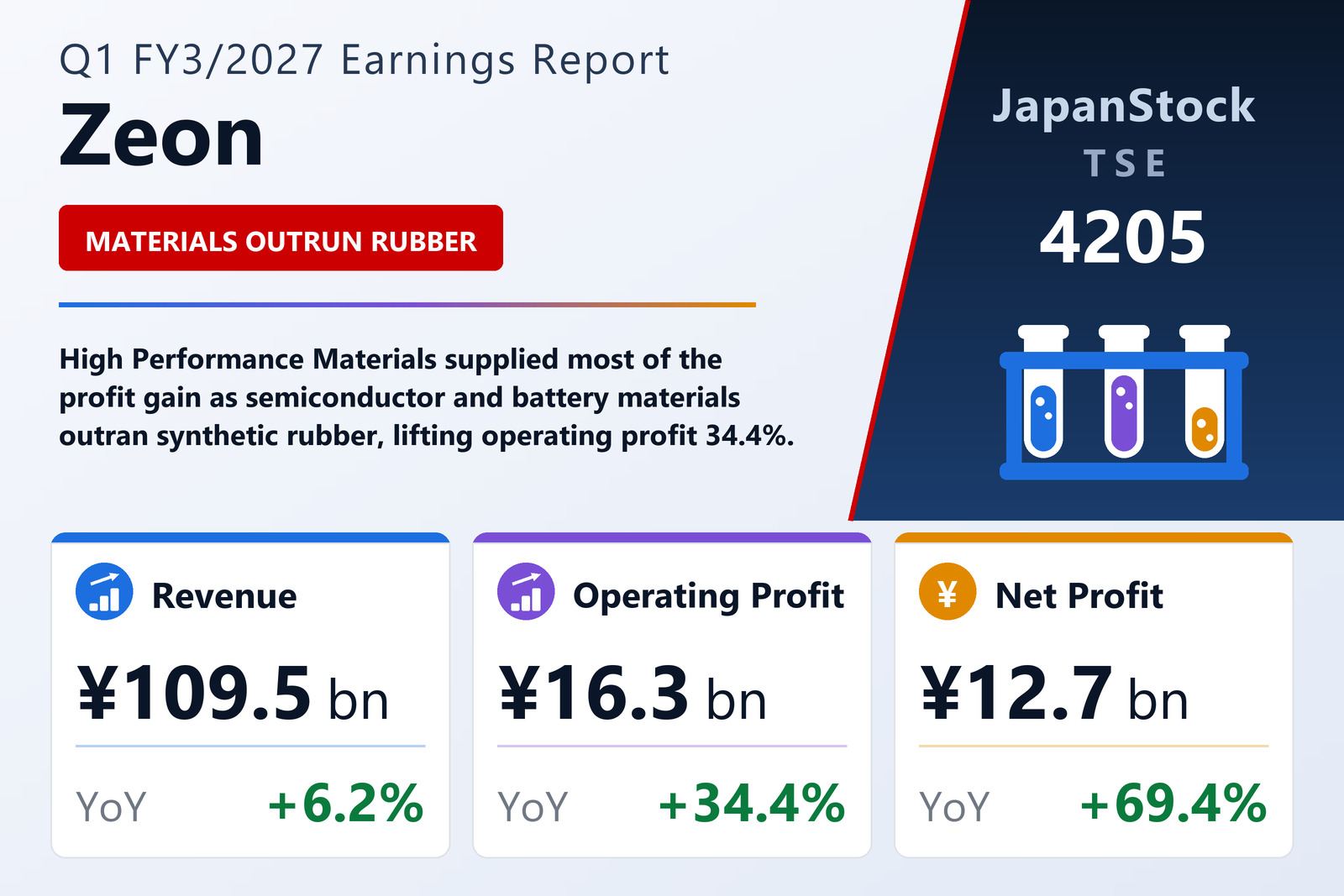
Zeon Corporation (TSE: 4205), the Tokyo-based specialty chemicals group whose products range from synthetic rubber and latex to cyclo-olefin polymers, lithium-ion battery materials and electronic materials, reported consolidated results for the first quarter of the fiscal year ending March 2027 — the three months from April 1 to June 30, 2026 — under Japanese GAAP. Revenue rose 6.2% to ¥109,466 million, operating profit climbed 34.4% to ¥16,300 million, ordinary profit jumped 57.4% to ¥18,849 million, and net profit attributable to owners of the parent surged 69.4% to ¥12,711 million. Basic earnings per share were ¥66.43 against ¥38.06 a year earlier, with diluted EPS of ¥66.40.
The profit growth came from the smaller half of the business
The striking feature of the quarter is where the money was made. The High Performance Materials segment lifted revenue by ¥4,543 million to ¥33,839 million and operating profit by ¥2,721 million to ¥10,109 million — a business roughly 58% the size of the elastomer operation by revenue that nonetheless generated about two-thirds of the group's operating-profit increase and now earns close to twice as much profit as the traditional rubber business. Management pointed to firm demand for cyclo-olefin polymer for semiconductor applications and optical film for large televisions; higher battery-material sales as European countries resumed purchase subsidies for battery electric vehicles, alongside continued global growth in demand for energy storage system batteries, including for AI data centres; and strength in electronic materials driven by active AI-related investment in the semiconductor market plus solid display-market demand. Toner revenue and profit also rose on recovering European demand. The one drag inside the segment was chemicals, where volumes increased — the year-earlier quarter had absorbed shipment adjustments during a periodic inspection at the main plant — but operating profit fell as competition in the synthetic-fragrance market intensified.
Elastomers held flat as Middle East disruption curbed rubber output
The Elastomer Materials segment, still the group's largest by sales, was essentially unchanged on the top line at ¥58,161 million — an increase of just ¥92 million — while operating profit rose ¥1,320 million to ¥5,546 million. In synthetic rubber, output was run to match feedstock availability amid the deteriorating situation in the Middle East and spot export sales of commodity rubber were deliberately restrained, so revenue fell; price revisions passing on higher raw-material costs, helped by the weaker yen, nevertheless lifted operating profit. Synthetic latex revenue fell after production equipment at the Tokuyama plant for medical and hygiene gloves was shut down earlier than planned, but price revisions and lower selling, general and administrative expenses again raised profit. Chemicals within the segment increased both revenue and operating profit on price revisions. In short, this was a pricing- and cost-led result rather than a volume-led one, consistent with the group-wide emphasis on thorough cost reduction through its "ZΣ (Z-Sigma) campaign" and production-innovation activity. The Other segment, largely subsidiary trading operations, grew revenue by ¥2,117 million to ¥18,495 million while operating profit slipped ¥45 million to ¥964 million.
Ordinary profit ran well ahead of the operating line
Below the operating line the numbers widen rather than narrow. Ordinary profit of ¥18,849 million exceeded operating profit by ¥2,549 million and grew 57.4% against the operating line's 34.4%, and net profit grew faster still at 69.4%. Earnings per share rose even more sharply, up 74.5%, because the average number of shares outstanding during the quarter fell to 191,345,489 from 197,190,844 a year earlier. Comprehensive income was the most dramatic line of all at ¥25,266 million, up 399.0% from ¥5,063 million, reflecting valuation movements well beyond the operating result. The year-earlier quarter provides a low base in several respects: revenue had then fallen 2.8%, ordinary profit 2.1% and net profit 8.3%, even as operating profit rose 34.2%.
A balance sheet inflated by securities valuation gains
Total assets stood at ¥603,320 million at the quarter end, up ¥55,074 million from ¥548,246 million at the March 2026 fiscal year-end — an increase the company attributes mainly to valuation gains on investment securities. Net assets rose to ¥395,811 million from ¥378,252 million, with shareholders' equity of ¥395,000 million against ¥377,476 million. Because assets expanded faster than equity, the equity ratio eased to 65.5% from 68.9%, a decline that reflects the composition of the balance-sheet growth rather than any deterioration in financial strength. The consolidation scope changed during the quarter with the addition of one new subsidiary, Zis Infotechno Co., Ltd., and no removals. The quarterly consolidated financial statements were not subject to review by a certified public accountant or an auditing firm.
Guidance untouched despite a fast start; dividend lifted to ¥79
Zeon left its full-year forecast for the year to March 2027 unchanged from the previous announcement: revenue of ¥405,000 million (down 1.7%), operating profit of ¥38,000 million (up 4.5%), ordinary profit of ¥37,000 million (down 7.6%), net profit of ¥36,000 million (down 0.6%) and EPS of ¥185.51. That creates an obvious tension with the quarter just reported. First-quarter ordinary profit of ¥18,849 million already represents about 51% of the ¥37,000 million full-year ordinary plan, and operating profit covers roughly 43% of the annual target, yet the guidance still implies a decline in ordinary profit for the year as a whole. The dividend plan is likewise unchanged from the previous announcement, at an interim of ¥39.00 and a year-end of ¥40.00 for an annual total of ¥79.00 per share, up from the ¥76.00 (¥36.00 interim plus ¥40.00 year-end) paid for the year ended March 2026.
| Metric | Q1 FY3/2027 | Q1 FY3/2026 | YoY |
|---|---|---|---|
| Revenue (¥ billion) | 109.47 | 103.08 | +6.2% |
| Operating profit (¥ billion) | 16.30 | 12.13 | +34.4% |
| Operating margin (%) | 14.9 | 11.8 | +3.1 pt |
| Ordinary profit (¥ billion) | 18.85 | 11.97 | +57.4% |
| Net profit attrib. to owners (¥ billion) | 12.71 | 7.51 | +69.4% |
| Comprehensive income (¥ billion) | 25.27 | 5.06 | +399.0% |
| Basic EPS (¥) | 66.43 | 38.06 | +74.5% |
| Diluted EPS (¥) | 66.40 | 38.05 | +74.5% |
| Elastomer Materials — revenue (¥ billion) | 58.16 | 58.07 | +0.2% |
| Elastomer Materials — operating profit (¥ billion) | 5.55 | 4.23 | +31.2% |
| High Performance Materials — revenue (¥ billion) | 33.84 | 29.30 | +15.5% |
| High Performance Materials — operating profit (¥ billion) | 10.11 | 7.39 | +36.8% |
| Other — revenue (¥ billion) | 18.50 | 16.38 | +12.9% |
| Other — operating profit (¥ billion) | 0.96 | 1.01 | −4.5% |
| Annual dividend (¥, FY3/27 forecast vs FY3/26 actual) | 79.00 | 76.00 | +¥3.00 |
JapanStockPulse provides informational content only and does not constitute investment advice. Figures are taken from the company's published earnings short report and may be subject to subsequent revision.