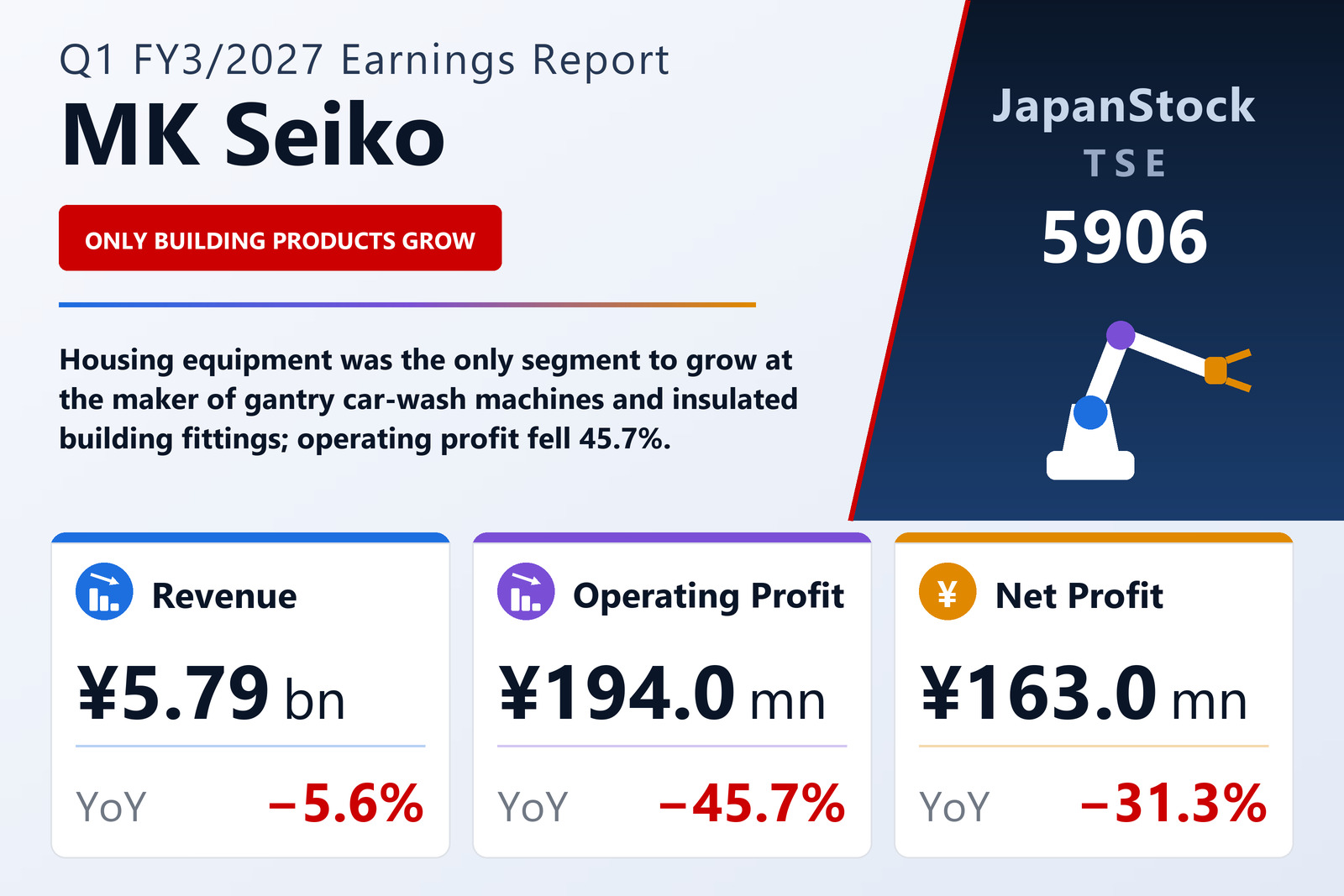
MK Seiko Co., Ltd. (TSE: 5906), the Nagano-based manufacturer of gantry-type car-wash machines, oil-service and information equipment, low-temperature storage units and insulated building fittings, reported consolidated results for the first quarter of the fiscal year ending March 2027 under Japanese GAAP. Because the company closes its books on 20 March rather than 31 March, the quarter covers the three months from 21 March to 20 June 2026. Revenue fell 5.6% to ¥5,788 million, operating profit fell 45.7% to ¥194 million, ordinary profit fell 34.7% to ¥250 million, and net profit attributable to owners of the parent fell 31.3% to ¥163 million. Basic earnings per share came to ¥11.73, down from ¥16.45. No diluted figure was reported.
A profit fall far steeper than the sales decline
The gap between a 5.6% revenue decline and a 45.7% drop in operating profit is the quarter's defining feature, and it comes from both sides of the income statement. Gross profit slipped to ¥2,039 million from ¥2,179 million as cost of sales fell more slowly than revenue, while selling, general and administrative expenses rose to ¥1,844 million from ¥1,821 million. The operating margin therefore narrowed to 3.4% from 5.8% a year earlier. Ordinary profit, at ¥250 million, again exceeded operating profit thanks to non-operating items, which left its decline shallower at 34.7%. The one line to rise was comprehensive income, up 65.7% to ¥254 million from ¥153 million, lifted by currency translation rather than trading performance.
The comparison is also unflattering in a second respect: the prior-year quarter was itself a steep decline. In the first quarter of the year ended March 2026, revenue had already fallen 12.9%, operating profit 51.1%, ordinary profit 50.1% and net profit 53.9%. The latest three months therefore mark a second consecutive first quarter of sharp contraction rather than a single soft patch against a strong base.
Car-wash machines hold, but signage revenue slides into the second quarter
Mobility & Service, the largest segment, generated revenue of ¥3,960 million, down 4.3%. The mainstay gantry-type car-wash machines held roughly flat with the prior year at service-station customers, although some buyers deferred orders while waiting for the subsidy rate under a government assistance programme to be fixed. Sales to car dealerships were sluggish, with new-build and refurbishment projects starting late or running long. Oil equipment grew, led by air-conditioner fresheners. Within information equipment, construction-safety equipment was weak on intensifying price competition, and large digital signage fell short of the prior year — but for a timing reason rather than a demand one: orders remained solid, and an increasing share of them will book revenue in the second quarter or later, building the order backlog instead of the current quarter's sales.
Life & Support gives back a prior-year demand surge
Life & Support revenue fell 10.7% to ¥1,152 million, the steepest decline among the three main segments. Low-temperature storage units, the segment's mainstay, beat the prior year helped by the order backlog carried over from the end of the previous fiscal year. Everything around them weakened. Agricultural materials and home appliances such as cooled rice bins and rice-milling machines fell against a prior-year surge in demand and softening current demand. Mixers declined in both sales and orders on the reaction to a large prior-year project and revised construction plans, even though manufacturers' capital-spending appetite was described as resilient. Food-processing machinery fell as investment appetite in the domestic bakery and confectionery industries weakened.
Insulated building products the one growth engine
Housing Equipment — wood and aluminium composite insulated fittings, steel fire doors and reflector-type silencing equipment — was the only segment to grow, with revenue up 5.1% to ¥632 million. High building-material prices and construction labour shortages left some projects with uncertain start dates after failed tenders, but composite insulated products stayed firm, supported by the promotion of timber use toward a decarbonised society and rising demand for highly insulating materials driven by ZEB (net-zero-energy building) adoption. Orders grew on large projects including big schools and resort hotels, while silencing equipment did well in logistics warehouses and medical facilities. On the sales side, composite insulated products gained at large public facilities as well as private universities, financial institutions and hotels, and silencers benefited from redevelopment work. The residual Other segment fell 59.4% to ¥42 million, reflecting the transfer of the hotel-related business during the previous fiscal year.
Inventories and short-term borrowings rise with the season
Total assets rose ¥738 million to ¥29,067 million at the quarter end from ¥28,328 million at the March 2026 year-end. Current assets grew ¥710 million to ¥18,226 million, driven mainly by a ¥1,110 million increase in inventories that the company attributed to normal seasonal factors in its business cycle; non-current assets edged up ¥28 million to ¥10,840 million. Total liabilities rose ¥693 million to ¥9,624 million, split between current liabilities up ¥853 million at ¥6,934 million and non-current liabilities down ¥159 million at ¥2,690 million — chiefly a ¥960 million increase in short-term borrowings, which in effect financed the seasonal inventory build. Net assets rose just ¥45 million to ¥19,442 million, mostly a ¥70 million increase in the foreign-currency translation adjustment, so the equity ratio slipped to 66.9% from 68.5%. Book value per share was ¥1,396.13, against ¥1,392.89. The average number of shares outstanding fell to 13,925,762 from 14,459,252, which softened the EPS decline to 28.7% against the 31.3% fall in net profit. The quarterly consolidated statements were not subject to review by a certified public accountant or auditing firm.
Full-year plan unchanged — and it already assumes a weaker year
MK Seiko left its full-year forecast exactly as published alongside the March 2026 results on 1 May 2026. For the first half it targets revenue of ¥13,500 million (−4.7%), operating profit of ¥800 million (−35.1%), ordinary profit of ¥800 million (−39.3%) and net profit of ¥600 million (−52.0%), for EPS of ¥43.09. For the full year to March 2027 it targets revenue of ¥30,000 million (+0.7%), operating profit of ¥2,200 million (−19.2%), ordinary profit of ¥2,300 million (−21.3%) and net profit of ¥1,500 million (−36.3%), for EPS of ¥107.71. In other words the company is not treating the current weakness as a passing squeeze: its own plan calls for flat sales and materially lower profit for the year as a whole. The ¥194 million of operating profit banked in the first quarter equals under 9% of that full-year target, leaving the seasonally heavier remainder of the year to carry it. The dividend plan, also unchanged from the previous announcement, is more encouraging: no interim payment and a year-end dividend of ¥18.00 per share, an increase on the ¥15.00 (nil interim plus ¥15.00 year-end) paid for the year ended March 2026.
| Metric | Q1 FY3/2027 | Q1 FY3/2026 | YoY |
|---|---|---|---|
| Revenue (¥ million) | 5,788 | 6,134 | −5.6% |
| Operating profit (¥ million) | 194 | 357 | −45.7% |
| Operating margin (%) | 3.4 | 5.8 | −2.5 pt |
| Ordinary profit (¥ million) | 250 | 383 | −34.7% |
| Net profit attrib. to owners (¥ million) | 163 | 237 | −31.3% |
| Comprehensive income (¥ million) | 254 | 153 | +65.7% |
| Basic EPS (¥) | 11.73 | 16.45 | −28.7% |
| Mobility & Service revenue (¥ million) | 3,960 | — | −4.3% |
| Life & Support revenue (¥ million) | 1,152 | — | −10.7% |
| Housing Equipment revenue (¥ million) | 632 | — | +5.1% |
| Other revenue (¥ million) | 42 | — | −59.4% |
| Equity ratio (%) | 66.9 | 68.5 | −1.6 pt |
| Annual dividend (¥, FY3/27 forecast vs FY3/26 actual) | 18.00 | 15.00 | +¥3.00 |
JapanStockPulse provides informational content only and does not constitute investment advice. Figures are taken from the company's published earnings short report and may be subject to subsequent revision. Balance-sheet comparisons are against the fiscal year-end of 20 March 2026; the equity ratio comparison and the dividend column refer to that prior fiscal year rather than to the prior first quarter.