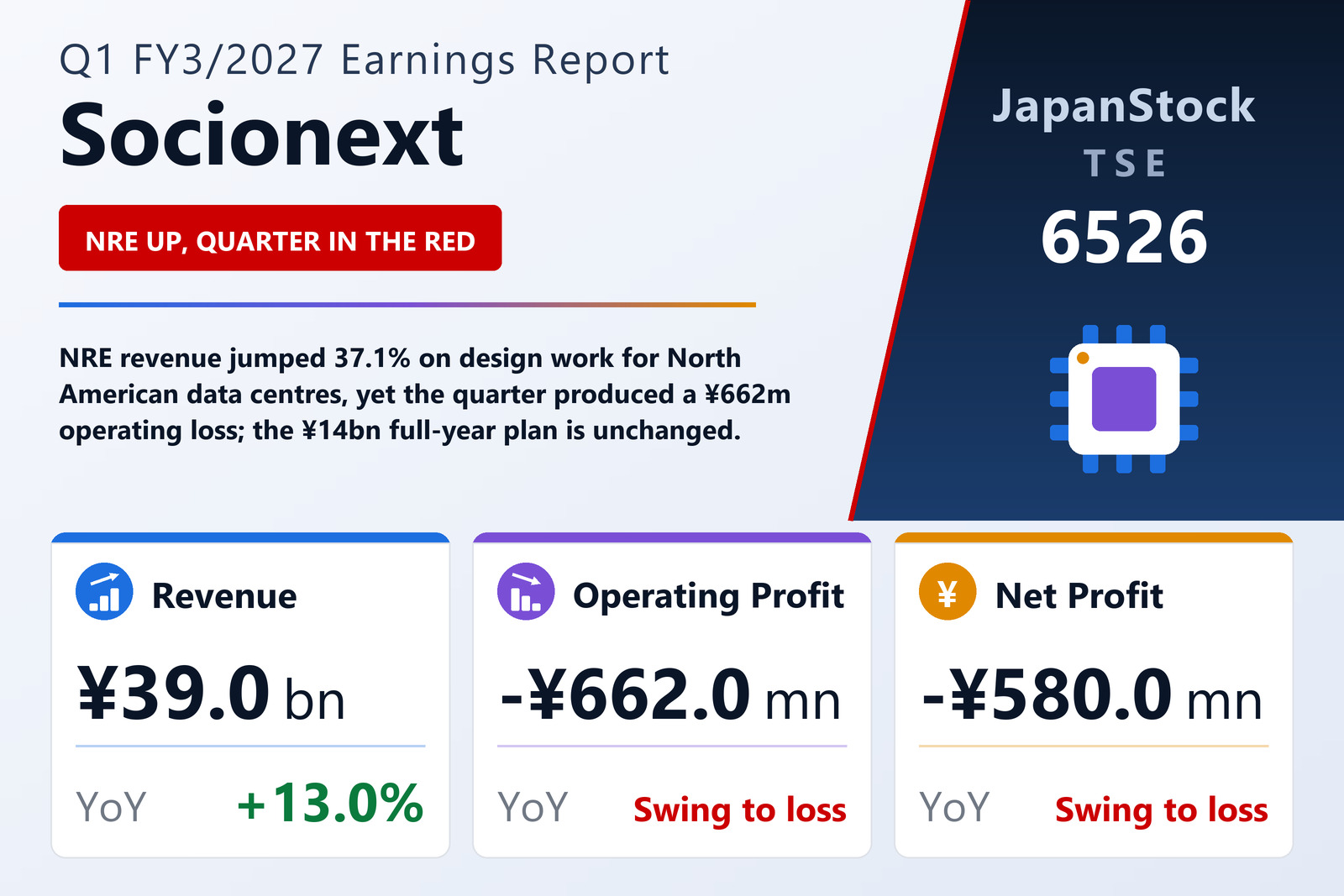
Socionext Inc. (TSE: 6526), the Yokohama-based fabless designer of custom system-on-chip devices, reported consolidated results for the first quarter of the fiscal year ending March 2027 — the three months from April 1 to June 30, 2026 — under Japanese GAAP. Revenue rose 13.0% to ¥39,039 million, a recovery from a year-earlier quarter in which sales had fallen 34.5%. Everything below the revenue line moved the other way. The company swung to an operating loss of ¥662 million from a ¥1,440 million profit, to an ordinary loss of ¥782 million from a ¥717 million profit, and to a net loss attributable to owners of the parent of ¥580 million from a ¥461 million profit. Basic earnings per share were −¥3.31, against ¥2.61 a year earlier. Comprehensive income was a loss of ¥406 million, versus income of ¥310 million.
NRE revenue does the heavy lifting; automotive shipments slip into Q2
The company described a global economy that remained hard to read — uncertainty over U.S. economic policy, weak domestic demand in China, and geopolitical risk from the military conflict in the Middle East and the prolonged war in Ukraine raising concerns over energy and raw-material supply — while investment in data-centre infrastructure expanded on growing AI demand. The yen stayed weak, continuing the previous year's trend. Group revenue comes from two main streams: product sales, received once a design reaches the mass-production stage, and NRE revenue, collected in stages to cover design and development costs. Product sales rose 5.9% to ¥27,400 million, a modest gain the company attributed to a temporary drag: shipments of automotive mass-production parts expected in the first quarter shifted into the second while procedures tied to a supply-chain change were completed, with the weaker yen partly offsetting the shortfall. NRE revenue grew 37.1% to ¥11,594 million, helped by prototype-related revenue for new mass-production products for North American data centres due to launch in the second half and beyond. Other revenue fell to ¥45 million from ¥216 million.
The loss came from spending, not from a demand shortfall
Cost of sales rose 23.0% to ¥17,717 million, well ahead of the 13.0% revenue gain, so gross profit advanced only 5.8% to ¥21,322 million. Below that line the pressure was heavier still. Research and development expenses climbed 19.2% to ¥16,978 million as the group funded prototype work for the North American data-centre and automotive products ramping from the second half, on top of continued advanced development. Total selling, general and administrative expenses — which include that R&D spending — rose 17.5% to ¥21,984 million, exactly ¥662 million more than gross profit, which is the operating loss in full. Foreign-exchange losses and other non-operating items carried the result down to a ¥782 million ordinary loss. The average dollar rate for the quarter was ¥159.5, ¥14.9 weaker than a year earlier.
The full-year plan is unchanged — and the arithmetic behind it is steep
Socionext left the forecast it issued on April 28, 2026 for the year to March 2027 exactly as it stood: revenue of ¥215,000 million (+7.1%), operating profit of ¥14,000 million (+13.3%), ordinary profit of ¥14,000 million (+19.1%), net profit of ¥10,000 million (+14.5%) and earnings per share of ¥57.02. Set against a first quarter that lost money, that leaves the entire year's profit and then some to be earned in the remaining nine months: ¥14,662 million of operating profit and ¥10,580 million of net profit between July 2026 and March 2027. The revenue gap is nearly as wide — ¥175,961 million, or roughly 82% of the annual plan, is still to come, against 18% delivered in the first quarter. The earnings report states only that the forecast is unchanged from the April announcement; it does not set out how that back-loaded recovery is expected to arrive.
Cash falls as inventories build, and the credit line is enlarged
Cash and cash equivalents closed the quarter at ¥37,317 million, down ¥7,224 million from the fiscal year-end. Operating cash flow was an inflow of ¥3,279 million, well short of the ¥10,031 million a year earlier: a ¥13,078 million reduction in trade receivables and ¥4,599 million of depreciation were largely absorbed by a ¥17,894 million build in inventories tied to automotive mass-production manufacturing. Investing outflows widened to ¥6,353 million from ¥3,472 million, with ¥2,120 million spent on tangible fixed assets — reticles, test boards and design-environment upgrades — and ¥4,224 million on intangibles including IP macros. Financing used ¥4,497 million, almost all of it the ¥4,412 million dividend payment. Citing rising working-capital needs alongside a slowing global economy and heightened geopolitical risk, the company increased its committed credit line by ¥20,000 million from July 2026, to ¥50,000 million in total; no borrowings were drawn under the facility during the quarter.
One segment, a thinner equity ratio, and an unchanged ¥50 dividend
Total assets grew to ¥173,424 million from ¥167,623 million at the March 2026 year-end, as fixed assets rose ¥5,996 million on reticles, test boards, design-environment capacity and IP macros for engagements already won. Net assets fell to ¥128,510 million from ¥133,056 million, reflecting the quarterly loss and the dividend payment, which pushed the equity ratio down 5.3 points to 74.1% from 79.4%. The group reports a single business segment centred on the SoCs it develops under its "Solution SoC" business model, so no segment breakdown is presented. Management said demand for custom SoCs continues to expand on the back of AI, new services and applications, and increasing SoC design complexity, and that it keeps winning large engagements in its focus areas of automotive, data centre/networking and industrial/smart devices. The dividend plan is unchanged from the previous announcement: an interim of ¥25.00 and a year-end of ¥25.00 for an annual ¥50.00 per share in the year to March 2027, matching the ¥50.00 paid for the year ended March 2026.
| Metric | Q1 FY3/2027 | Q1 FY3/2026 | YoY |
|---|---|---|---|
| Revenue | 39,039 | 34,553 | +13.0% |
| — Product sales | 27,400 | 25,879 | +5.9% |
| — NRE revenue | 11,594 | 8,458 | +37.1% |
| — Other | 45 | 216 | −79.2% |
| Gross profit | 21,322 | 20,153 | +5.8% |
| Operating profit / (loss) | −662 | 1,440 | Swing to loss |
| Ordinary profit / (loss) | −782 | 717 | Swing to loss |
| Net profit / (loss) attrib. to owners | −580 | 461 | Swing to loss |
| Comprehensive income / (loss) | −406 | 310 | Swing to loss |
| Basic EPS (¥) | −3.31 | 2.61 | Swing to loss |
| Annual dividend (¥, FY3/27 forecast vs FY3/26 actual) | 50.00 | 50.00 | Unchanged |
JapanStockPulse provides informational content only and does not constitute investment advice. Figures are taken from the company's published earnings short report and may be subject to subsequent revision.