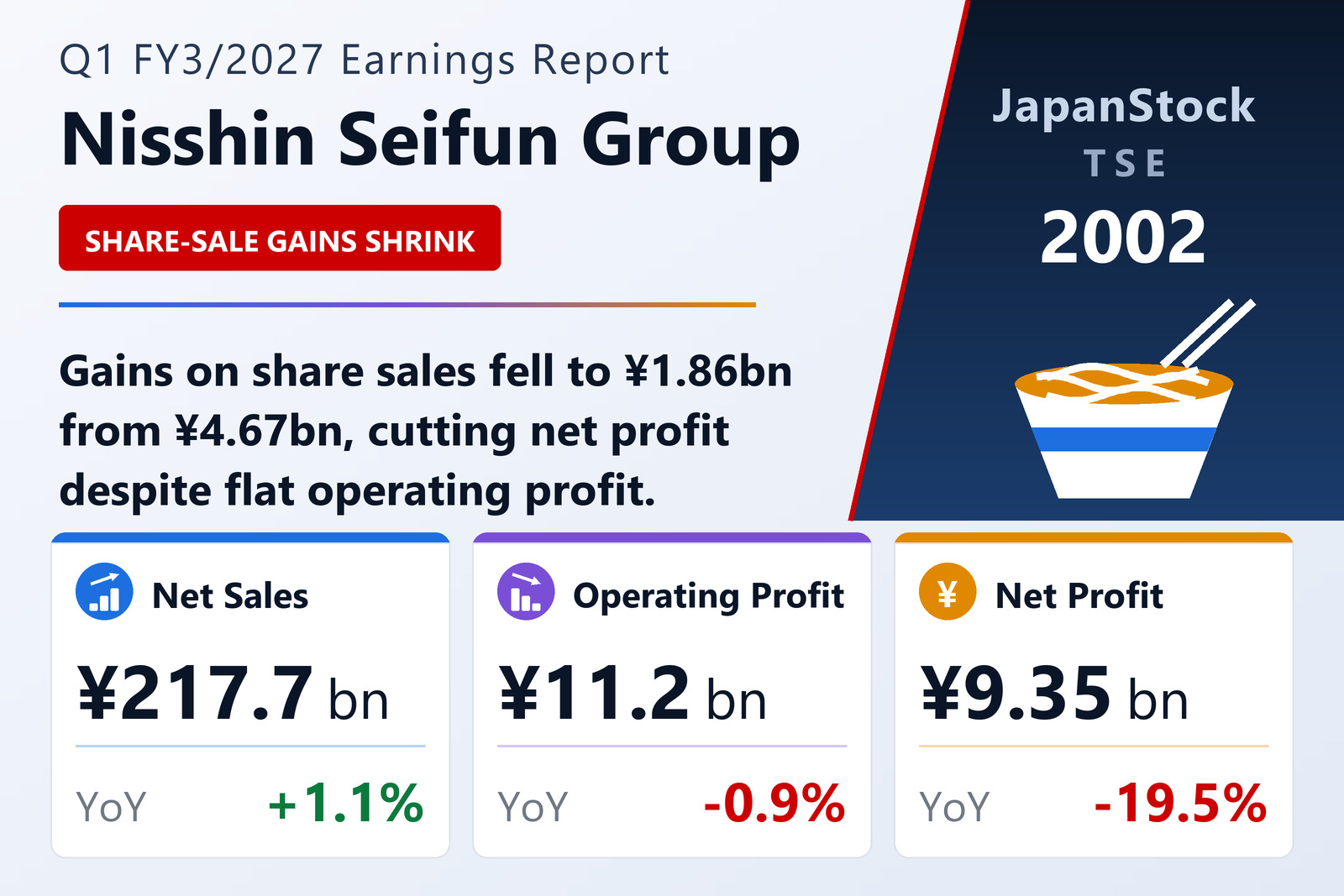
NISSHIN SEIFUN GROUP INC. (TSE: 2002), Japan's largest flour-milling group and the parent of Nisshin Seifun Welna, Toukatsu Foods and Oriental Yeast, reported consolidated results for the three months ended June 30, 2026 under Japanese GAAP. Net sales rose 1.1% to ¥217,681 million, operating profit edged down 0.9% to ¥11,197 million and ordinary profit fell 3.2% to ¥12,517 million. Net profit attributable to owners of the parent dropped 19.5% to ¥9,349 million, and quarterly earnings per share came in at ¥33.41 against ¥40.11 a year earlier. Comprehensive income fell 34.4% to ¥8,273 million.
Flour milling does the heavy lifting
The Flour Milling segment supplied all of the group's growth. Segment sales rose 7.0% to ¥112,008 million and segment profit rose 6.8% to ¥7,128 million, helped by higher domestic shipments on an active sales push and, more importantly, by an expanded U.S. production base and a favourable currency translation on the overseas milling business. Australia remained a difficult market. On costs, the government's selling price for imported wheat was raised 2.5% on a five-brand average in April, and the company followed with a price revision on commercial-use flour in June to cover that and higher transport and labour costs. At home, Nisshin Flour Milling continues to push automation and labour-saving investment around its Mizushima plant.
Food steady; prepared dishes and engineering slip
The Processed Food segment was essentially flat at the top line — sales of ¥54,688 million, down 0.1% — but profit jumped 23.5% to ¥2,285 million on stronger shipments of baker's yeast in Japan and India and of diagnostic-reagent raw materials in the bio business, offsetting weaker culture-media volumes. From April 1 the health-foods business of Nisshin Pharma was transferred to Oriental Yeast, and the former Health Foods and Yeast & Bio units were merged into a single "Yeast, Health and Bio" business. Prepared Dishes and Other Prepared Foods went the other way: unseasonable weather depressed sales of chilled noodles, cutting segment sales 3.4% to ¥39,388 million and segment profit 32.7% to ¥956 million once cost inflation is added. The Other segment — engineering, mesh cloths and cargo handling — saw sales fall 23.7% to ¥11,595 million and profit fall 34.1% to ¥955 million, purely because the prior-year quarter contained a large plant-engineering contract; mesh cloths grew.
Below the segments, cost of sales actually fell 0.2% while sales rose, lifting the gross margin to 23.0% from 22.0%. That gain was spent on selling, general and administrative expenses, which rose 7.5% to ¥38,820 million, leaving the operating margin a touch lower at 5.1%. Ordinary profit fell faster than operating profit because equity-method investment income halved to ¥504 million and interest expense rose to ¥1,115 million.
What cut net profit: smaller share-sale gains
The 19.5% drop at the bottom line did not come from trading. It came from the extraordinary-items line. The group continued to unwind its policy (cross-) shareholdings on schedule, but booked a gain on sale of investment securities of only ¥1,857 million against ¥4,668 million a year earlier — a ¥2,811 million swing. Extraordinary losses edged up to ¥420 million from ¥404 million and included a ¥195 million charge for the closure of Nisshin Flour Milling's Sakaide plant, alongside fixed-asset retirement losses and business-restructuring costs. Pre-tax profit therefore fell 18.9% to ¥13,954 million; after ¥4,164 million of tax and ¥440 million attributable to non-controlling interests, ¥9,349 million was left for parent shareholders. The steeper 34.4% fall in comprehensive income reflects the same portfolio unwind — the valuation-difference reserve on securities swung to a ¥4,151 million negative from a ¥3,240 million positive.
Full-year guidance left untouched
Management reaffirmed the forecasts issued on May 14 without change. For the full year to March 2027 it still guides net sales of ¥870,000 million (+0.6%), operating profit of ¥46,000 million (−1.5%), ordinary profit of ¥49,000 million (−4.7%) and net profit of ¥41,000 million (+25.8%), with EPS of ¥146.59. The first-half guidance is net sales of ¥430,000 million (−0.3%), operating profit of ¥22,000 million (−2.8%), ordinary profit of ¥23,000 million (−7.2%) and net profit of ¥17,000 million (+64.6%), for EPS of ¥60.76.
The obvious tension is that the full-year plan calls for 25.8% net-profit growth after a quarter in which net profit fell 19.5%. Two things reconcile it. First, the comparison base is soft: the +64.6% first-half guidance implies a prior-year first half of roughly ¥10.3 billion, which is less than the ¥11,620 million earned in last year's first quarter alone — in other words the year-earlier second quarter was a net loss, and simply not repeating it delivers much of the growth. Second, the guidance assumes further disposals of policy shareholdings through the rest of the year, plus cost reductions and further selling-price revisions as the group watches the impact of Middle East instability on energy and raw-material costs. On the operating line the quarter is on plan — ¥11,197 million is 24.3% of the ¥46,000 million full-year target, and sales at 25.0% of plan — but the net line has only banked 22.8% of its annual goal.
Dividend still headed to ¥65; balance sheet shrinks
The dividend forecast is unchanged as well. Against ¥60.00 paid for FY3/2026 (¥30.00 interim plus ¥30.00 year-end), the company plans a ¥65.00 annual dividend for FY3/2027 — ¥32.00 at the interim and ¥33.00 at the year-end, a ¥5.00 increase. That is a projected consolidated payout ratio of 44.3%, or 54.1% once non-recurring special items are excluded, against a stated policy of holding the ex-special payout ratio near 50% by FY3/2027.
The balance sheet contracted modestly over the quarter. Total assets fell ¥9,803 million to ¥839,901 million, mostly on a ¥12,839 million drop in cash and deposits to ¥84,952 million; investment securities fell to ¥182,316 million from ¥189,060 million as the cross-shareholding sales and mark-to-market moves came through. Total liabilities fell ¥7,173 million to ¥304,092 million, largely on lower income taxes payable and short-term borrowings. Net assets slipped ¥2,630 million to ¥535,809 million as the quarter's profit was more than offset by dividends, buybacks (treasury shares rose to 2,497,549 from 1,408,094) and lower accumulated other comprehensive income. The equity ratio nonetheless improved to 61.4% from 61.1%. No quarterly cash-flow statement was prepared; depreciation was ¥6,699 million against ¥6,146 million, with goodwill amortisation flat at ¥317 million.
| Metric | Q1 FY3/2027 | Q1 FY3/2026 | YoY |
|---|---|---|---|
| Net sales (¥ billion) | 217.68 | 215.36 | +1.1% |
| Operating profit (¥ billion) | 11.20 | 11.30 | −0.9% |
| Ordinary profit (¥ billion) | 12.52 | 12.93 | −3.2% |
| Net profit attrib. to owners (¥ billion) | 9.35 | 11.62 | −19.5% |
| Comprehensive income (¥ billion) | 8.27 | 12.61 | −34.4% |
| Basic EPS (¥) | 33.41 | 40.11 | −16.7% |
| Gain on sale of investment securities (¥ billion) | 1.86 | 4.67 | −60.2% |
| Flour Milling — sales (¥ billion) | 112.01 | 104.65 | +7.0% |
| Flour Milling — segment profit (¥ billion) | 7.13 | 6.68 | +6.8% |
| Processed Food — sales (¥ billion) | 54.69 | 54.75 | −0.1% |
| Processed Food — segment profit (¥ billion) | 2.29 | 1.85 | +23.5% |
| Prepared Dishes — sales (¥ billion) | 39.39 | 40.77 | −3.4% |
| Prepared Dishes — segment profit (¥ billion) | 0.96 | 1.42 | −32.7% |
| Other — sales (¥ billion) | 11.60 | 15.19 | −23.7% |
| Other — segment profit (¥ billion) | 0.96 | 1.45 | −34.1% |
JapanStockPulse provides informational content only and does not constitute investment advice. Figures are taken from the company's published earnings short report and may be subject to subsequent revision.