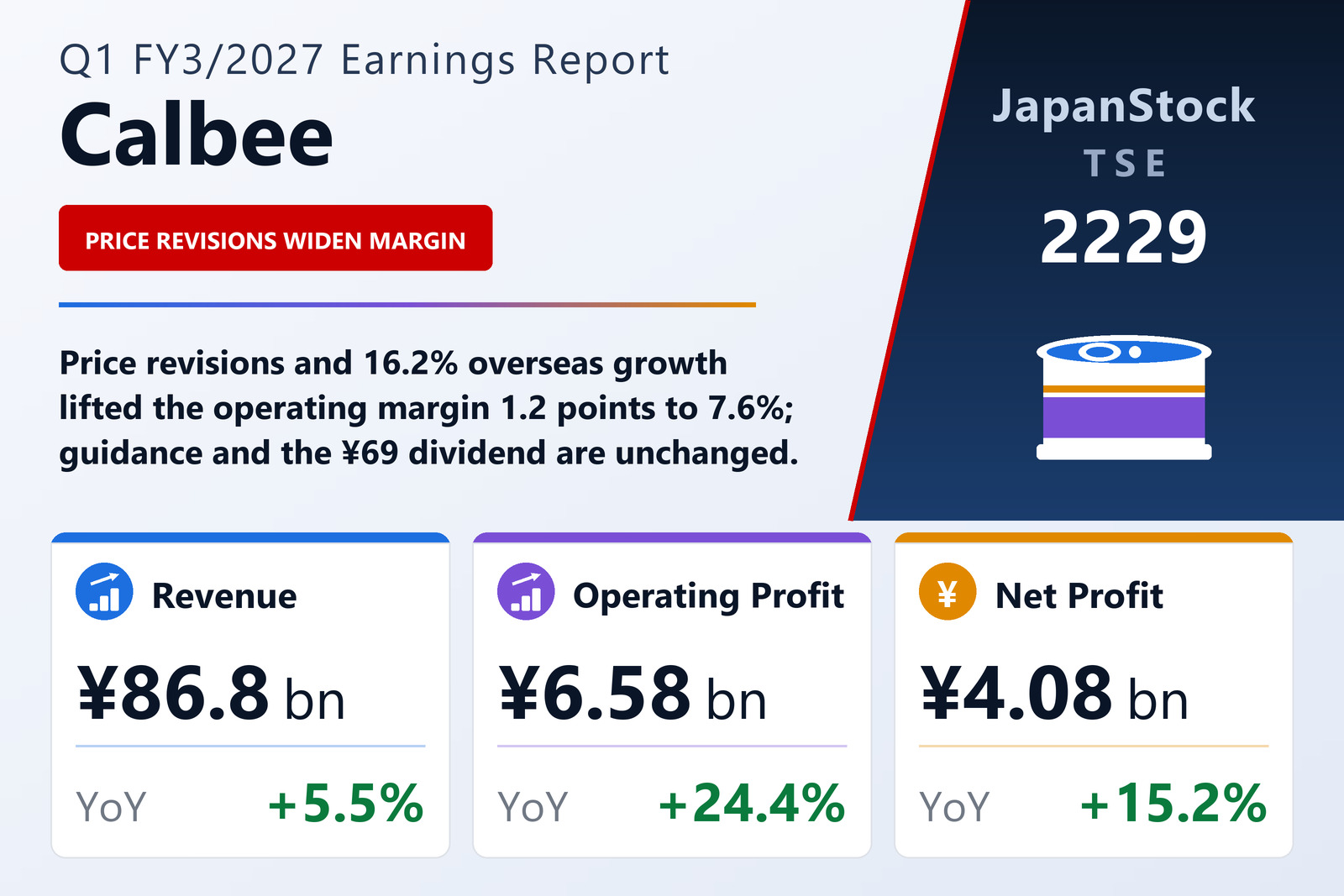
Calbee, Inc. (TSE: 2229), Japan's largest snack-food maker and the company behind the Potato Chips, Jagarico and Frugra brands, reported consolidated results for the first quarter of the fiscal year ending March 2027 — the three months from April 1 to June 30, 2026 — under Japanese GAAP. Revenue rose 5.5% to ¥86.76 billion, operating profit rose 24.4% to ¥6.59 billion, ordinary profit rose 26.1% to ¥6.66 billion and net profit attributable to owners of the parent rose 15.2% to ¥4.09 billion. Earnings per share came to ¥33.59 against ¥28.38 a year earlier, up 18.4%; no diluted figure was reported, and comprehensive income jumped 64.4% to ¥5.25 billion. The rebound is measured against a punishing base: in the same quarter last year operating profit fell 31.0% and net profit halved.
Domestic snacks edge higher while cereals keep shrinking
Domestic food manufacturing and sales revenue rose 2.0% to ¥62.98 billion. Within it, domestic snacks — reported before rebate deductions — rose 1.8% to ¥58.45 billion. Potato chips advanced 2.4% to ¥25.97 billion on steady sales of core items such as the lightly salted Usushio flavour and the firmer-textured Kataage Potato line. Jagarico fell 1.3% to ¥12.41 billion because last autumn's smaller potato harvest continued to constrain volume. Other snacks rose 3.1% to ¥20.08 billion as the wheat-, corn- and bean-based products Calbee has been pushing since the second half of last year gained ground. Domestic cereals fell 3.9% to ¥7.83 billion, with the company blaming a category market that has turned to contraction, while the domestic new-category and other line — which includes the sweet-potato business — rose 16.3% to ¥4.18 billion. Rebate deductions widened to ¥7.48 billion from ¥7.40 billion. Management credited staged price and specification revisions, plus productivity gains from higher utilisation at the Setouchi Hiroshima plant, for converting a volume decline and cost inflation into higher domestic profit.
Overseas revenue up 16%, but only 5.6% in local currency
Overseas food manufacturing and sales revenue rose 16.2% to ¥23.78 billion — a gain of just 5.6% on a local-currency basis, with the difference coming from currency translation. Europe and the Americas rose 15.6% to ¥12.85 billion, or 5.4% in local currency; the existing North American business, which excludes the food-and-health operation, rose 8.9% to ¥7.52 billion in yen but fell 1.5% in local currency, as steady sales of the bean-based Harvest Snaps line and Japan-origin legacy brands such as Kappa Ebisen were outweighed by lower contract manufacturing of snacks. The consolidation of Hodo, Inc. from August last year also lifted the reported figure. Asia and Oceania was the strongest region, up 22.2% to ¥14.13 billion and 10.3% in local currency, led by Greater China and Indonesia; in Greater China, potato chips together with locally contract-manufactured Jagabee and the Frugra cereal line sold well into local retail stores. Profitability diverged by region: Europe and the Americas saw earnings decline, but a larger increase in Asia and Oceania more than offset it, leaving overseas profit higher overall.
Margin widens 1.2 points; tax and one-off losses temper the bottom line
Gross profit rose to ¥28.08 billion from ¥25.91 billion, lifting the gross margin to 32.4% from 31.5%, while selling, general and administrative expenses of ¥21.50 billion grew more slowly than sales. The operating margin therefore reached 7.6%, up 1.2 points. Below the operating line a currency swing helped: the quarter carried a ¥94 million foreign-exchange gain inside non-operating income of ¥293 million, against a ¥250 million foreign-exchange loss a year earlier, and with non-operating expenses of ¥215 million that pushed ordinary-profit growth (26.1%) ahead of operating-profit growth (24.4%). Two items then held back the bottom line. Special losses of ¥242 million — including ¥121 million of fixed-asset retirement losses and a ¥96 million settlement payment — compared with ¥53 million a year earlier. And the tax burden rose: total income taxes of ¥2.20 billion on pre-tax profit of ¥6.42 billion equated to 34.3%, against 30.9% a year earlier. Net profit attributable to owners of the parent consequently grew 15.2%, well behind the operating line, while EPS grew 18.4% because the average share count fell 2.7% to 121.6 million after buybacks.
Assets and cash decline on the year-end dividend payout
Total assets fell ¥3.85 billion from the March 2026 year-end to ¥323.76 billion, driven mainly by lower cash and deposits, which dropped to ¥45.23 billion from ¥51.55 billion as the year-end dividend was paid. Inventories rose to ¥30.30 billion from ¥29.09 billion, and tangible fixed assets rose to ¥157.47 billion from ¥155.46 billion, with construction in progress up to ¥5.49 billion from ¥3.66 billion. Liabilities fell ¥945 million to ¥104.89 billion: the bonus provision shrank to ¥2.24 billion from ¥5.86 billion and income taxes payable to ¥1.78 billion from ¥4.15 billion, offset by a ¥2.37 billion increase in other non-current liabilities from newly recognised lease obligations. Net assets fell ¥2.90 billion to ¥218.87 billion as retained earnings dropped ¥4.13 billion to ¥211.51 billion on the dividend, leaving the equity ratio at 64.1%, 0.2 points below the year-end. Cash and cash equivalents fell ¥7.19 billion to ¥38.39 billion: operating cash flow was a ¥5.94 billion inflow, ¥3.72 billion smaller than a year earlier; investing outflows narrowed by ¥6.38 billion to ¥5.30 billion on lower purchases of fixed assets; and financing outflows widened by ¥856 million to ¥8.12 billion on higher dividend payments.
Full-year plan untouched; annual dividend still set to rise to ¥69
Calbee left the guidance it issued on May 14, 2026 unchanged: full-year revenue of ¥370.00 billion (+8.8%), operating profit of ¥26.20 billion (+0.1%), ordinary profit of ¥26.70 billion (−1.4%), net profit of ¥17.40 billion (+0.4%) and EPS of ¥143.04. The first quarter therefore represents 23.4% of the revenue plan and 25.1% of the operating-profit plan, putting earnings marginally ahead of a straight-line pace even though the company's own full-year forecast implies essentially flat profit for the year as a whole. Management said the impact of the Middle East situation has begun to materialise but was limited in the quarter, and that it is prioritising stable product supply while pressing ahead with measures against cost inflation. The dividend forecast is likewise unchanged from the previous announcement — no interim payment and a year-end of ¥69.00, for an annual ¥69.00 against ¥66.00 for the year ended March 2026. There were no changes to the scope of consolidation or to accounting policies, the quarterly consolidated statements were subject to a voluntary review by the company's auditor, and Calbee held a results briefing for institutional investors and analysts on July 30.
| Metric | Q1 FY3/2027 | Q1 FY3/2026 | YoY |
|---|---|---|---|
| Revenue (¥ million) | 86,759 | 82,234 | +5.5% |
| Operating profit (¥ million) | 6,585 | 5,295 | +24.4% |
| Operating margin (%) | 7.6 | 6.4 | +1.2 pt |
| Ordinary profit (¥ million) | 6,664 | 5,283 | +26.1% |
| Net profit attributable to owners of parent (¥ million) | 4,085 | 3,545 | +15.2% |
| Basic EPS (¥) | 33.59 | 28.38 | +18.4% |
| Domestic food business revenue (¥ million) | 62,983 | 61,766 | +2.0% |
| Overseas food business revenue (¥ million) | 23,776 | 20,468 | +16.2% |
| Total assets (¥ million, vs FY3/26 year-end) | 323,759 | 327,609 | −1.2% |
| Equity ratio (%, vs FY3/26 year-end) | 64.1 | 64.3 | −0.2 pt |
| FY3/27 revenue plan (¥ million) | 370,000 | — | +8.8% |
| FY3/27 operating profit plan (¥ million) | 26,200 | — | +0.1% |
| Annual dividend (¥, FY3/27 forecast vs FY3/26 actual) | 69.00 | 66.00 | +¥3.00 |
JapanStockPulse provides informational content only and does not constitute investment advice. Figures are taken from the company's published earnings short report and may be subject to subsequent revision.