Two sets of numbers pointing in opposite directions
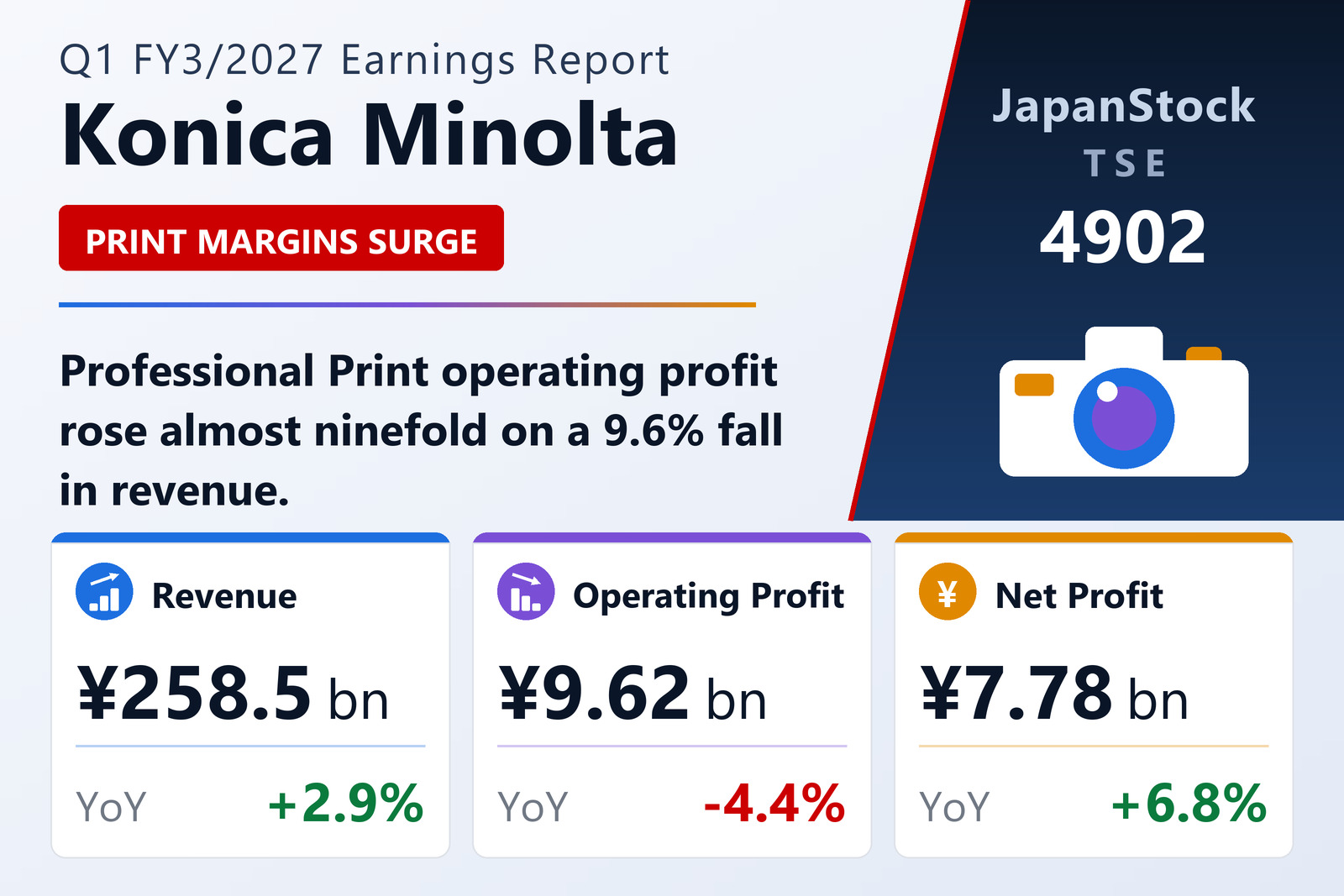
Konica Minolta, Inc. (TSE: 4902), the Tokyo-based imaging, office-equipment and industrial-optics group, disclosed consolidated first-quarter results for the fiscal year ending March 2027 — April 1 to June 30, 2026 — under IFRS on July 30, 2026. Revenue rose 2.9% to ¥258,517 million from ¥251,204 million, reversing an 8.2% decline in the same quarter a year earlier. Below the top line the company's two profit measures move in opposite directions: business contribution profit — revenue less cost of sales less selling, general and administrative expenses, Konica Minolta's own gauge of trading performance — rose 25.8% to ¥11,566 million, while reported operating profit fell 4.4% to ¥9,620 million from ¥10,062 million.
The divergence widens one line further down and then reverses. Profit before tax fell 14.4% to ¥7,608 million, yet profit for the period rose 2.7% to ¥7,813 million and profit attributable to owners of the parent rose 6.8% to ¥7,780 million — because the tax charge fell to ¥2,742 million from ¥4,268 million as the tariff refund improved US subsidiary earnings and carried-forward tax losses were used. Basic earnings per share came in at ¥15.74 against ¥14.74, and diluted EPS at ¥15.68 against ¥14.70. Comprehensive income was ¥17,893 million, up 313.4% from ¥4,328 million, on ¥10,079 million of other comprehensive income of which ¥8,854 million was foreign-currency translation of overseas operations — the same yen weakness that runs through the trading lines, showing up again in equity.
One accounting boundary matters when reading these figures. The Precision Medicine business has been classified as a discontinued operation since the third quarter of the fiscal year before last, so revenue, gross profit, business contribution profit, operating profit, pre-tax profit and R&D are all continuing-operations amounts, while profit for the period and EPS combine continuing and discontinued operations. Continuing operations contributed ¥4,865 million of quarterly profit, up 5.3%, and discontinued operations ¥2,948 million, down 1.2% — the latter including ¥2,916 million recognised on selling the Tempus AI, Inc. shares received as consideration for the transfer of Ambry Genetics Corporation. Konica Minolta has now disposed of its entire Tempus holding, so that contribution does not repeat.
The bridge from ¥11.6 billion to ¥9.6 billion
The trading half of the quarter is straightforwardly good. Cost of sales fell 4.6% to ¥134,474 million even as revenue rose 2.9%, lifting gross profit 12.5% to ¥124,042 million and the gross margin to 48.0% from 43.9%. Inside that sits the ¥7.4 billion refund of US tariff costs expensed in the previous fiscal year — on its own more than half of the ¥13,789 million by which gross profit grew. Selling, general and administrative expenses rose 11.3% to ¥112,476 million on the weaker yen and the roll-off of one-off reductions booked a year earlier, taking the SG&A ratio to 43.5% from 40.2%. Net of the two, business contribution profit added ¥2,371 million.
Everything between that ¥11,566 million and the reported ¥9,620 million sits in two lines — other income and other expenses — and it is the income side that does the damage, not the cost side. Other income collapsed to ¥659 million from ¥3,866 million, because the prior year contained a ¥2,271 million gain on the sale of subsidiary shares with no counterpart this year. Other expenses, by contrast, actually fell, to ¥2,605 million from ¥2,998 million: business structural reform costs in the overseas Digital Workplace and Professional Print operations rose to ¥1,146 million from ¥181 million, but the prior year's ¥1,034 million loss on that same share disposal did not recur. Taken together, other items moved from an ¥868 million contribution to a ¥1,946 million drag — a ¥2,814 million swing that more than consumes the ¥2,371 million of contribution-profit growth and leaves operating profit ¥442 million lower. The restructuring charge is real, but it is the disappearance of last year's disposal gain that turns a 25.8% rise into a 4.4% fall.
The step from operating profit to pre-tax profit has its own explanation. The financial and equity-method account worsened by ¥840 million: financial income fell to ¥1,276 million from ¥1,897 million — the prior year included a gain arising on the acquisition of real-estate trust beneficiary rights — financial costs rose to ¥3,260 million from ¥3,071 million, and equity-method results turned to a ¥28 million loss from a ¥2 million profit. That is what stretches a 4.4% operating decline into a 14.4% pre-tax one.
Running underneath every line is the currency. The average dollar rate was ¥159.49 against ¥144.59, a 10.3% weaker yen, and the euro ¥185.39 against ¥163.80, 13.2% weaker. Konica Minolta has left its assumptions for the second quarter onward unchanged at ¥150 to the dollar and ¥180 to the euro — both stronger than the rates the first quarter actually delivered, which is a conservative footing for the guidance discussed below.
Digital Workplace steady, Professional Print a pure margin story
Digital Workplace, the largest segment, produced revenue of ¥149.1 billion, up 6.8%, with business contribution profit of ¥8.9 billion, up 25.7%, and operating profit of ¥7.7 billion, up 14.9%. The Office unit grew on the weaker yen; stripping currency out, hardware fell against the reaction to a large prior-year deal — concentrated in the United States and China — and non-hardware consumables and services fell on a shrinking installed base, mainly in Europe and the US. The DW-DX unit, which sells IT services and solutions, grew on more than currency: business-content and business-process management services traded well in Europe, the US and Japan, and Konica Minolta's own AI SaaS business in Japan, including an AI-based learning-support service, expanded. The contribution-profit gain came largely from the tariff refund landing in the Office unit's gross profit, while the structural reform charge lands on this segment's operating line.
Professional Print produced the quarter's most arresting arithmetic. Revenue fell 9.6% to ¥58.1 billion, and yet business contribution profit rose 206.2% to ¥4.3 billion and operating profit rose 795.7% to ¥4.0 billion — almost nine-fold, on falling sales. The revenue decline is a portfolio effect rather than a demand one: last year's transfer of Konica Minolta Marketing Services Holding Company Limited, part of a deliberate selection-and-concentration exercise, removed its sales from the base, and excluding that effect revenue rose with currency behind it. Hardware grew on the yen, with underlying declines in Europe, the US and China offset by growth in India; non-hardware grew, down in Europe and China but up in the US and India; and the industrial print unit advanced as higher label-press unit sales outweighed lower inkjet and decorative press sales. The profit surge, though, comes from neither volume nor price. It is the tariff refund plus the non-recurrence of the loss on that same subsidiary sale — a margin story with a one-year shelf life.
Industry advances on demand; Imaging Solutions slips into loss
Industry is the one reporting segment whose profit growth is driven by trading rather than by one-off items. Revenue rose 10.4% to ¥31.7 billion, business contribution profit 33.6% to ¥5.2 billion and operating profit 31.2% to ¥5.2 billion, with the gain attributed to higher gross profit on higher sales, led by the Sensing unit. There, light-source colour measuring instruments sold more as a major customer expanded display capital spending, orders for hyperspectral imaging instruments held up and automotive appearance-inspection equipment traded steadily. Optical components grew as interchangeable camera lenses rode expanding demand and semiconductor-inspection optics — a focus area — benefited from chiplet-driven demand met by added capacity; inkjet components grew on a sign-graphics product launched last year. The one soft spot, functional materials, fell for a supply reason rather than a demand one: film demand held up, but capacity constraints in the previous fiscal year left too little inventory to serve the quarter.
Imaging Solutions went the other way. Revenue rose 5.4% to ¥19.3 billion — healthcare up on currency, with digital radiography growing on OEM sales and India and medical IT growing in the US against lower Japanese resale volumes, and video solutions up on steady LED sales — but the business contribution loss widened to ¥1.2 billion from ¥0.5 billion and the operating line swung to a ¥1.6 billion loss from a ¥1.4 billion profit. The wider contribution loss is a raw-material story, the surging silver price in the healthcare unit, compounded by the roll-off of a one-off reduction booked a year earlier; the operating swing adds the non-recurrence of the gain on transferring the MOBOTIX AG stake. The image-IoT unit meanwhile narrowed its product range and moved some activities elsewhere in the group.
Two structural points frame those segment comparisons. First, they are restated: from this fiscal year video solution services moved from Imaging Solutions into Digital Workplace and gas-monitoring solutions into Industry, with prior-year figures rebuilt on the same basis. Second, the corporate line has grown heavier. "Other" and eliminations took ¥5.7 billion off business contribution profit against ¥2.6 billion a year earlier, which is why the four reporting segments' combined 45.5% rise in contribution profit becomes 25.8% at the consolidated level, and their 21.1% operating-profit gain becomes a 4.4% decline.
Cash flow swings ¥36 billion; guidance held, dividend up 50%
Total assets stood at ¥1,229,912 million at June 30, 2026, down ¥5.0 billion from ¥1,234,909 million three months earlier: trade and other receivables fell ¥19.9 billion and other financial assets ¥11.3 billion, against increases of ¥10.9 billion in inventories, ¥6.2 billion in cash and equivalents and ¥6.1 billion in other current assets. Total liabilities fell ¥19.4 billion to ¥666.5 billion, mainly on a ¥10.3 billion reduction in trade and other payables and ¥5.1 billion in other current liabilities. Total equity rose to ¥563,398 million from ¥548,971 million, and equity attributable to owners of the parent to ¥550,786 million from ¥536,505 million — a ¥14.2 billion increase of which ¥9.8 billion is translation movement inside other components of equity and ¥7.8 billion the quarter's profit. The equity ratio improved to 44.8% from 43.4%, a 1.4-point gain earned on both sides of the balance sheet at once, since equity grew while assets shrank.
Cash flow is where the year-on-year change is largest. Operating cash flow was an inflow of ¥11.6 billion against an ¥11.5 billion outflow a year earlier, and investing activities produced an inflow of ¥5.8 billion against a ¥7.3 billion outflow — ¥16.1 billion of proceeds from selling investment securities, largely the Tempus shares, against ¥6.9 billion of property, plant and equipment purchases and ¥3.2 billion of intangibles. Free cash flow therefore came in at ¥17.4 billion against negative ¥18.8 billion, a swing of ¥36.3 billion. How much of that is durable is worth weighing: capital expenditure fell 64.6% to ¥8.8 billion from ¥25.0 billion, and the investing inflow rests on an asset sale that has now been completed in full, so much of the improvement is a spending decision and a disposal rather than operating leverage. Depreciation and amortisation, at ¥15.6 billion and up 12.6%, is now roughly double the capex rate. R&D spending rose 3.0% to ¥13.5 billion and group headcount fell 1.9% to 34,133. Financing activities used ¥12.7 billion against a ¥13.0 billion inflow a year earlier — a ¥5.7 billion net reduction in short-term borrowings, ¥5.2 billion of lease repayments and ¥3.2 billion of dividends, partly funded by ¥2.2 billion of bond issuance and long-term borrowing — leaving cash and equivalents at ¥116,986 million, up ¥6.2 billion.
Guidance for the full year is unchanged from the forecast published on May 14, 2026: revenue of ¥1,105,000 million, up 1.6%; business contribution profit of ¥56,000 million, up 5.3%; operating profit of ¥50,000 million, up 0.3%; and profit attributable to owners of the parent of ¥28,500 million, down 5.8%, for EPS of ¥57.57. Measured against those targets the first quarter delivered 23.4% of the revenue, 20.7% of the contribution profit and 19.2% of the operating profit — all a shade under a straight-line quarter — but already 27.3% of the full-year attributable profit, flattered by the low tax charge and the Tempus disposal. This is year one of the medium-term plan "Corporate Plan 2026–2028", under which Konica Minolta treats the three years as a period for building the foundation for long-term growth, concentrating on profit growth in the Industry and Professional Print businesses, a stronger financial base, and commercialising what it calls its seeds of growth.
Shareholder returns move faster than the guidance does. The FY3/2027 dividend forecast is ¥18.00 per share — ¥9.00 at the interim and ¥9.00 at the year-end — against ¥12.00 paid for FY3/2026 as ¥5.00 plus ¥7.00, a 50% increase and unrevised from the previous announcement. Against forecast EPS of ¥57.57 that is a payout ratio of roughly 31%, raised in a year in which the company's own guidance has attributable profit falling 5.8% — a signal about the balance-sheet strength the plan is meant to build rather than about the current year's earnings.
| Metric | Q1 FY3/2027 | Q1 FY3/2026 | Change |
|---|---|---|---|
| Revenue (¥ million) | 258,517 | 251,204 | +2.9% |
| Gross profit (¥ million) | 124,042 | 110,253 | +12.5% |
| SG&A expenses (¥ million) | 112,476 | 101,058 | +11.3% |
| Business contribution profit (¥ million) | 11,566 | 9,195 | +25.8% |
| Other income (¥ million) | 659 | 3,866 | −83.0% |
| Other expenses (¥ million) | 2,605 | 2,998 | −13.1% |
| Operating profit (¥ million) | 9,620 | 10,062 | −4.4% |
| Profit before tax (¥ million) | 7,608 | 8,891 | −14.4% |
| Profit for the period (¥ million) | 7,813 | 7,606 | +2.7% |
| Profit attrib. to owners of parent (¥ million) | 7,780 | 7,283 | +6.8% |
| Comprehensive income (¥ million) | 17,893 | 4,328 | +313.4% |
| Basic EPS (¥) | 15.74 | 14.74 | +6.8% |
| Diluted EPS (¥) | 15.68 | 14.70 | +6.7% |
| Digital Workplace revenue (¥ billion) | 149.1 | 139.6 | +6.8% |
| Digital Workplace operating profit (¥ billion) | 7.7 | 6.7 | +14.9% |
| Professional Print revenue (¥ billion) | 58.1 | 64.2 | −9.6% |
| Professional Print operating profit (¥ billion) | 4.0 | 0.4 | +795.7% |
| Industry revenue (¥ billion) | 31.7 | 28.8 | +10.4% |
| Industry operating profit (¥ billion) | 5.2 | 4.0 | +31.2% |
| Imaging Solutions revenue (¥ billion) | 19.3 | 18.3 | +5.4% |
| Imaging Solutions operating profit / loss (¥ billion) | −1.6 | 1.4 | Swing to loss |
| Free cash flow (¥ billion) | 17.4 | −18.8 | +¥36.3bn |
| Capital expenditure (¥ billion) | 8.8 | 25.0 | −64.6% |
| Average USD rate (¥) | 159.49 | 144.59 | +10.3% |
| Total assets (¥ million; vs Mar 31, 2026) | 1,229,912 | 1,234,909 | −0.4% |
| Equity attrib. to owners (¥ million; vs Mar 31, 2026) | 550,786 | 536,505 | +2.7% |
| Equity ratio (vs Mar 31, 2026) | 44.8% | 43.4% | +1.4 pt |
| FY3/2027 dividend forecast (¥) | 18.00 | 12.00 | +50.0% |
JapanStockPulse provides informational content only and does not constitute investment advice. Figures are taken from the company's published earnings short report and may be subject to subsequent revision.