Multipliers that need unpacking
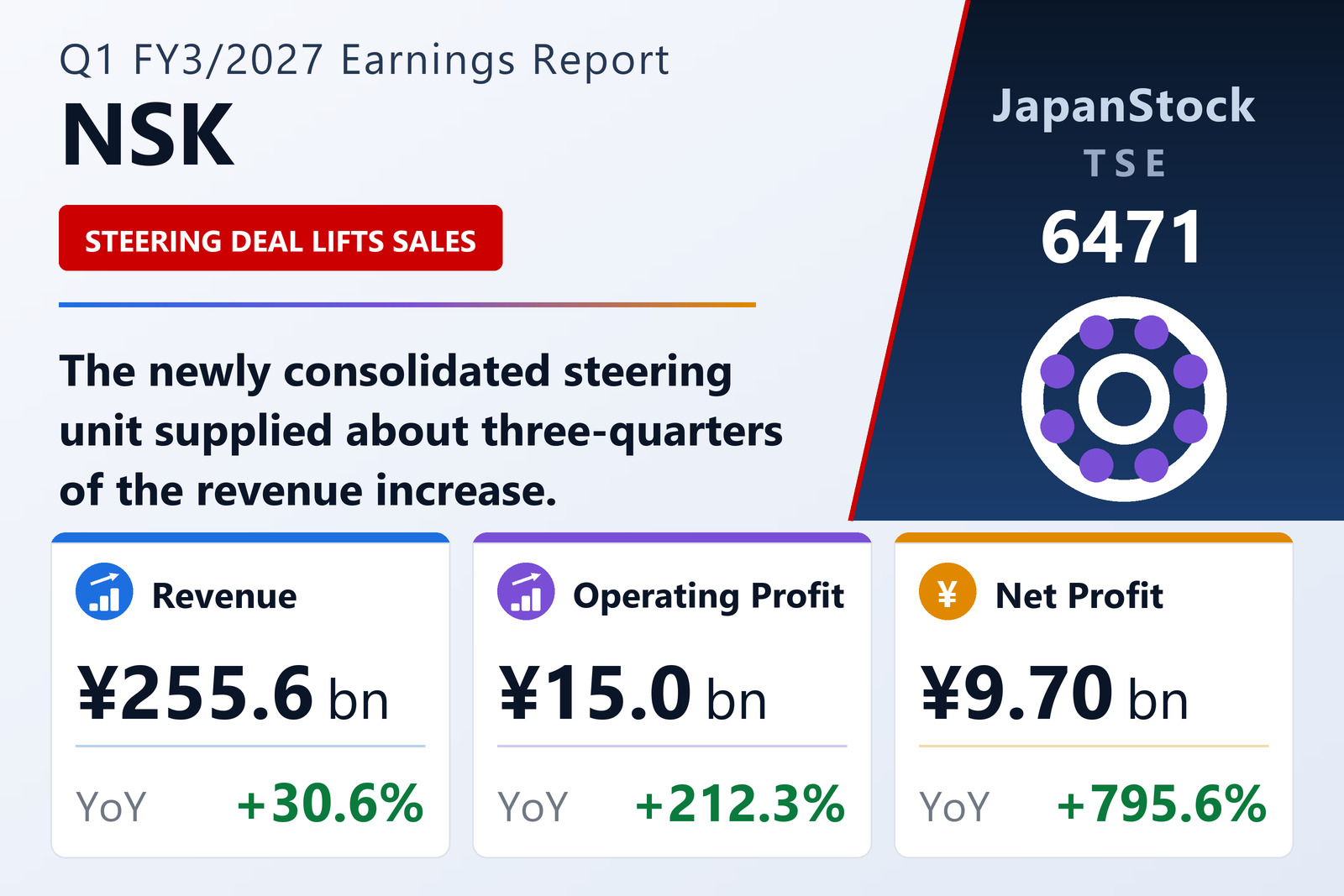
NSK Ltd. (TSE: 6471), the Tokyo-based bearings and precision machinery maker, disclosed consolidated first-quarter results for the fiscal year ending March 2027 — April 1 to June 30, 2026 — under IFRS on July 30, 2026. Revenue rose 30.6% to ¥255,638 million from ¥195,760 million. Operating profit rose 212.3% to ¥14,961 million from ¥4,790 million, profit before tax rose 199.4% to ¥14,653 million, and profit attributable to owners of the parent rose 795.6% to ¥9,701 million from ¥1,083 million. Basic earnings per share came in at ¥19.83 against ¥2.22, with diluted EPS of ¥19.74 against ¥2.21.
The three headline multiples get progressively larger as you move down the income statement, and each step has its own cause. Operating profit tripled; profit before tax grew slightly less, at 199.4%, because net finance costs swung to an expense of ¥307 million from net income of ¥104 million a year earlier. Profit for the period then leapt 751.7% to ¥10,274 million from ¥1,206 million, a far larger jump than the pre-tax line, because the effective tax rate fell to 29.9% from 75.4%: the prior-year quarter carried a tax charge of ¥3,688 million against pre-tax profit of just ¥4,894 million. Attributable profit then grew faster still, at 795.6%, even though non-controlling interests took ¥572 million against ¥123 million — because the parent's share expanded from a base of only ¥1,083 million. Comprehensive income of ¥22,791 million against ¥340 million is the most extreme ratio on the page at roughly 67 times, and it is almost entirely currency: ¥7,647 million of foreign-currency translation gains and ¥4,709 million on financial assets measured at fair value through other comprehensive income.
Underneath, the operating economics did genuinely improve. Gross profit rose 39.7% to ¥59,075 million, lifting the gross margin to 23.1% from 21.6%, while selling, general and administrative expenses of ¥45,003 million fell as a share of revenue to 17.6% from 19.3%. Share of profit from equity-method investees, by contrast, fell to ¥558 million from ¥1,061 million — a direct consequence of the change described below, since earnings that used to arrive on that line now arrive through consolidation instead.
Three-quarters of the revenue gain came from a business NSK already part-owned
On 1 September 2025 NSK acquired 100% of NSK Steering & Control Co., Ltd. ("NS&C") — the company that oversees the steering business globally — from Japan Industrial Solutions Fund III. NS&C had until then been an equity-method affiliate; NSK has consolidated it and its subsidiaries from the acquisition date, and reports it as a third segment alongside Industrial Machinery and Automotive. This is the first first-quarter comparison that includes it, since the year-earlier quarter ended two months before the deal closed. It is worth being precise here: the company reports no significant change to the scope of consolidation during this quarter. The steering effect is a year-on-year comparability effect, not a fresh acquisition.
The scale of that effect is large. Steering booked revenue of ¥44,263 million and operating profit of ¥1,570 million in the quarter. Against a total revenue increase of ¥59,878 million, that single segment accounts for 73.9% of the gain. Strip it out and the rest of the group grew 8.0%, to ¥211,375 million — respectable, but a different story from 30.6%. Note also that steering is not entirely without a comparative: because NSK reclassified the pre-acquisition steering equity-method result out of Automotive, the segment shows prior-year profit of ¥250 million on nil external revenue, so its profit line is up 528.0% rather than being a blank.
Turn to operating profit, however, and the ranking inverts. Of the ¥10,171 million increase, Industrial Machinery supplied ¥6,511 million, or 64.0%; Steering supplied ¥1,320 million, or 13.0%; Automotive ¥1,252 million, or 12.3%; and the unallocated adjustment line ¥1,112 million, or 10.9%, swinging to a positive ¥387 million from a negative ¥725 million as unallocated other operating income of ¥331 million replaced unallocated other operating expense. Consolidation, in other words, dominates the top line and is close to marginal at the profit line. The genuinely new news is elsewhere.
Industrial machinery: AI capital spending lifts operating profit five-fold
Industrial Machinery — bearings for general industry, precision-machinery products and condition-monitoring systems — produced revenue of ¥104,532 million, up 17.2%, and operating profit of ¥8,103 million, up 408.7% from ¥1,592 million. That is a five-fold profit result on a 17% revenue gain, and it is the single largest contributor to the group's quarter. NSK attributes it to the expansion of AI-related investment, which lifted demand for machine tools and semiconductor production equipment.
The regional split is uneven. Japan grew on higher sales into semiconductor production equipment and machine tools. China also grew, again led by machine tools and semiconductor equipment — notable given the company's own description of a weak Chinese economy, and a reminder that the AI capex cycle is running on a different clock from the broader Chinese industrial economy. The Americas were flat: underlying sales held, but tariff refunds paid to customers subtracted from reported revenue. Europe declined, on sluggish aftermarket and related demand.
Automotive: flat revenue, a 37.7% profit gain, and a much weaker yen
Automotive revenue was ¥98,863 million against ¥98,867 million — down 0.0%, which is as close to unchanged as a segment of that size gets. Operating profit nonetheless rose 37.7% to ¥4,576 million from ¥3,324 million. The company's explanation for the flat top line is that declines centred on Europe and China were offset by a weaker yen, and the currency tables bear that out: the average rate for the quarter was ¥159.49 to the dollar against ¥144.60 a year earlier, ¥185.38 to the euro against ¥163.81, and ¥23.43 to the yuan against ¥19.99 — the yen 10.3%, 13.2% and 17.2% weaker respectively. Translation alone was doing substantial work.
By region, Japan fell on lower sales of automatic-transmission components. The Americas fell, partly because of tariff refunds paid to customers — the same drag that flattened industrial machinery there. Europe fell on continued weak demand. China fell overall despite growth in ball screws for electric brakes, because weak sales of Japanese-brand cars outweighed that gain. In other words, the segment's volume picture was negative on every one of its four regions, and both the flat revenue and the profit growth rest heavily on translation and on mix rather than on underlying demand.
Scale changed with the steering deal as well. NSK now reports 90 consolidated subsidiaries against 76 a year earlier and 26,214 employees against 23,876 — of which the non-Japan headcount rose to 15,414 from 13,626. Depreciation and amortisation of ¥15,675 million, up 23.6%, ran well ahead of capital expenditure of ¥9,405 million, which was down 1.1%; research and development on a statutory basis was ¥4,447 million, up 23.5%.
Balance sheet, cash flow, and a raised full-year forecast
Total assets stood at ¥1,297,799 million at 30 June 2026, up ¥58,030 million or 4.7% from ¥1,239,769 million at the end of March. Total liabilities rose ¥44,753 million to ¥592,387 million, and total equity rose ¥13,276 million to ¥705,412 million, with equity attributable to owners of the parent at ¥685,786 million against ¥671,975 million. Because assets grew faster than equity, the equity attributable to owners ratio fell to 52.8% from 54.2% even though equity itself increased — the ratio's decline is a denominator story, not a deterioration in the capital base. Within equity, retained earnings added only ¥1,375 million as the ¥8,327 million dividend to owners absorbed most of the quarter's profit, while other components of equity rose ¥12,391 million on the currency and fair-value moves noted above.
Operating cash flow was ¥28,532 million against ¥27,413 million, up 4.1% — a far smaller advance than the profit lines, which is the usual signature of a quarter whose earnings growth is partly non-cash and partly base effect. Investing cash flow was an outflow of ¥35,423 million against just ¥1,600 million a year earlier, on purchases of property, plant and equipment and intangibles plus acquisitions of other non-current assets. Financing cash flow was an inflow of ¥18,278 million against an outflow of ¥5,813 million, as a net increase in short-term borrowings more than covered ¥9,559 million of dividends paid. Cash and equivalents ended at ¥156,783 million, up ¥14,660 million over three months but ¥1,104 million lower than a year earlier.
NSK revised the FY3/2027 guidance it had issued on 12 May 2026. It now expects full-year revenue of ¥1,040,000 million, up 14.1%; operating profit of ¥50,000 million, up 28.8%; profit before tax of ¥48,000 million, up 26.2%; and attributable profit of ¥29,000 million, up 26.8%, for basic EPS of ¥59.27. The first-half targets are revenue of ¥514,000 million (+24.7%), operating profit of ¥26,000 million (+46.8%), pre-tax profit of ¥25,000 million (+44.5%) and attributable profit of ¥15,200 million (+44.3%), for EPS of ¥31.06. By segment, full-year revenue is guided at ¥425,000 million for industrial machinery, ¥405,000 million for automotive and ¥179,000 million for steering.
Set the quarter against those targets and the first quarter is running ahead of a straight line on profit but not on revenue: ¥255,638 million of revenue is 24.6% of the full-year figure, while ¥14,961 million of operating profit is 29.9% and ¥9,701 million of attributable profit 33.5%. Against the first-half targets the gap is wider still — 49.7% of half-year revenue but 63.8% of half-year attributable profit — implying management expects the second quarter to be materially softer than the first. Part of that is currency: the guidance assumes ¥155 to the dollar in the second half against the ¥159.49 actually realised in the first quarter, so the translation tailwind is budgeted to fade.
The quarter sits inside a strategy announced in May 2026. "NSK Vision 2036" sets the ten-year goal of "realising ideal motion together through tribology solutions", and the accompanying Mid-Term Management Plan 2028 runs under the banner "Bearings & Beyond" — generating stable earnings from existing bearings and linear-motion products while growing new businesses and new domains, through portfolio transformation, continuous structural reform and appropriate control of shareholders' equity. NSK also intends to move beyond machine components into system-optimisation proposals built on unit products and customer problem-solving solutions. Management flags continuing uncertainty from geopolitical risk, US tariff policy and the weak Chinese economy. The FY3/2027 dividend forecast is unchanged at ¥34.00 per share — ¥17 at the interim and ¥17 at the year-end, the same as the prior year — implying a payout ratio of roughly 57% against forecast EPS of ¥59.27. The quarterly consolidated financial statements were not reviewed by an accounting auditor, and the company reports no material subsequent events.
| Metric | Q1 FY3/2027 | Q1 FY3/2026 | Change |
|---|---|---|---|
| Revenue (¥ million) | 255,638 | 195,760 | +30.6% |
| Gross profit (¥ million) | 59,075 | 42,272 | +39.7% |
| Operating profit (¥ million) | 14,961 | 4,790 | +212.3% |
| Profit before tax (¥ million) | 14,653 | 4,894 | +199.4% |
| Profit for the period (¥ million) | 10,274 | 1,206 | +751.7% |
| Profit attrib. to owners of parent (¥ million) | 9,701 | 1,083 | +795.6% |
| Comprehensive income (¥ million) | 22,791 | 340 | ×67.0 |
| Basic EPS (¥) | 19.83 | 2.22 | +793.2% |
| Diluted EPS (¥) | 19.74 | 2.21 | +793.2% |
| Effective tax rate | 29.9% | 75.4% | −45.5 pt |
| Industrial Machinery revenue (¥ million) | 104,532 | 89,156 | +17.2% |
| Industrial Machinery operating profit (¥ million) | 8,103 | 1,592 | +408.7% |
| Automotive revenue (¥ million) | 98,863 | 98,867 | −0.0% |
| Automotive operating profit (¥ million) | 4,576 | 3,324 | +37.7% |
| Steering revenue (¥ million) | 44,263 | — | No comparative |
| Steering operating profit (¥ million) | 1,570 | 250 | +528.0% |
| Operating cash flow (¥ million) | 28,532 | 27,413 | +4.1% |
| Total assets (¥ million; vs Mar 31, 2026) | 1,297,799 | 1,239,769 | +4.7% |
| Total equity (¥ million; vs Mar 31, 2026) | 705,412 | 692,135 | +1.9% |
| Equity attrib. to owners ratio (vs Mar 31, 2026) | 52.8% | 54.2% | −1.4 pt |
| FY3/2027 revenue guidance (¥ million) | 1,040,000 | 911,644 | +14.1% |
| FY3/2027 operating profit guidance (¥ million) | 50,000 | 38,812 | +28.8% |
| FY3/2027 attrib. profit guidance (¥ million) | 29,000 | 22,867 | +26.8% |
| Annual dividend per share (¥) | 34.00 | 34.00 | Unchanged |
JapanStockPulse provides informational content only and does not constitute investment advice. Figures are taken from the company's published earnings short report and may be subject to subsequent revision.