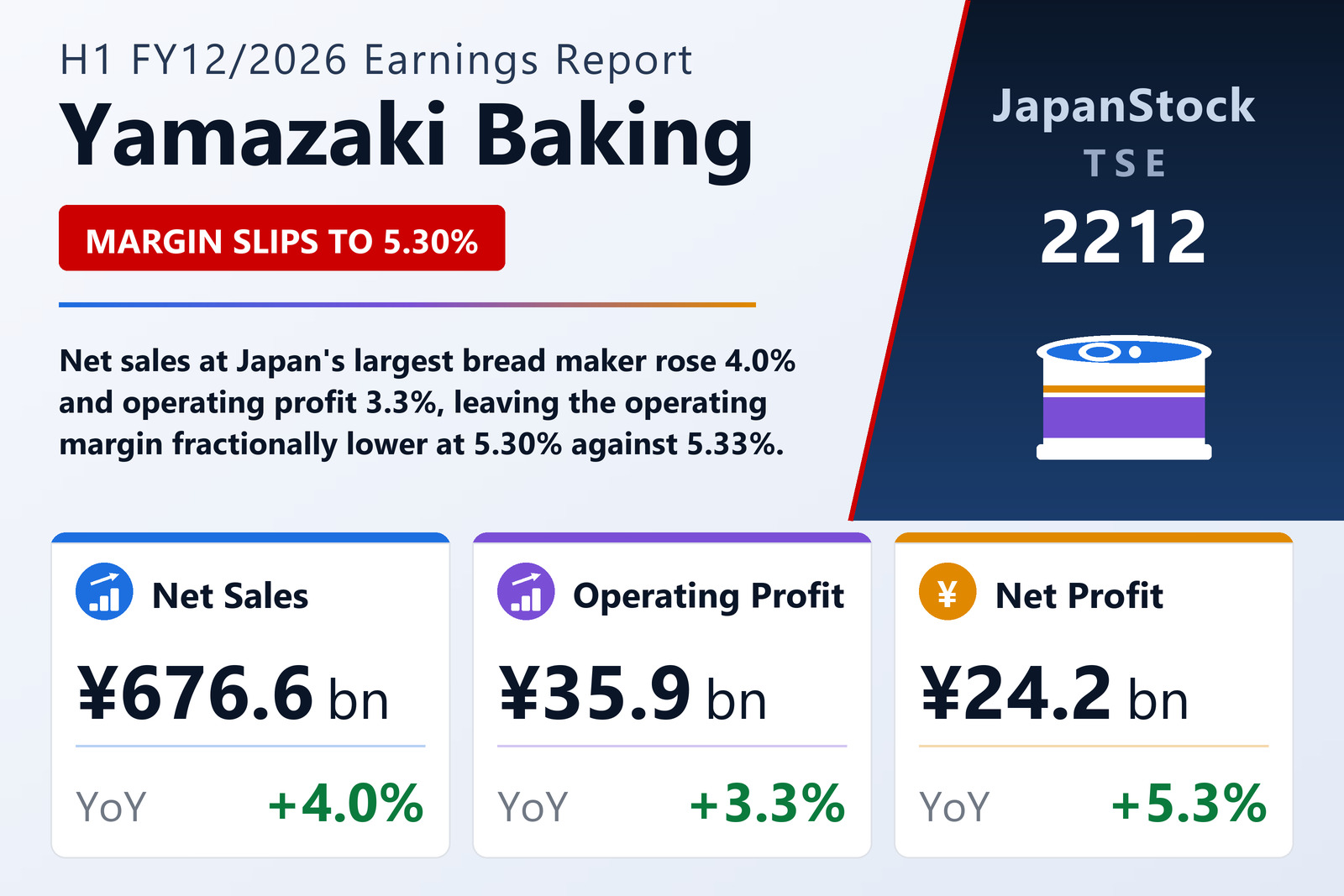
Yamazaki Baking Co., Ltd. (TSE: 2212), Japan's largest baked-goods manufacturer, reported consolidated results for the first half of the fiscal year ending December 2026 — the six months from January 1 to June 30, 2026 — under Japanese GAAP. Net sales rose 4.0% to ¥676,636 million from ¥650,633 million, operating profit 3.3% to ¥35,850 million from ¥34,690 million, ordinary profit 6.8% to ¥37,875 million from ¥35,448 million and profit attributable to owners of parent 5.3% to ¥24,197 million from ¥22,983 million. Basic earnings per share came to ¥122.77 against ¥116.11; no diluted figure was reported. Comprehensive income rose 22.3% to ¥27,712 million after a 10.6% decline a year earlier. Management attributed the increase to steady progress at the parent company, helped by quality upgrades using Yamazaki's own production technology, alongside strong results at consolidated subsidiaries. The half-year report is scheduled to be filed on August 7, 2026, and an earnings briefing for institutional investors and securities analysts is planned for August 5.
Sweet buns and snack products drove a ¥26.0 billion sales increase
The ¥26,003 million of additional revenue came overwhelmingly from the food segment, whose external sales rose 4.1% to ¥629,211 million and which accounted for 93.0% of the group total. Within it, the largest line — sweet buns and pastries — grew 4.5% to ¥254,640 million, or 37.6% of consolidated sales, as the flagship "Marugoto Sausage" roll expanded sharply and quality-upgraded staples such as "Koppepan" were joined by growth in pastries including "Apple Pie" and the "Zusshiri Danish" range; products made using Yamazaki technology at YK Baking Company also performed well. Confectionery, rice crackers and other merchandise rose 6.5% to ¥99,278 million, the fastest growth of any food line, on Fujiya's "Home Pie" and snacks such as Yamazaki Biscuits' "Aerial" and Tohato's "Poteco". Japanese confectionery gained 6.4% to ¥41,735 million, led by skewered dango and daifuku plus the reformulated "Hokkaido Cheese Steamed Cake" and the low-priced "Yamazaki Mushi-pan". Western confectionery advanced 3.1% to ¥84,158 million on two-piece fresh cakes, the "Ichigo Special" series and "Ookina Twin Shu" cream puffs, whose cream flavour was improved with new technology. Loaf bread rose only 2.6% to ¥63,942 million — the January quality upgrade to the mainstay "Royal Bread" was reinforced by strong growth in low-priced loaves, including chain-original products. The slowest line was prepared bread and rice products, up 1.2% to ¥85,455 million, where subsidiary Sundelica increased sandwich business with convenience-store chains and mass retailers.
Cost inflation kept operating profit growth below sales growth
Operating profit grew more slowly than revenue, so the operating margin edged down to 5.30% from 5.33%. Cost of sales rose 3.9% to ¥451,505 million and selling, general and administrative expenses 4.3% to ¥189,281 million, both broadly in line with or ahead of the 4.0% top line; gross profit rose 4.1% to ¥225,131 million. Yamazaki described a difficult operating environment in which entrenched consumer thrift and a preference for low prices met rising prices for fats, oils and packaging materials on top of higher personnel and logistics costs. The convenience-store industry faced its own squeeze from intensified competition with drugstores and small supermarkets. Against that backdrop the company pushed a "polarisation" product strategy — broadening its low-priced range while developing higher-value products through a team led by female product developers — and extended to "Royal Bread" in January the quality-improvement technology first applied to "Double Soft".
A foreign-exchange swing pushed ordinary profit ahead of operating profit
Ordinary profit grew twice as fast as operating profit because the net non-operating balance improved by roughly ¥1.3 billion. Non-operating expenses fell 41.9% to ¥1,261 million from ¥2,172 million, principally because the prior year's ¥868 million foreign-exchange loss did not recur; this year the company instead booked a ¥369 million foreign-exchange gain within non-operating income. Interest expense rose to ¥865 million from ¥692 million and miscellaneous losses fell to ¥273 million from ¥473 million. Non-operating income rose 12.2% to ¥3,286 million, with dividend income of ¥1,176 million, interest income of ¥326 million, property rental income of ¥473 million and miscellaneous income of ¥753 million; equity-method investment income fell to ¥187 million from ¥445 million, so the currency swing rather than affiliate earnings did the work. Below the ordinary line, extraordinary gains of ¥155 million — ¥100 million on fixed-asset disposals and ¥55 million on sales of investment securities — were outweighed by extraordinary losses of ¥1,307 million, comprising ¥985 million of fixed-asset retirement and disposal losses, ¥285 million of impairment and ¥36 million of other items. Profit before income taxes was ¥36,724 million and the tax charge ¥11,570 million, an effective rate of 31.5% against 30.1% a year earlier.
Daily Yamazaki widened its loss as the food business improved
The segment picture divides cleanly. Food segment profit rose 5.3% to ¥34,806 million from ¥33,069 million — ahead of that segment's 4.1% sales growth. The distribution segment, essentially the Daily Yamazaki convenience-store chain and Fresh Bakery retail operations, lifted sales just 0.7% to ¥39,204 million and, with personnel and other costs rising, posted an operating loss of ¥957 million against a ¥243 million loss a year earlier — a deterioration of ¥714 million that absorbed roughly 60% of the food segment's profit gain. Yamazaki said it extended its Matsudo and Suginami dominant-area projects to Osaka, working with area plants to improve returns on the Daily Hot bakery range, and pursued store remodelling and merchandising changes. The other segment grew fastest of the three, with sales up 14.8% to ¥8,220 million and profit up 8.9% to ¥1,774 million. An intersegment elimination of ¥227 million, against ¥235 million a year earlier, bridges the ¥35,623 million segment total to the reported ¥35,850 million. Among the main subsidiaries, Sundelica raised sales 1.9% to ¥58,439 million and operating profit 3.2% to ¥2,065 million, YK Baking Company lifted sales 6.1% to ¥20,942 million and operating profit 81.2% to ¥833 million, Tohato grew sales 8.5% to ¥16,718 million, and Fujiya raised sales 4.8% to ¥59,410 million but saw operating profit fall 75.3% to ¥297 million from ¥1,202 million.
Total assets shrank while the equity ratio climbed to 51.5%
The balance sheet moved in an unusual direction for a growing business: total assets fell ¥15,415 million to ¥916,463 million from ¥931,878 million at the December 2025 year-end. Current assets declined ¥16,137 million to ¥349,333 million, mainly on lower accounts receivable, while non-current assets edged up ¥722 million to ¥567,130 million on higher investment securities. Total liabilities fell ¥28,127 million to ¥392,923 million as trade payables were reduced and borrowings repaid. Net assets rose ¥12,712 million to ¥523,540 million on retained earnings, and shareholders' equity reached ¥471,554 million against ¥459,881 million. The combination lifted the equity ratio to 51.5% from 49.3%, a 2.2-point improvement. Under a board resolution of February 25, 2026, the company acquired 649,800 of its own shares; treasury stock consequently increased ¥2,224 million during the period to ¥57,741 million. Shares issued were unchanged at 220,282,860, treasury shares stood at 23,378,061 against 22,728,150, and the weighted-average count used for per-share figures was 197,090,513 against 197,933,886.
Operating cash flow held steady as capital spending increased
Operating activities generated ¥62,411 million, ¥392 million more than a year earlier, built on ¥36,724 million of pre-tax profit and ¥22,036 million of depreciation. Investing activities used ¥33,183 million, an increase of ¥4,771 million in outflows driven by purchases of property, plant and equipment. Financing activities used ¥22,789 million, ¥9,210 million more than a year earlier, on dividend payments and debt repayment. Cash and cash equivalents therefore ended the period at ¥163,228 million, up ¥7,804 million from the year-end balance of ¥155,423 million. On a parent-only basis, Yamazaki Baking reported net sales of ¥462,378 million, up 3.1%, operating profit of ¥23,370 million, up 2.6%, ordinary profit of ¥26,800 million, up 8.6%, and interim net profit of ¥18,120 million, up 4.3%.
Full-year forecast and ¥60.00 annual dividend both left unchanged
Yamazaki reaffirmed the full-year plan it published on February 12, 2026: net sales of ¥1,338,000 million, up 2.0%, operating profit of ¥64,000 million, up 4.7%, ordinary profit of ¥67,000 million, up 4.2%, and profit attributable to owners of parent of ¥42,500 million, up 3.9%, for full-year earnings per share of ¥215.73. The first half therefore delivered 50.6% of the sales target but 56.0% of the operating-profit target and 56.9% of the net-profit target. Management expects the operating environment to stay difficult, with prices for wheat flour, fats and oils and packaging rising alongside personnel, logistics and utility costs, though it noted that price revisions on some loaf bread, sweet buns and Japanese and Western confectionery took effect with shipments from July 1, 2026 and that careful preparation — including quality upgrades and factory-floor 5S activity led by managers — had allowed it to protect sales volumes, leaving trading on plan. The dividend forecast is likewise unchanged at a year-end dividend of ¥60.00 for an annual total of ¥60.00, matching the year ended December 2025; Yamazaki pays once a year, so the absence of an interim dividend is its normal practice rather than a suspension. There was no material change to the scope of consolidation, no special accounting treatments applied to the interim statements and no changes to accounting policies or estimates. As is standard for a Japanese interim earnings report, the statements were not subject to audit or review by a certified public accountant or audit firm.
| Metric | H1 FY12/2026 | H1 FY12/2025 | YoY |
|---|---|---|---|
| Net sales (¥ million) | 676,636 | 650,633 | +4.0% |
| Food segment sales (¥ million) | 629,211 | 604,520 | +4.1% |
| — Loaf bread (¥ million) | 63,942 | 62,345 | +2.6% |
| — Sweet buns & pastries (¥ million) | 254,640 | 243,606 | +4.5% |
| — Japanese confectionery (¥ million) | 41,735 | 39,217 | +6.4% |
| — Western confectionery (¥ million) | 84,158 | 81,639 | +3.1% |
| — Prepared bread & rice products (¥ million) | 85,455 | 84,468 | +1.2% |
| — Confectionery, rice crackers & other (¥ million) | 99,278 | 93,243 | +6.5% |
| Distribution segment sales (¥ million) | 39,204 | 38,951 | +0.7% |
| Other segment sales (¥ million) | 8,220 | 7,160 | +14.8% |
| Gross profit (¥ million) | 225,131 | 216,214 | +4.1% |
| Operating profit (¥ million) | 35,850 | 34,690 | +3.3% |
| Operating margin (%) | 5.30 | 5.33 | −0.03 pt |
| Food segment profit (¥ million) | 34,806 | 33,069 | +5.3% |
| Distribution segment loss (¥ million) | −957 | −243 | wider |
| Other segment profit (¥ million) | 1,774 | 1,630 | +8.9% |
| Non-operating income (¥ million) | 3,286 | 2,929 | +12.2% |
| Non-operating expenses (¥ million) | 1,261 | 2,172 | −41.9% |
| Ordinary profit (¥ million) | 37,875 | 35,448 | +6.8% |
| Profit before income taxes (¥ million) | 36,724 | 34,623 | +6.1% |
| Profit attributable to owners of parent (¥ million) | 24,197 | 22,983 | +5.3% |
| Comprehensive income (¥ million) | 27,712 | 22,654 | +22.3% |
| Basic EPS (¥) | 122.77 | 116.11 | +5.7% |
| Operating cash flow (¥ million) | 62,411 | 62,018 | +0.6% |
| Cash & equivalents at period end (¥ million) | 163,228 | 165,897 | −1.6% |
| Total assets (¥ million, vs FY12/25 year-end) | 916,463 | 931,878 | −1.7% |
| Net assets (¥ million, vs FY12/25 year-end) | 523,540 | 510,828 | +2.5% |
| Shareholders' equity (¥ million, vs FY12/25 year-end) | 471,554 | 459,881 | +2.5% |
| Equity ratio (%, vs FY12/25 year-end) | 51.5 | 49.3 | +2.2 pt |
| FY12/26 net sales forecast (¥ million) | 1,338,000 | — | +2.0% |
| FY12/26 operating profit forecast (¥ million) | 64,000 | — | +4.7% |
| FY12/26 ordinary profit forecast (¥ million) | 67,000 | — | +4.2% |
| FY12/26 profit attributable to owners forecast (¥ million) | 42,500 | — | +3.9% |
| FY12/26 forecast EPS (¥) | 215.73 | — | — |
| Annual dividend (¥, FY12/26 forecast vs FY12/25 actual) | 60.00 | 60.00 | unchanged |
JapanStockPulse provides informational content only and does not constitute investment advice. Figures are taken from the company's published earnings short report and may be subject to subsequent revision.