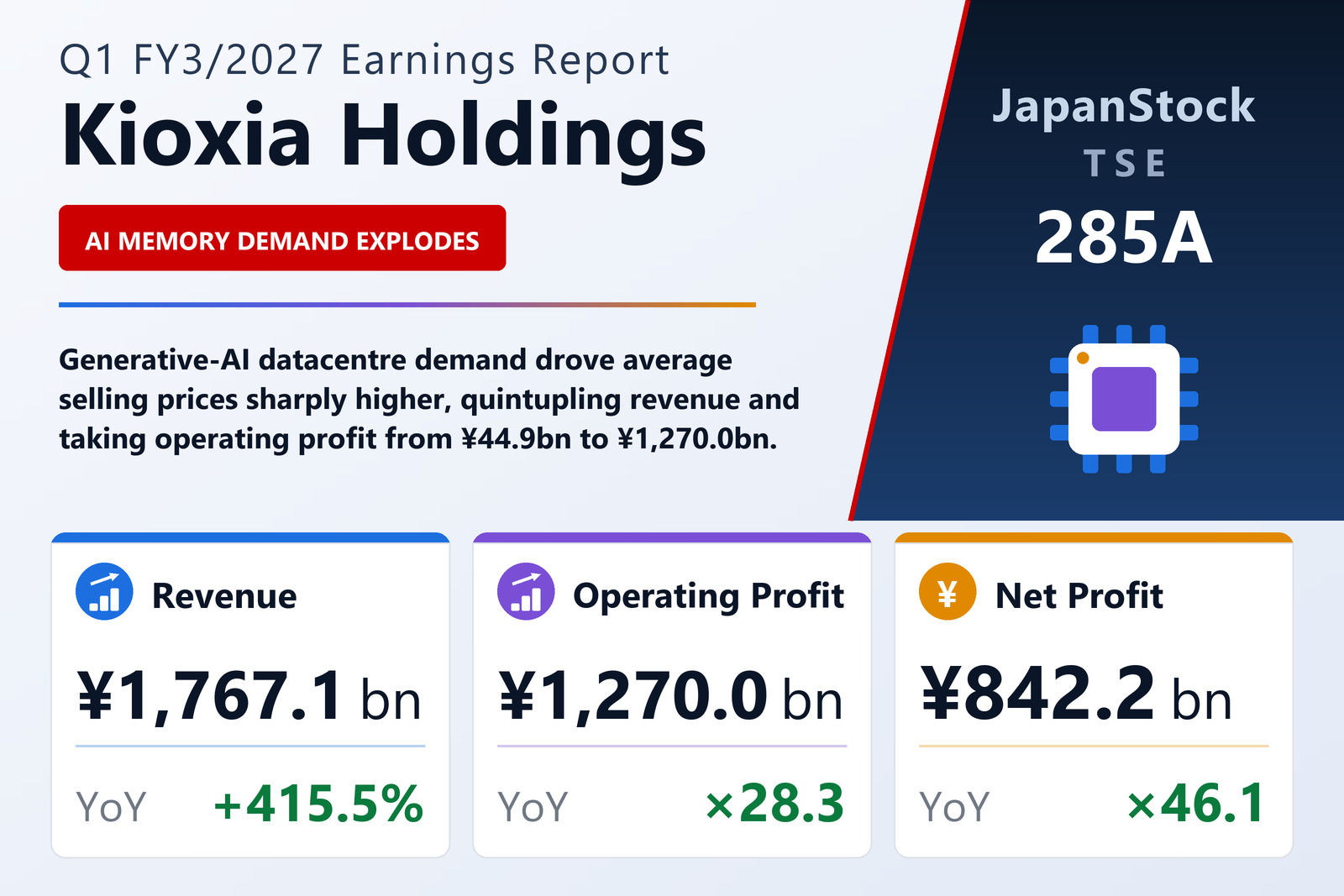
Kioxia Holdings Corporation (TSE: 285A), the Tokyo-based NAND flash memory manufacturer, reported consolidated results for the first quarter of the fiscal year ending March 2027 — the three months from April 1 to June 30, 2026 — under IFRS. Revenue rose 415.5% to ¥1,767.1 billion from ¥342.8 billion, operating profit reached ¥1,270.0 billion against ¥44.9 billion, profit before tax ¥1,234.7 billion against ¥27.3 billion and profit attributable to owners of the parent ¥842.2 billion against ¥18.3 billion. Basic earnings per share were ¥1,539.91, up from ¥33.90, with a diluted figure of ¥1,525.09. The company runs a single memory segment and breaks revenue out by application; on the same day it published these results, its board resolved a three-for-one common stock split effective October 1, 2026, which none of the per-share figures in the report reflect.
Generative-AI datacenter demand drove a five-fold revenue increase
Management attributed the increase to strong demand from datacenter customers centred on generative-AI applications, which produced a sharp rise in average selling prices alongside higher bit shipments and a favourable currency effect: the average US dollar rate was ¥160 against ¥145 a year earlier. By application, SSD & Storage — SSDs and memory products for PCs, datacenters and enterprise systems — generated ¥1,174.7 billion against ¥217.4 billion, taking its share of revenue to 66.5% from 63.4%. Smart Devices, the embedded memory used in smartphones, tablets, televisions, automotive and industrial equipment, contributed ¥525.7 billion against ¥79.0 billion, lifting its share to 29.7% from 23.1%. Other revenue — retail products such as SD cards and USB drives, plus sales to the Sandisk group booked through three manufacturing joint ventures — rose more modestly, to ¥66.7 billion from ¥46.3 billion. Kioxia described smartphone and PC demand as firm while datacenter and enterprise demand for AI servers continued to expand the market.
Gross margin approached 78% as cost of sales barely moved
The scale of the profit increase comes from cost lines that did not follow revenue upward. Cost of sales rose 42.5% to ¥387.1 billion while revenue rose more than five-fold, so gross profit multiplied more than nineteen times to ¥1,380.1 billion from ¥71.2 billion and the gross margin reached 78.1%, against 20.8%. Selling, general and administrative expenses rose 140.3% to ¥71.7 billion — a ¥41.9 billion increase set against a ¥1,308.9 billion gain in gross profit — while other income fell to ¥0.5 billion from ¥3.9 billion and other expenses of ¥38.9 billion, up from ¥0.4 billion, absorbed the litigation provision described below. The operating margin finished at 71.9% against 13.1%. Beneath the operating line, net finance costs widened to ¥35.6 billion from ¥17.5 billion as finance costs rose to ¥52.8 billion, and income tax expense of ¥392.5 billion represented an effective rate of 31.8%, slightly below the 33.0% booked a year earlier.
A ¥36.6 billion litigation provision separates IFRS from Non-GAAP profit
Kioxia reports alongside IFRS a set of Non-GAAP measures that strip out non-recurring items and other adjustments it judges to impair comparability. For the quarter those adjustments totalled ¥56.2 billion: a ¥36.6 billion litigation loss provision, ¥19.4 billion of share-based compensation expense and ¥0.2 billion of purchase-price-allocation effects. Adding them back produces Non-GAAP operating profit of ¥1,326.2 billion against ¥45.2 billion a year earlier, Non-GAAP profit before tax of ¥1,291.5 billion and Non-GAAP profit attributable to owners of the parent of ¥887.0 billion — ¥44.8 billion above the IFRS figure — for a Non-GAAP basic EPS of ¥1,621.81. The company cautions that these are internal management indicators rather than IFRS accounting items, and that they have been neither audited nor reviewed.
Revenue rose ¥764.3 billion from the previous quarter
Measured against the fourth quarter of the year to March 2026, the step up is nearly as striking as the year-on-year comparison. Revenue rose ¥764.3 billion, or 76.2%, from ¥1,002.9 billion, with SSD & Storage up ¥574.4 billion from ¥600.3 billion and Smart Devices up ¥188.3 billion from ¥337.3 billion; Other revenue was essentially flat at ¥66.7 billion against ¥65.2 billion. Operating profit improved ¥673.2 billion from ¥596.8 billion and profit attributable to owners rose ¥434.4 billion from ¥407.7 billion, taking basic EPS from ¥747.72 to ¥1,539.91. The sequential gain in Non-GAAP operating profit was larger still, at ¥727.1 billion, because the litigation provision did not exist in the prior quarter and share-based compensation then amounted to only ¥2.1 billion. The average dollar rate moved from ¥155 to ¥160.
Cash flow and the balance sheet were transformed in three months
Operating cash flow reached ¥866.3 billion against ¥61.1 billion a year earlier, as the ¥1,234.7 billion pre-tax profit far outweighed a ¥472.1 billion increase in trade and other receivables. Investing activities used ¥117.3 billion against ¥34.1 billion, including ¥78.2 billion to acquire shares in Nanya Technology Corporation and ¥51.2 billion of property, plant and equipment. Financing activities used ¥430.4 billion against ¥17.3 billion, almost entirely a ¥433.2 billion early repayment of long-term borrowings. Cash and cash equivalents ended the quarter at ¥791.0 billion, up ¥320.3 billion from the March year-end. Total assets grew ¥1,040.4 billion to ¥4,730.5 billion, driven by a ¥491.0 billion rise in trade and other receivables, while total liabilities rose only ¥35.0 billion to ¥2,326.0 billion as the ¥413.0 billion reduction in bonds and borrowings offset a ¥235.5 billion increase in income taxes payable, ¥111.9 billion more trade payables and ¥49.3 billion more provisions. Equity attributable to owners of the parent therefore jumped 71.9% to ¥2,404.3 billion and the equity ratio improved to 50.8% from 37.9%, a 12.9-point gain. Total comprehensive income of ¥995.8 billion included ¥153.6 billion of other comprehensive income, of which ¥148.6 billion was a net fair-value gain on financial assets measured at fair value through other comprehensive income; currency translation added just ¥1.9 billion.
Second-quarter guidance points to a further 35% step up
Kioxia does not publish a full-year plan, on the grounds that conditions in the semiconductor memory industry can change substantially over short periods, and guides one quarter at a time. For the second quarter — July 1 to September 30, 2026 — it expects revenue of ¥2,390.0 billion, up 35.2% sequentially, operating profit of ¥1,890.0 billion, up 48.8%, Non-GAAP operating profit of ¥1,900.0 billion, up 43.3%, profit before tax of ¥1,870.0 billion, up 51.5%, and profit attributable to owners of the parent of ¥1,270.0 billion, up 50.8%, for a basic EPS of ¥2,317.46 and a Non-GAAP basic EPS of ¥2,335.70. That implies an operating margin of 79.1% and assumes an average dollar rate of ¥162 against ¥160 in the first quarter. On a cumulative first-half basis the guidance equates to revenue of ¥4,157.1 billion, up 425.5% year on year, operating profit of ¥3,160.0 billion and profit attributable to owners of ¥2,112.2 billion. The company expects datacenter demand to remain strong through the period.
Three-for-one stock split resolved, but still no dividend
The board resolved on July 31 to split each share of common stock into three, effective October 1, 2026; none of the per-share figures reported for the quarter reflect it, so the ¥1,539.91 of basic quarterly EPS corresponds to ¥513.30 on a post-split basis. Kioxia paid no dividend for the year ended March 2026 and forecasts ¥0.00 again for the year ending March 2027, unchanged from its previous announcement. Shares issued including treasury stock stood at 548,015,088 at the quarter-end against 546,086,290 at the March year-end, treasury shares at 450 against 161, and the weighted-average count used for earnings per share was 546,890,636 against 539,420,549 a year earlier. There was no material change to the scope of consolidation and no change to accounting policies or estimates during the period. The condensed quarterly consolidated financial statements were subject to a voluntary review by PwC Japan LLC, which reported no matters requiring modification.
| Metric | Q1 FY3/2027 | Q1 FY3/2026 | YoY |
|---|---|---|---|
| Revenue (¥ million) | 1,767,117 | 342,799 | +415.5% |
| SSD & Storage revenue (¥ million) | 1,174,719 | 217,411 | ×5.4 |
| Smart Devices revenue (¥ million) | 525,656 | 79,040 | ×6.7 |
| Other revenue (¥ million) | 66,742 | 46,348 | +44.0% |
| Gross profit (¥ million) | 1,380,066 | 71,179 | ×19.4 |
| Gross margin (%) | 78.1 | 20.8 | +57.3 pt |
| Non-GAAP operating profit (¥ million) | 1,326,216 | 45,214 | ×29.3 |
| Operating profit (¥ million) | 1,270,017 | 44,899 | ×28.3 |
| Operating margin (%) | 71.9 | 13.1 | +58.8 pt |
| Profit before tax (¥ million) | 1,234,720 | 27,294 | ×45.2 |
| Quarterly profit (¥ million) | 842,171 | 18,273 | ×46.1 |
| Profit attributable to owners of parent (¥ million) | 842,165 | 18,284 | ×46.1 |
| Basic EPS (¥) | 1,539.91 | 33.90 | ×45.4 |
| Non-GAAP basic EPS (¥) | 1,621.81 | 34.31 | ×47.3 |
| Total comprehensive income (¥ million) | 995,798 | 22,415 | ×44.4 |
| Operating cash flow (¥ million) | 866,337 | 61,106 | ×14.2 |
| Average USD rate (¥) | 160 | 145 | +¥15 |
| Total assets (¥ million, vs FY3/26 year-end) | 4,730,476 | 3,690,071 | +28.2% |
| Equity attributable to owners (¥ million, vs FY3/26 year-end) | 2,404,320 | 1,398,929 | +71.9% |
| Equity ratio (%, vs FY3/26 year-end) | 50.8 | 37.9 | +12.9 pt |
| Q2 FY3/27 revenue guidance (¥ million, vs Q1 actual) | 2,390,000 | 1,767,117 | +35.2% |
| Q2 FY3/27 operating profit guidance (¥ million, vs Q1 actual) | 1,890,000 | 1,270,017 | +48.8% |
| Q2 FY3/27 profit attributable to owners guidance (¥ million, vs Q1 actual) | 1,270,000 | 842,165 | +50.8% |
| Annual dividend (¥, FY3/27 forecast vs FY3/26 actual) | 0.00 | 0.00 | — |
JapanStockPulse provides informational content only and does not constitute investment advice. Figures are taken from the company's published earnings short report and may be subject to subsequent revision.