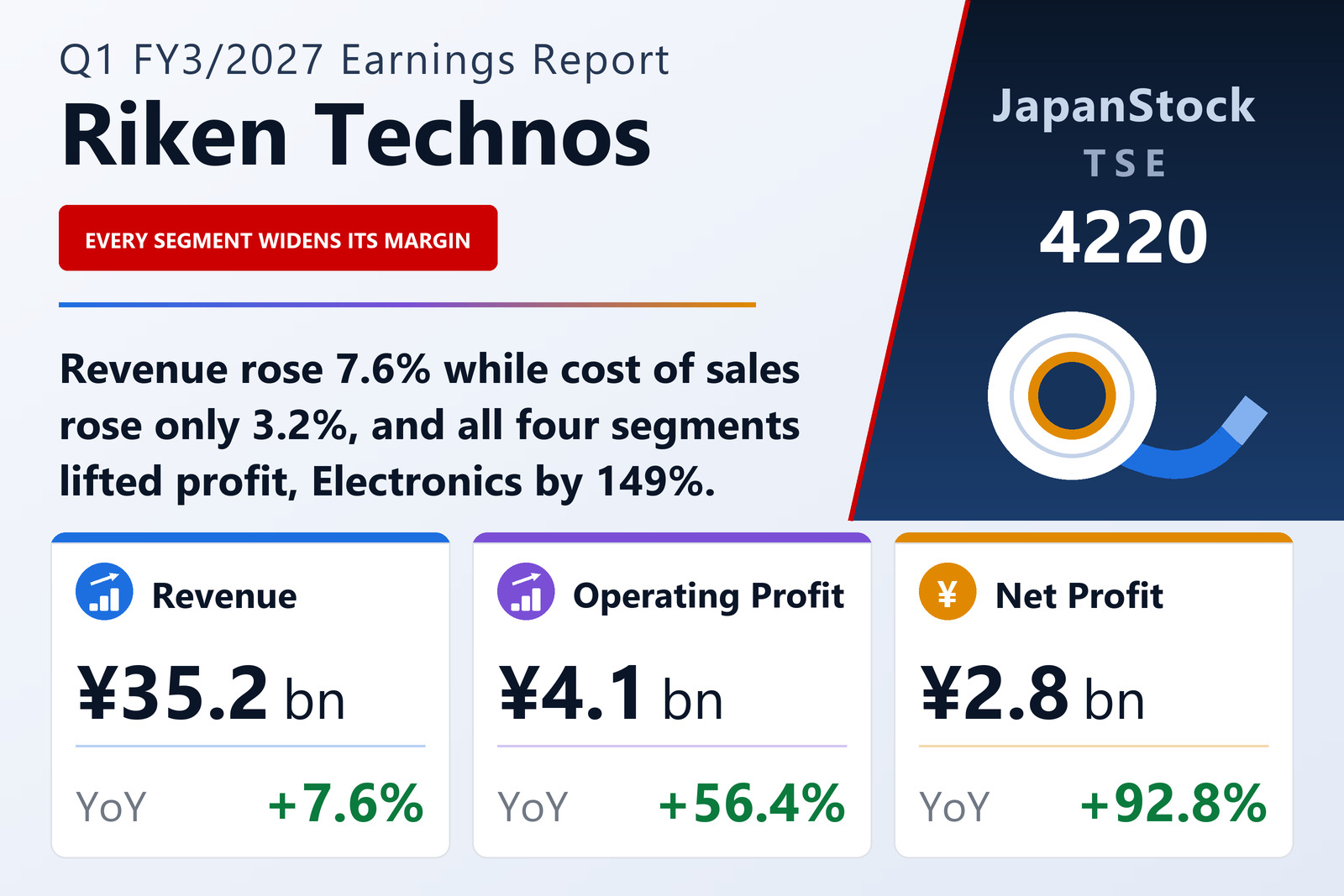
Revenue up 7.6%, cost of sales up 3.2% — that gap made the quarter
Riken Technos Corporation (TSE: 4220), the Japanese maker of PVC and non-PVC compounds and food-packaging wrap, published consolidated first-quarter results for the three months from April 1 to June 30, 2026 on July 31, 2026 under Japanese GAAP. Revenue rose 7.6% to ¥35,158 million, operating profit 56.4% to ¥4,146 million, ordinary profit 74.7% to ¥4,272 million and profit attributable to owners of the parent 92.8% to ¥2,842 million. Earnings per share were ¥59.87 against ¥28.96, up 106.7% — faster than profit, because the average number of shares outstanding fell 6.7% to 47,468,206. The company is listed on the Tokyo Stock Exchange.
The arithmetic of the quarter is short. Cost of sales rose only 3.2% to ¥27,272 million against revenue growth of 7.6%, so gross profit climbed 26.3% to ¥7,885 million and the gross margin widened from 19.1% to 22.4%. Selling, general and administrative expenses grew 4.1% to ¥3,739 million, slower than revenue, and their ratio to sales slipped from 11.0% to 10.6%, so the operating margin rose further still, from 8.1% to 11.8%. Of the ¥1,641 million increase in gross profit, ¥145 million went on higher SG&A and ¥1,496 million became operating profit.
Below the operating line, a currency swing and a smaller minority share
Ordinary profit rose faster again, 74.7% to ¥4,272 million, and the income statement shows why: a foreign-exchange gain of ¥75 million replaced a foreign-exchange loss of ¥244 million a year earlier, turning net non-operating items from −¥205 million to +¥125 million. Extraordinary items were negligible in both years. Pre-tax profit was ¥4,274 million, up 75.3%; income taxes rose 91.2% to ¥952 million, a tax burden of 22.3% of pre-tax profit against 20.4%, and profit for the period rose 71.3% to ¥3,322 million. Profit attributable to non-controlling interests barely moved, at ¥480 million against ¥465 million, so their share of the total fell from 24.0% to 14.5% and profit attributable to owners of the parent grew 92.8%. Comprehensive income rose 587.1% to ¥3,806 million from ¥554 million, chiefly because foreign-currency translation adjustments swung from −¥1,734 million to +¥389 million.
All four segments grew profit far faster than revenue
Transportation, which serves the auto, rail and shipbuilding markets and is the largest segment by revenue, grew sales 6.2% to ¥11,175 million and segment profit 27.9% to ¥1,302 million. Daily Life & Healthcare — medical, household materials and food packaging — grew revenue 6.9% to ¥9,818 million and profit 45.5% to ¥1,403 million, overtaking Transportation as the largest profit contributor. Electronics, serving energy, information and communications and IT equipment, grew fastest on both lines: revenue 12.5% to ¥7,153 million and profit 149.0% to ¥899 million, the largest gain of any segment in yen at about ¥538 million. Building & Construction grew revenue 6.2% to ¥7,007 million and profit 90.8% to ¥520 million. Every segment's margin widened, most sharply in Electronics, from 5.7% to 12.6%. The four segments account for ¥35,155 million of revenue; the rest comes from an 'Other' unit that buys and sells raw materials, whose profit fell to ¥11 million from ¥41 million.
At home, volume and pass-through; abroad, three of four segments sold less
The filing gives the same two-part cause for each segment's domestic revenue gain: higher sales and progress in passing on raw-material price increases. Overseas the picture split. Transportation sold more compounds, mainly in Thailand and Vietnam, and the filing credits that overseas growth for most of the segment's profit gain. The other three segments reported lower overseas revenue — medical PVC compounds in ASEAN for Daily Life & Healthcare, PVC compounds in the United States and Indonesia for Electronics, and PVC compounds in the United States for Building & Construction. Their profit gains came from elsewhere: Daily Life & Healthcare cites higher sales of food-packaging wrap and price optimisation at home and abroad; Electronics cites domestic PVC and non-PVC compounds for the wire and cable market and PVC compounds for power-industry cables in Thailand; Building & Construction cites higher domestic compound sales. The filing does not quantify how much of the margin gain came from price rather than volume.
Management describes a Japanese economy on a gradual recovery path despite persistent inflation and the situation in the Middle East, moderate expansion in the United States and a continued slowdown in China, with rising interest rates and geopolitical risk keeping the outlook uncertain. The quarter was the second year of its medium-term plan, 'One Vision, New Stage 2027', built on three strategies: 'Global One Company', going beyond customer expectations, and taking on new businesses and products.
A modestly larger balance sheet, with more treasury stock
Total assets rose 2.7% to ¥122,363 million from ¥119,103 million at March 31, 2026, which the filing attributes mainly to higher trade receivables and inventories: accounts receivable rose to ¥23,157 million from ¥21,334 million, and inventories to ¥21,148 million from ¥20,339 million. Liabilities rose ¥2,943 million to ¥43,605 million, mainly on trade payables, which reached ¥20,341 million, and long-term borrowings, at ¥3,816 million. Net assets edged up only 0.4% to ¥78,758 million: retained earnings grew ¥1,200 million after a dividend payment of ¥1,641 million at ¥34 per share, while treasury stock rose to ¥5,025 million from ¥4,229 million — including shares held by a new employee stock ownership trust introduced in April, which held 281 thousand shares at quarter-end — and non-controlling interests fell to ¥10,334 million from ¥10,817 million. The equity ratio slipped from 56.8% to 55.9%. Cash and deposits stood at ¥26,174 million against short- and long-term borrowings of ¥11,800 million. No quarterly cash-flow statement was prepared; depreciation rose 15.6% to ¥1,159 million.
Guidance revised the same day, with a weaker second half built in
Riken Technos revised its first-half and full-year guidance on July 31, 2026 in a separate release, citing recent performance; the filing does not restate the previous figures. It now forecasts FY3/2027 revenue of ¥145,000 million (+10.4%), operating profit of ¥14,500 million (+27.1%), ordinary profit of ¥14,500 million (+23.0%) and profit attributable to owners of the parent of ¥9,500 million (+25.5%), or ¥211.92 per share. For the first half it forecasts revenue of ¥72,500 million (+10.6%), operating profit of ¥7,900 million (+42.8%) and net profit of ¥6,100 million (+76.2%), of which the first quarter has already delivered 52.5% at the operating line. The shape is notable: on identical revenue of ¥72,500 million in each half, guidance implies second-half operating profit of ¥6,600 million against ¥7,900 million in the first half, and second-half net profit of ¥3,400 million against ¥6,100 million. The filing gives no reason for the weaker second half.
Dividend forecast at ¥85, and a buyback of up to ¥8,800 million
The dividend forecast was also revised in a separate release the same day. Riken Technos now plans an interim dividend of ¥42.00 and a year-end dividend of ¥43.00, for an annual ¥85.00 against ¥54.00 for FY3/2026 — up 57.4%, and about 40% of guided earnings per share. After the quarter closed, on July 31, 2026, the board resolved to buy back up to 4,000,000 shares, about 7.8% of the 51,274,821 shares in issue, for up to ¥8,800 million between August 3 and December 30, 2026, to allow a flexible capital policy, improve capital efficiency and return value to shareholders. That ceiling is about a third of the ¥26,174 million of cash and deposits held at June 30.
| Metric | Q1 FY3/2027 | Q1 FY3/2026 | Change |
|---|---|---|---|
| Revenue (¥ million) | 35,158 | 32,679 | +7.6% |
| Gross profit (¥ million) | 7,885 | 6,243 | +26.3% |
| Gross margin | 22.4% | 19.1% | +3.3 pt |
| SG&A expenses (¥ million) | 3,739 | 3,593 | +4.1% |
| Operating profit (¥ million) | 4,146 | 2,650 | +56.4% |
| Operating margin | 11.8% | 8.1% | +3.7 pt |
| Ordinary profit (¥ million) | 4,272 | 2,445 | +74.7% |
| Income taxes (¥ million) | 952 | 498 | +91.2% |
| Net profit attrib. to owners of parent (¥ million) | 2,842 | 1,473 | +92.8% |
| EPS (¥) | 59.87 | 28.96 | +106.7% |
| Comprehensive income (¥ million) | 3,806 | 554 | +587.1% |
| Transportation — revenue (¥ million) | 11,175 | 10,525 | +6.2% |
| Transportation — segment profit (¥ million) | 1,302 | 1,018 | +27.9% |
| Daily Life & Healthcare — revenue (¥ million) | 9,818 | 9,188 | +6.9% |
| Daily Life & Healthcare — segment profit (¥ million) | 1,403 | 964 | +45.5% |
| Electronics — revenue (¥ million) | 7,153 | 6,359 | +12.5% |
| Electronics — segment profit (¥ million) | 899 | 361 | +149.0% |
| Building & Construction — revenue (¥ million) | 7,007 | 6,600 | +6.2% |
| Building & Construction — segment profit (¥ million) | 520 | 272 | +90.8% |
| Total assets (¥ million) | 122,363 | 119,103 | +2.7% |
| Net assets (¥ million) | 78,758 | 78,442 | +0.4% |
| Equity ratio | 55.9% | 56.8% | −0.9 pt |
| FY3/2027 guidance — revenue (¥ million) | 145,000 | — | +10.4% |
| FY3/2027 guidance — operating profit (¥ million) | 14,500 | — | +27.1% |
| FY3/2027 guidance — ordinary profit (¥ million) | 14,500 | — | +23.0% |
| FY3/2027 guidance — net profit (¥ million) | 9,500 | — | +25.5% |
| FY3/2027 guidance — EPS (¥) | 211.92 | — | n.m. |
| Annual dividend per share (¥) | 85.00 | 54.00 | +57.4% |
JapanStockPulse provides informational content only and does not constitute investment advice. Figures are taken from the company's published earnings short report and may be subject to subsequent revision.