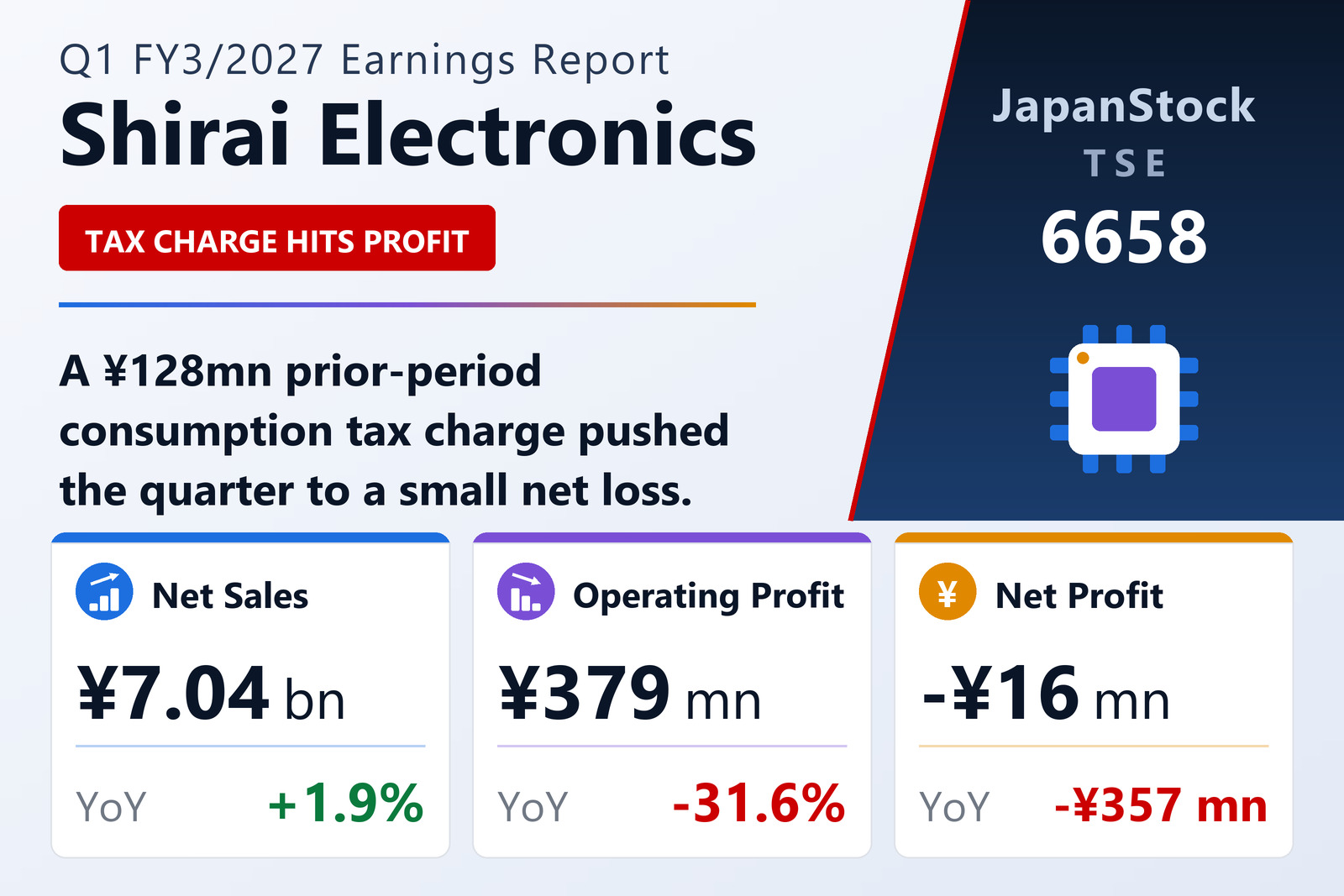
Shirai Electronics Industrial Co., Ltd. (TSE: 6658), a Shiga Prefecture-based manufacturer of printed wiring boards, reported consolidated results for the first quarter of the fiscal year ending March 31, 2027 (April 1 – June 30, 2026) under Japanese GAAP. Net sales rose 1.9% to ¥7,039 million, but operating profit fell 31.6% to ¥379 million, ordinary profit dropped 45.6% to ¥271 million, and the company swung to a loss attributable to owners of the parent of ¥16 million, against a ¥341 million profit a year earlier. Basic loss per share was ¥1.08, versus earnings of ¥22.87. There were no dilutive securities, and the quarterly statements were not reviewed by an auditor.
A ¥128 million back-tax charge did the damage
Operating profit was still comfortably positive, so the swing into the red opened up entirely below the operating line, in two places. First, non-operating expenses nearly doubled to ¥119 million from ¥63 million, driven by a foreign-exchange loss of ¥71 million (against ¥11 million a year earlier) and a ¥33 million equity-method investment loss (¥22 million); interest expense was ¥13 million, against ¥19 million. Non-operating income of ¥11 million, including a ¥3 million gain on debt forgiveness, only partly offset that, leaving ordinary profit down 45.6%. Second, extraordinary losses of ¥130 million — almost all of it a ¥128 million charge for prior-period consumption tax, which management explicitly describes as unplanned — cut pre-tax profit to ¥141 million from ¥495 million. Income taxes of ¥155 million then exceeded that pre-tax figure, producing a quarterly net loss of ¥13 million; after ¥2 million attributable to non-controlling interests, the loss attributable to owners of the parent came to ¥16 million.
Car electronics holds up, but raw materials bite
The core printed wiring board segment lifted sales 1.3% to ¥6,860 million but saw segment profit fall 34.4% to ¥365 million. Order intake in the main car-electronics field held firm, yet raw-material supply constraints limited output, and a sharp rise in raw-material prices and in purchase prices from OEM partners more than offset continuing productivity and cost-reduction work. The smaller inspection equipment and solutions segment grew sales 3.6% to ¥156 million as trade-show appearances brought in new orders, but higher procurement and development costs cut segment profit 37.8% to ¥10 million. An "other" category, made up of a transport business, added ¥71 million of sales and ¥1 million of profit. Management characterises the printed wiring board industry as operating in a tough environment shaped by cost-push inflation in raw materials and by supply constraints arising from tight supply-demand conditions, with a weaker yen pushing import prices higher.
Guidance untouched — and it already assumes a steep fall
Shirai left its full-year FY3/2027 forecasts unchanged from the numbers published with the FY3/2026 results on May 12, 2026: net sales of ¥29,000 million (−0.4%), operating profit of ¥850 million (−58.1%), ordinary profit of ¥800 million (−56.1%) and profit attributable to owners of the parent of ¥600 million (−54.2%), for EPS of ¥40.01. Q1 operating profit represents 44.7% of that full-year operating profit target — a fast start, but against a deliberately low bar, and management expects high raw-material prices and tight supply to keep pressure on margins for some time. The group also flags that FY3/2027 sales and profit are on course to fall short of the medium-term plan targets it published in May 2024, while pointing to an active push into growth markets in ASEAN and India, efficiency and labour-saving investment in production equipment and systems, and a search for new alliances. It says it will disclose any revision to guidance promptly if the outlook changes.
Dividend still set to be cut to ¥20
The dividend forecast was likewise left unchanged. Shirai plans an annual dividend of ¥20.00 per share for FY3/2027 — no interim payment and ¥20.00 at the year-end — down from the ¥35.00 paid for FY3/2026, which was itself all paid at the year-end. Against forecast EPS of ¥40.01, the reduced payout equates to a ratio of roughly 50%.
Borrowings fund the balance sheet; equity ratio slips
Total assets grew ¥821 million from the March year-end to ¥20,007 million. Current assets rose ¥814 million to ¥11,266 million, led by a ¥615 million build in cash and deposits to ¥1,442 million and a ¥106 million rise in inventories; non-current assets were broadly flat at ¥8,740 million. Total liabilities rose ¥976 million to ¥9,052 million, with current liabilities up ¥1,145 million to ¥8,023 million as short-term borrowings jumped ¥1,066 million to ¥2,079 million and electronically recorded obligations rose ¥148 million, partly offset by a ¥103 million fall in notes and accounts payable and a ¥284 million drawdown of the bonus provision. Non-current liabilities fell ¥169 million to ¥1,029 million. Net assets slipped ¥155 million to ¥10,954 million, as a ¥541 million fall in retained earnings outweighed a ¥298 million gain in the foreign-currency translation adjustment, and the equity ratio fell to 54.0% from 57.1%. No quarterly cash flow statement was prepared; depreciation was ¥228 million, up from ¥212 million. Comprehensive income was ¥369 million, against a negative ¥56 million a year earlier, helped by ¥383 million of other comprehensive income led by a ¥239 million translation gain.
| Metric | Q1 FY3/2027 | Q1 FY3/2026 | YoY |
|---|---|---|---|
| Net sales (¥ million) | 7,039 | 6,910 | +1.9% |
| Operating profit (¥ million) | 379 | 555 | −31.6% |
| Ordinary profit (¥ million) | 271 | 498 | −45.6% |
| Profit attrib. to owners (¥ million) | −16 | 341 | Swing to loss |
| Basic EPS (¥) | −1.08 | 22.87 | Swing to loss |
| Comprehensive income (¥ million) | 369 | −56 | Swing to profit |
| Printed wiring board segment profit (¥ million) | 365 | 557 | −34.4% |
| Depreciation (¥ million) | 228 | 212 | +7.5% |
JapanStockPulse provides informational content only and does not constitute investment advice. Figures are taken from the company's published earnings short report and may be subject to subsequent revision.